Pensacola Woman Indicted on Federal Charge of Arming a Convicted Felon
A federal grand jury indicted a Pensacola woman on charges of giving a firearm to a convicted felon in Escambia County.
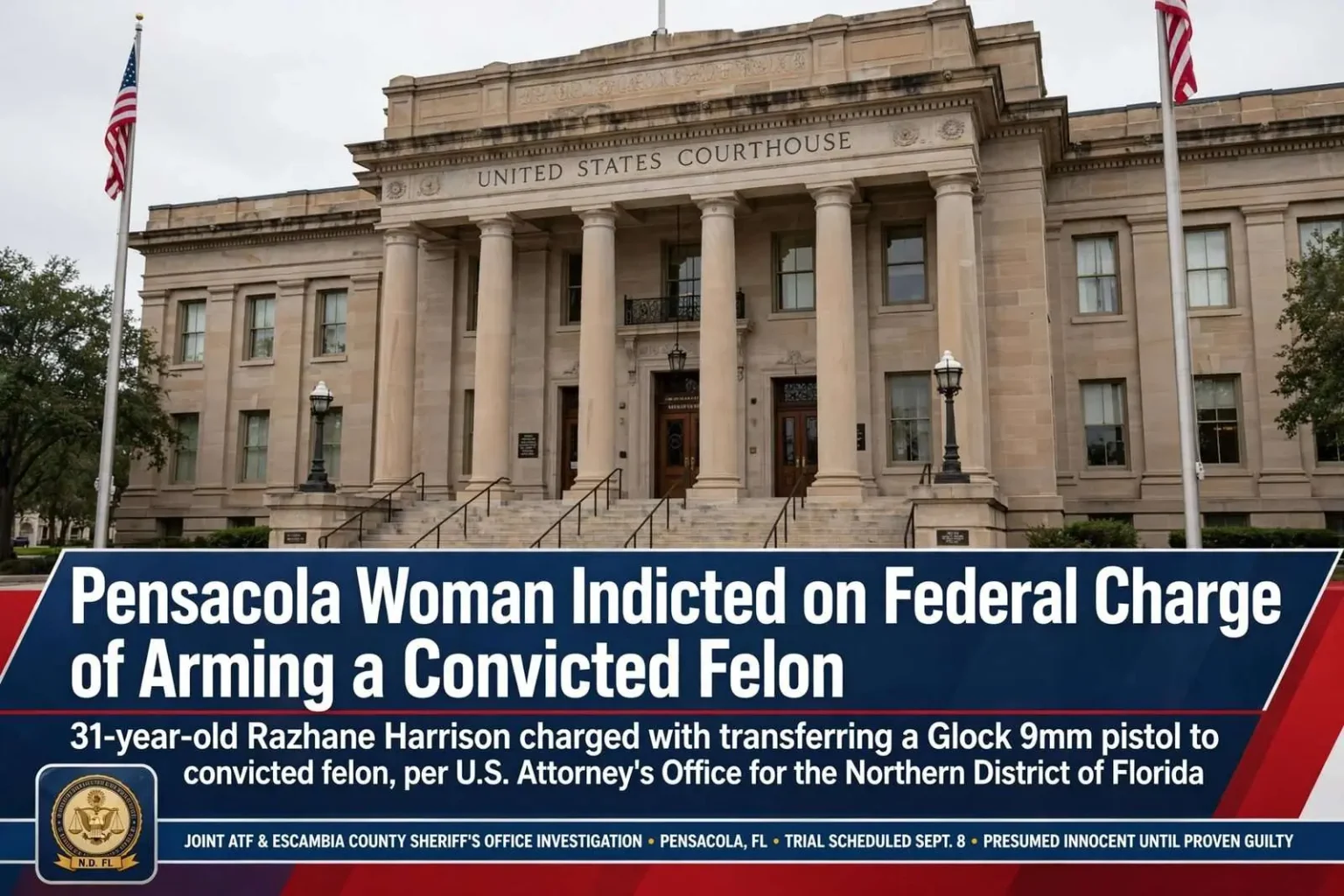
A Pensacola woman has been indicted on a federal charge accusing her of providing a firearm to a convicted felon, according to the U.S. Attorney’s Office for the Northern District of Florida.
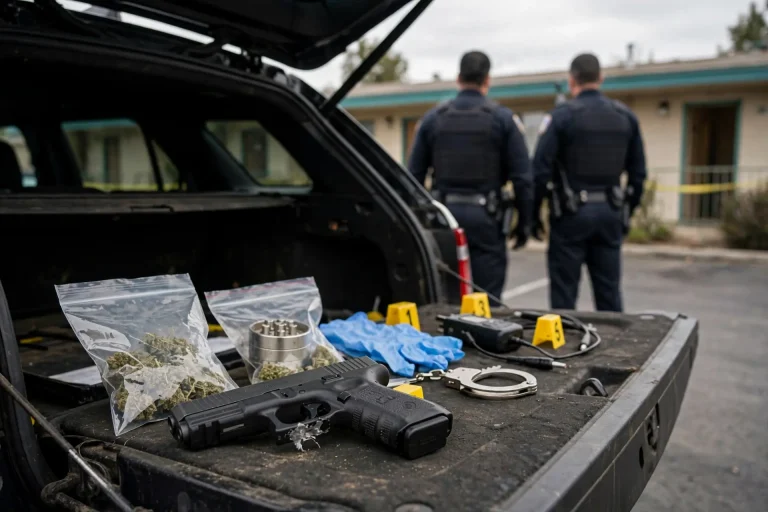
Razhane Harrison, 31, was indicted in federal court on a charge of transferring a firearm to a prohibited person. The indictment alleges Harrison gave a Glock 9-millimeter pistol to Marcellous Likely-McWilliams III, a convicted felon who pleaded guilty earlier this month to possession of marijuana with intent to distribute, possession of a firearm by a convicted felon, and possession of a firearm in furtherance of a drug trafficking crime.
The case falls under one of the most frequently prosecuted sections of federal firearms law. Federal statutes make it a crime for a person convicted of a felony to possess a firearm or ammunition, and separately make it a crime for anyone to sell, give, or otherwise transfer a firearm to a person they know or have reasonable cause to believe is prohibited from possessing one. Prosecutors in the Northern District of Florida, which covers Pensacola, Tallahassee, Gainesville and the Panhandle, routinely pair charges like these with drug trafficking cases, working from the premise that the flow of guns into the hands of people who cannot legally carry them feeds directly into drug markets and violent crime.
Under the law, the category of prohibited persons is broad. It includes anyone convicted of a crime punishable by more than a year in prison, along with unlawful drug users, people subject to certain protective orders, and others spelled out in the federal code. A transfer charge does not require a sale; a simple gift of a pistol, as alleged here, is enough to support the count.
How the alleged transfer came to light
The indictment is the product of a joint investigation by the Bureau of Alcohol, Tobacco, Firearms and Explosives and the Escambia County Sheriff’s Office. The ATF, which maintains field offices across Florida and works alongside local sheriff’s and police departments on gun tracing and illegal trafficking cases, supplies the federal investigative resources in prosecutions of this kind, while the Escambia County Sheriff’s Office contributes local knowledge of Pensacola and its surrounding communities. Partnerships of this type are common along the Gulf Coast, where agents and deputies coordinate to trace crime guns, monitor secondhand transfers, and build cases against people who put weapons back into the hands of individuals barred from owning them.
Federal prosecutors have not laid out in public filings how investigators say the Glock changed hands or what first pointed them toward Harrison. An indictment is a formal accusation returned by a grand jury after prosecutors present evidence, and it marks the beginning of the criminal process rather than the end. Harrison has been indicted, not convicted, and is presumed innocent unless proven guilty.
The co-defendant’s guilty plea
While Harrison’s case moves toward trial, the man accused of receiving the pistol has already resolved his own case. Likely-McWilliams entered guilty pleas earlier this month to three counts: possession of marijuana with intent to distribute, possession of a firearm by a convicted felon, and possession of a firearm in furtherance of a drug trafficking crime. The third of those charges carries a mandatory minimum prison term under federal law that must run consecutively to any other sentence imposed, a provision Congress adopted to punish offenders who arm themselves while trafficking drugs.
Read together, the two cases show how federal authorities in the district build firearms prosecutions. Rather than stopping at the person found with the weapon, investigators frequently trace the gun backward to identify whoever supplied it, and then charge that person as well. The strategy targets the upstream suppliers, the people who reintroduce guns to the street after a felony record or another disqualifying status should have taken them out of circulation.
Arraignment before Magistrate Judge Cannon
Harrison appeared in federal court in Pensacola for her arraignment before U.S. Magistrate Judge Hope T. Cannon. Arraignment in the federal system is typically a short proceeding: the defendant appears, is formally advised of the charges in the indictment, and enters an initial plea, which in most cases is not guilty. Magistrate judges handle these early stages of federal prosecutions, along with bond determinations, discovery scheduling and other pretrial matters, before a case moves to a district judge for trial.
If convicted, Harrison faces up to 15 years in prison. The maximum reflects the weight Congress has placed on keeping firearms away from people legally barred from having them, though actual sentences in such cases are usually far lower. Judges calculate penalties under the advisory federal sentencing guidelines, which weigh factors including the defendant’s criminal history and the circumstances of the offense, and any sentence would come only after a presentence investigation and a sentencing hearing following conviction.
Her jury trial is scheduled for Sept. 8.
What happens between now and trial
In the weeks ahead, defense attorneys and prosecutors will exchange evidence in the discovery process, a stage that includes police reports, investigator notes, forensic results and any recorded communications the government intends to use. The defense may file motions to suppress evidence or to dismiss the indictment, and both sides are free to negotiate a plea agreement at any point before a verdict. If the case proceeds, a jury drawn from the Northern District of Florida will hear the evidence, and prosecutors will have to prove every element of the charge beyond a reasonable doubt, the standard the Constitution requires in every criminal trial.
That burden is deliberately high because the accusation itself is not proof. A grand jury hears only the government’s side of the case in deciding whether an indictment is warranted, and no finder of fact has yet weighed Harrison’s defense. Her presumption of innocence remains intact unless and until a jury unanimously finds the government proved the charge.
The wider push against gun trafficking on the Gulf Coast
Firearms cases like this one have become a fixture of federal dockets across the Panhandle and south Alabama. The ATF’s field divisions work with sheriffs’ offices and police departments on initiatives aimed at reducing shootings by focusing on the small number of people who repeatedly supply guns used in crimes. Those efforts lean heavily on tracing, the process of following a recovered weapon from its original retail sale through the secondary market to see where the chain of custody broke down.
For residents of the Gulf Coast, the practical takeaway from prosecutions of this kind is straightforward. Handing a firearm to someone known to have a felony record is not a private matter or a favor between acquaintances; it is a federal felony carrying serious prison exposure, and federal investigators in the district have shown a willingness to charge both sides of the transfer. Gun owners who no longer want a weapon are directed to sell through licensed dealers, who run background checks on buyers, or to turn it in to local law enforcement rather than passing it along informally.
About Alabama’s courts, and why a Florida case matters across the line
Harrison’s prosecution will play out entirely in the federal system, but readers in south Alabama follow Pensacola court news closely for a simple reason: the communities share a border, a news market and, often, family ties. Escambia County, Florida, sits directly across the state line from Baldwin County, Alabama, and a case in the Pensacola federal courthouse can involve residents, witnesses and evidence from both sides of the line.
The federal and state court systems run on parallel tracks. Alabama’s judicial system includes trial courts, the Court of Civil Appeals and the Court of Criminal Appeals, and the state Supreme Court, along with a network of district and circuit courts that handle everything from traffic offenses to serious felonies. Judges in Alabama are elected in partisan races, and the state’s high courts have frequently been drawn into election-law disputes, including those arising from redistricting. Cases that begin in state trial courts can be appealed upward through the appellate hierarchy, and where federal questions are presented, they may ultimately reach the federal courts, which handle their own docket of federal crimes, constitutional claims and disputes between parties from different states.
The two systems differ in important ways for people watching a case like this one. Federal prosecutors have smaller caseloads than their state counterparts and take cases to trial with full investigative files built by agencies such as the ATF. Federal sentencing runs through the advisory guidelines rather than a statutory range alone, and there is no parole in the federal system, so a prison term imposed there is served in full, with only limited good-conduct credit. State court, by contrast, handles the bulk of everyday criminal matters, from DUI cases to robberies, through the district and circuit courts that serve each of Alabama’s 67 counties.
What the case means for local residents
For lawful gun owners in the region, the charge serves as a reminder of how narrow the path is for legally disposing of a firearm. A pistol left in a closet, sold at a roadside swap or handed to a relative with an old felony conviction can generate a federal case for the giver, not just the receiver. Licensed dealers remain the legal channel for private sales in most circumstances, because they are equipped to run the background check that determines whether a buyer is prohibited.
The case also underscores the continuing collaboration between federal and local law enforcement along the Gulf Coast. The Escambia County Sheriff’s Office and the ATF built this investigation jointly, and similar partnerships operate in Mobile and Baldwin counties, where task forces share information about guns recovered at crime scenes and drugs moving along the I-10 corridor. As Likely-McWilliams faces sentencing on his drug and firearm convictions and Harrison prepares for her Sept. 8 trial, the outcome in the Pensacola courthouse will be watched as another data point in that ongoing effort to slow the movement of illegal guns through the region.