Person airlifted after ATV accident in Washington County
A person was airlifted to University Hospital in Mobile after an ATV accident early Thursday at Saint Stephens Historical Park in Washington County.
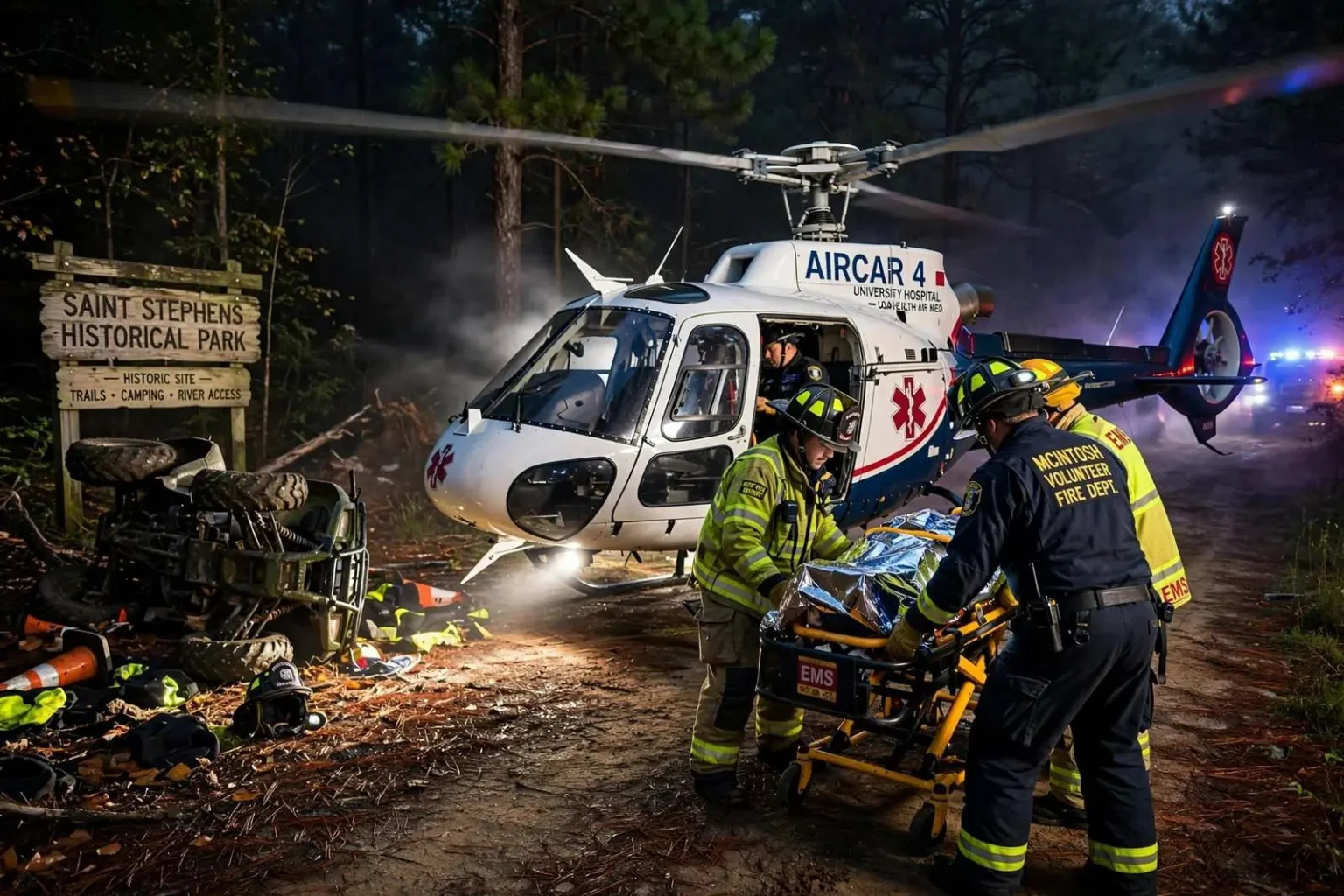
WASHINGTON COUNTY, Ala. — A person was involved in an ATV accident early Thursday morning in Washington County and was flown to a Mobile hospital, according to first responders. The McIntosh Volunteer Fire Department said the crash occurred around 2 a.m. at Saint Stephens Historical Park. The injured person was airlifted to University Hospital in Mobile, though their condition was not immediately known.
The 2 a.m. call brought volunteer firefighters to a park better known for its history than for middle-of-the-night rescue work, and the darkness added difficulty to every stage of the response. Locating a crash victim inside a park that spans hundreds of acres of wooded terrain requires coordination, and responders on the scene worked to stabilize the injured person while an air ambulance was summoned from Mobile.
Air ambulances are routinely requested for serious trauma in rural southwest Alabama, where ground transport to a trauma center can take an hour or more. University Hospital in Mobile operates as a regional referral center and trauma facility for the Gulf Coast, and the flight from Washington County cuts what would be a long, rough ambulance ride to a matter of minutes in the air.
Saint Stephens Historical Park
Saint Stephens Historical Park preserves the site of Old St. Stephens, the former county seat and one of the most historically significant towns in early Alabama. Before the seat of government moved and the town faded, St. Stephens served as the territorial capital of Alabama and was a bustling river port on the Tombigbee River in the early 1800s. Today the park draws visitors for its historic sites, the Spanish fort ruins, hiking trails, camping areas, and the exposed limestone bluffs along the Tombigbee that give the grounds their scenic character.
The park’s remote setting and varied terrain — bluffs, woods, trails, and water access — make it a popular spot for outdoor recreation, including the off-road and trail riding that ATVs are used for. It also means that emergencies inside the park can be difficult to reach. Emergency vehicles depend on the park’s access roads, and parts of the grounds are accessible only on foot, complicating rescue efforts when a rider is hurt far from the entrance.
The McIntosh Volunteer Fire Department, based in the nearby town of McIntosh in southern Washington County, is among the small volunteer agencies that protect this corner of the county. Volunteer departments in rural Alabama handle fire, rescue, and medical first response across wide territories with limited manpower, and calls like this one — in the middle of the night, in difficult terrain — test the capacity of even the most dedicated crews.
ATV crashes in rural Alabama
All-terrain vehicles are a fixture of rural life in Washington County and across south Alabama, used for hunting, farm work, trail riding, and recreation. They are also a persistent source of serious injuries. ATVs offer no crash protection to the rider, travel at speeds their terrain sometimes cannot support, and require active balance and strength to control. Riders who are thrown or pinned under a machine frequently suffer fractures, head injuries, and internal trauma that demand hospital care.
Alabama law addresses ATV use mainly through age restrictions for operating vehicles on public roads, but most ATV riding happens on private land and park trails, where rules depend on the property owner. Safety organizations have long urged riders to wear helmets, avoid paved roads, keep passengers off single-rider machines, and keep young riders on age-appropriate vehicles. Night riding multiplies the danger, because riders cannot see washouts, stumps, drop-offs, and other obstacles in time to react.
A crash at 2 a.m. suggests the kinds of conditions safety officials warn about — darkness, possibly unfamiliar terrain, and no help nearby when things go wrong. The fact that the injured person was found and reached quickly enough to be flown for treatment reflects the response of the volunteer crews and the coordination required to land an air ambulance in a rural park in the middle of the night.
Getting a patient to trauma care
The air medical system that served this rescue is a network of hospital-based and commercial helicopter services covering Alabama and the Gulf Coast. When a 911 call reports serious trauma in a rural area, dispatchers weigh ground transport times against flight times and weather conditions, and a helicopter is dispatched when the math favors it. Crews on the ground prepare a landing zone — a flat, open area clear of wires and debris — which in a park setting often means a ball field, open grounds, or a mowed area near the entrance.
University Hospital, part of USA Health in Mobile, functions as a major trauma and referral center for the region, receiving patients by helicopter and ambulance from across south Alabama and the Florida panhandle. For trauma patients, the difference between arriving at a community hospital and arriving at a trauma center can be measured in outcomes, which is why rural rescues so often end with a flight to Mobile.
Details about the injured person — their name, age, hometown, and what they were doing in the park — were not released, and their condition was not immediately known following the flight. Rural crash victims are frequently transferred to the care of family or transported onward once stabilized, and updates from authorities were not immediately available.
A reminder for riders
Rescues like Thursday’s echo a familiar warning from emergency crews in southwest Alabama: ATVs demand the same respect as any motor vehicle. Riders are urged to wear helmets and protective gear, to ride with others rather than alone, and to tell someone where they are going when they head out on trails — precautions that matter most in the remote, wooded country around Saint Stephens Historical Park, where an injured rider cannot simply wave down a passing car.
The McIntosh Volunteer Fire Department and assisting responders completed their mission in the early hours of Thursday morning, handing the injured person over to air medical crews for the flight to Mobile. The crash remains a reminder of both the risks of off-road riding and the reach of the rural emergency network that stands ready when those risks catch up with someone.
Washington County’s emergency response network
Washington County, spread across more than a thousand square miles of rolling piney woods along the Mississippi state line, is among the more rural counties in Alabama, with a population of roughly 15,000 people. Its incorporated towns — Chatom, McIntosh, Millry, Vinegar Bend, and others — are served by volunteer fire departments and the Washington County Sheriff’s Office, with ambulance service provided under regional arrangements that cover long distances between calls.
Volunteer firefighters in departments like McIntosh’s balance full-time jobs with the demands of the pager, responding at all hours to fires, wrecks, and medical emergencies across their service areas. Training requirements for volunteer firefighters and medical first responders have risen steadily over the years, and small departments constantly recruit to keep their rosters full. Calls like the one at Saint Stephens Historical Park show why the work matters: when seconds count in a rural emergency, the closest responders are usually the local volunteers.
The county’s location along the Tombigbee River and its history as one of Alabama’s oldest settled areas give it a landscape of historic sites, hunting clubs, timber land, and river access points. Emergencies in such settings — whether on the water, in the woods, or at a historic park — often require responders to combine road rescue with foot or ATV access, and local crews practice exactly those skills.
How ATV crashes are investigated
Recreational vehicle crashes in parks and on private land are investigated by the local sheriff’s office, which documents the scene and determines whether any factors beyond rider error contributed. In park settings, officials also review whether the activity was permitted in the area where it occurred and whether park rules were followed. Most such crashes are accidents in the fullest sense — a matter of terrain, speed, and visibility — and conclude without charges.
Investigators and park officials use the findings from crashes to inform safety measures, from trail signage to rules about night access. Parks that permit off-road riding generally restrict it to designated trails, require safety equipment, and limit hours, both to protect riders and to preserve the historic and natural features that make places like Saint Stephens worth protecting.
For the family of the injured person, the hours after a flight to University Hospital are consumed by waiting and updates from trauma teams. Rural communities in Washington County are accustomed to rallying around families in those circumstances, and news of a serious crash travels fast through the close-knit towns of the county.
The broader toll of off-road crashes
ATV crashes send thousands of Americans to emergency rooms every year, and the victims are disproportionately young. Injuries range from broken bones and lacerations to severe head and spinal trauma, and deaths most often involve rollovers, collisions with fixed objects, or riders being struck by their own machines. Helmets are the single most effective protection available to riders, and studies consistently show they reduce the risk of fatal head injury dramatically.
Emergency crews in rural Alabama see the consequences of that up close. Calls for ATV wrecks come in from county roads, hunting clubs, and trail systems throughout the year, peaking during holiday weekends and hunting season. Each one sets in motion the same sequence that played out at Saint Stephens Historical Park: locate the rider, stabilize the injuries, decide whether the hospital helicopter is needed, and get the patient to definitive care.
Thursday’s early-morning rescue ended with the injured person in Mobile, their condition unknown to the public, and a park that would open later that day to visitors with no visible sign of what had happened hours before. For the volunteer firefighters who responded, it was one more call in the long service record of a small department — and for riders across southwest Alabama, another reminder that the terrain they enjoy can turn dangerous in an instant.