Pine Hill Haints Bring Alabama Ghost Music to The Merry Widow with Lost Bayou Ramblers
Pine Hill Haints bring their Alabama ghost music to The Merry Widow in downtown Mobile Oct. 15 with Cajun rockers Lost Bayou Ramblers.
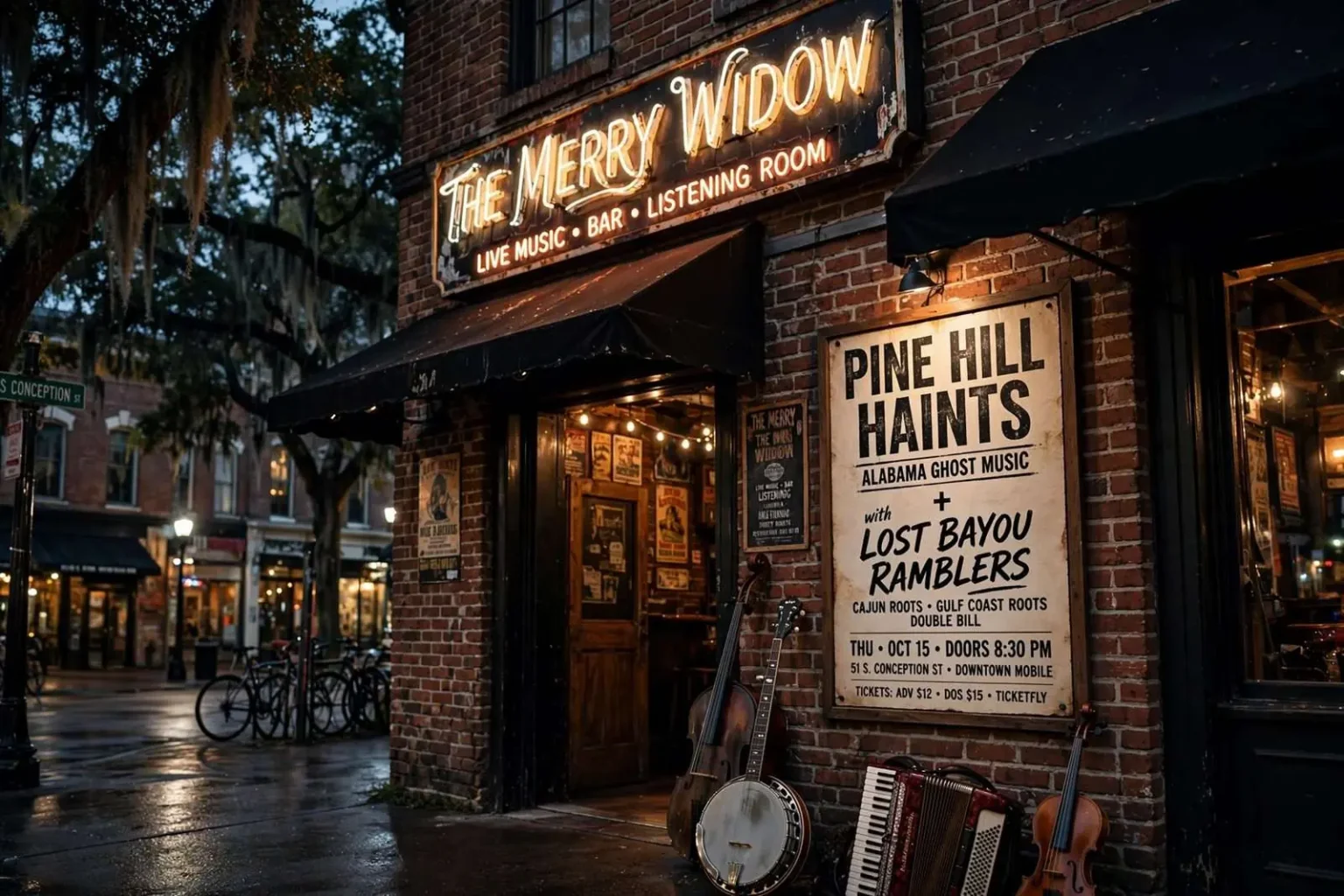
Downtown Mobile music venue The Merry Widow, 51 S. Conception St., hosts a double bill of Gulf Coast roots acts on Thursday, Oct. 15, with doors opening at 8:30 p.m. Mobile-area favorites Pine Hill Haints top the bill alongside Lafayette’s Lost Bayou Ramblers. Tickets are $12 in advance and $15 the day of the show, available through Ticketfly.
The pairing puts two of the northern Gulf Coast’s most distinctive independent acts on one stage, and it lands on a stretch of Conception Street that has quietly become one of downtown Mobile’s most reliable destinations for live original music. The Merry Widow has long served as a home base for touring bands that fall between the major-market club circuit and the region’s bars and festival stages, and weeknight bills like this one give local listeners a chance to see nationally traveled acts without a trip to New Orleans or Pensacola.
For the Pine Hill Haints, the show is another entry on a long list of hometown appearances, even though the band has never been a straightforward Mobile act in the conventional sense. Though they hail from outside the city limits, the Pine Hill Haints have become a fixture of Mobile’s musical calendar, most notably through their annual Joe Cain Day performances, where the band plays its self-styled “Alabama ghost music” for crowds of Carnival revelers.
A Fixture of the Carnival Season
That annual slot matters. Joe Cain Day, observed on the Sunday before Fat Tuesday, is one of the more singular traditions in Mobile’s Mardi Gras season, which is itself the oldest organized Carnival celebration in the United States. The day honors Joe Cain, the Mobile resident widely credited with reviving the city’s Mardi Gras festivities after the Civil War, and it has grown into a sprawling, anarchic procession that locals treat as the freewheeling counterweight to the more formal mystic society parades.
For a band to hold a recurring place on that day’s program is a mark of how deeply the Pine Hill Haints are woven into Mobile’s cultural fabric. Crowds in costume line the route for hours, and the band’s mixture of old-time songs, death-tinged ballads, and barnstorming rhythms has become part of the soundtrack that Mobilians associate with the season. A Thursday-night club show is a far more intimate setting than a Carnival street performance, and that intimacy is precisely where the band’s unusual sound tends to make its strongest impression.
The group’s sound blends traditional bluegrass and country into an Americana style that leans almost entirely on acoustic instruments — proof, as local fans like to note, that a band doesn’t need amplification to fill a room. Mandolin, upright bass, acoustic guitar, and scrapes of fiddle and banjo form the backbone of the arrangements, with vocal harmonies stacked on top in a way that nods as much to Appalachian string bands as to the honky-tonk tradition.
The “Alabama Ghost Music” Aesthetic
The band’s self-applied label — Alabama ghost music — is more than a marketing hook. Their songs dwell regularly on graves, rivers, storms, hard travel, and the departed, delivered with an energy that pulls the material away from mournful and toward something closer to a front-porch revival meeting. It is a sound that could only have come out of the region that produced it: the piney woods and river bottoms of south Alabama, where country, gospel, blues, and coastal folk traditions sit within earshot of one another.
That regional grounding has earned the band a following well beyond the city where they are best loved. Acoustic acts occupy a curious position in the modern booking economy, since festival stages and club rooms are typically built around amplified bands, yet the Pine Hill Haints’ volume and drive have made them a reliable draw in listening rooms, street festivals, and dive bars alike across the Southeast.
The acoustic approach also gives the band unusual flexibility in a live setting. Unplugged arrangements can be reshaped on the fly to fit whatever room they play, from a hushed listening crowd to a festival lawn, and the stripped-down setup means the emphasis falls squarely on songwriting and harmony rather than on production. In an era when much independent music is assembled in layers in the studio, there is a durable appeal to a group that has to deliver everything the old-fashioned way, instrument by instrument, night after night.
For Mobile audiences, the Oct. 15 date offers a chance to hear the band on its own terms — not as Carnival entertainment but as a working roots act with a deep songbook. Listeners who know the group primarily from Joe Cain Day will find the same core identity, just with more room for the quieter, spookier numbers that the Mardi Gras crush tends to crowd out.
Lost Bayou Ramblers Bring Cajun Country to Mobile
The touring band Lost Bayou Ramblers is a familiar face in the Azalea City as well. The five-piece carries the native sound of South Louisiana into a modern register, layering rock overtones onto Cajun standards sung in French. Their sets mix authentic Cajun two-steps and waltzes with zydeco flourishes, and the Grammy-nominated group recently captured its live energy on the release “Gasa Gasa Live.”
The band takes its name and its outlook from the bayou country around Lafayette, a region whose musical tradition runs deep and unbroken. Cajun music, born of the Acadian settlers of southwest Louisiana, has survived displacement, assimilation campaigns, and generations of commercial pressure, and it remains a living dance music — fiddle and accordion at the center, sung in a French dialect that has mostly disappeared everywhere else in North America. Bands like the Lost Bayou Ramblers are a large part of the reason the tradition keeps finding new listeners rather than fading into heritage tourism.
The group’s willingness to push the form has defined its career. Rather than treating Cajun standards as museum pieces, the band runs them through the rewiring of a rock rhythm section, letting distortion, driving drums, and inventive arrangements sit alongside waltzes that could have been played on a family porch a century ago. The approach has made them regulars on festival stages across the country and a recurring presence in New Orleans, which sits only a few hours’ drive from Lafayette and has long shared musical DNA with its western neighbor.
Mobile audiences occupy a particular position in that cultural geography. The Alabama coast and Acadiana are neighbors separated by the Mississippi line, and the ties between them — family migration, trade, Catholic parishes, and Carnival itself — run in both directions. Cajun and zydeco records have circulated in south Alabama record collections for decades, and traveling bands from Lafayette have always found a welcome on Mobile stages.
“Gasa Gasa Live” captures that touring-band momentum in a way studio records often cannot. Recorded in front of an audience, the release showcases the band’s strongest asset: a set that builds from straight-ahead dance-hall figures into full-tilt rock breakdowns without ever losing the French vocals and accordion-and-fiddle core that make the music recognizably Cajun. For listeners who have never seen the band in person, the album is a fair preview of what Thursday’s crowd can expect — music meant first for dancing and second for everything else.
A Rare Double Bill of Gulf Coast Roots
Bills that put an Alabama acoustic act and a Louisiana Cajun band on the same stage are uncommon, and the pairing gives the night a coherent arc. Both groups trade in regional vernacular music, both refuse to sand down the rough edges of their traditions, and both have built durable careers by playing hundreds of small rooms across the Southeast rather than waiting for a mainstream breakthrough. The overlap should make for an audience that stretches beyond either band’s core following.
Practical details are straightforward. Doors open at 8:30 p.m., with music to follow; The Merry Widow is a standing-room club, so early arrival is the surest way to get close to the stage. Advance tickets are $12 through Ticketfly, rising to $15 on the day of the show. As with most downtown Mobile venues, attendees should plan for street parking and lot parking in the blocks around Conception Street, which fills quickly on weeknights when multiple bars along the corridor are busy.
The Pine Hill Haints’ path to that Thursday headlining slot also reflects how south Alabama bands sustain themselves over the long run. Rather than relocating to a larger market, the group has treated the whole Gulf Coast as its home circuit, moving between Mobile, Pensacola, the Alabama beach towns, and New Orleans rooms, building an audience one show at a time. That steady regional grind is why a weeknight date in their home territory still functions as an event, and why the band’s name on a downtown marquee continues to pull listeners who might not come out for a touring act they have never seen.
For a city whose musical identity is so often framed around Carnival cover bands and touring national acts, a night like this is a reminder of the depth of original roots music along the northern Gulf Coast. The Pine Hill Haints represent the Alabama side of that story, the Lost Bayou Ramblers the Louisiana side, and for one Thursday night in October the two traditions share the same downtown Mobile stage.