PJ Martin Waited Four Years for the Job. His First Road Start Is at Home in New Orleans.
South Alabama senior running back PJ Martin returns to his hometown Saturday as the Jaguars face Tulane at Yulman Stadium. Martin spent three seasons behind 1,000-yard backs before taking over as the starter.
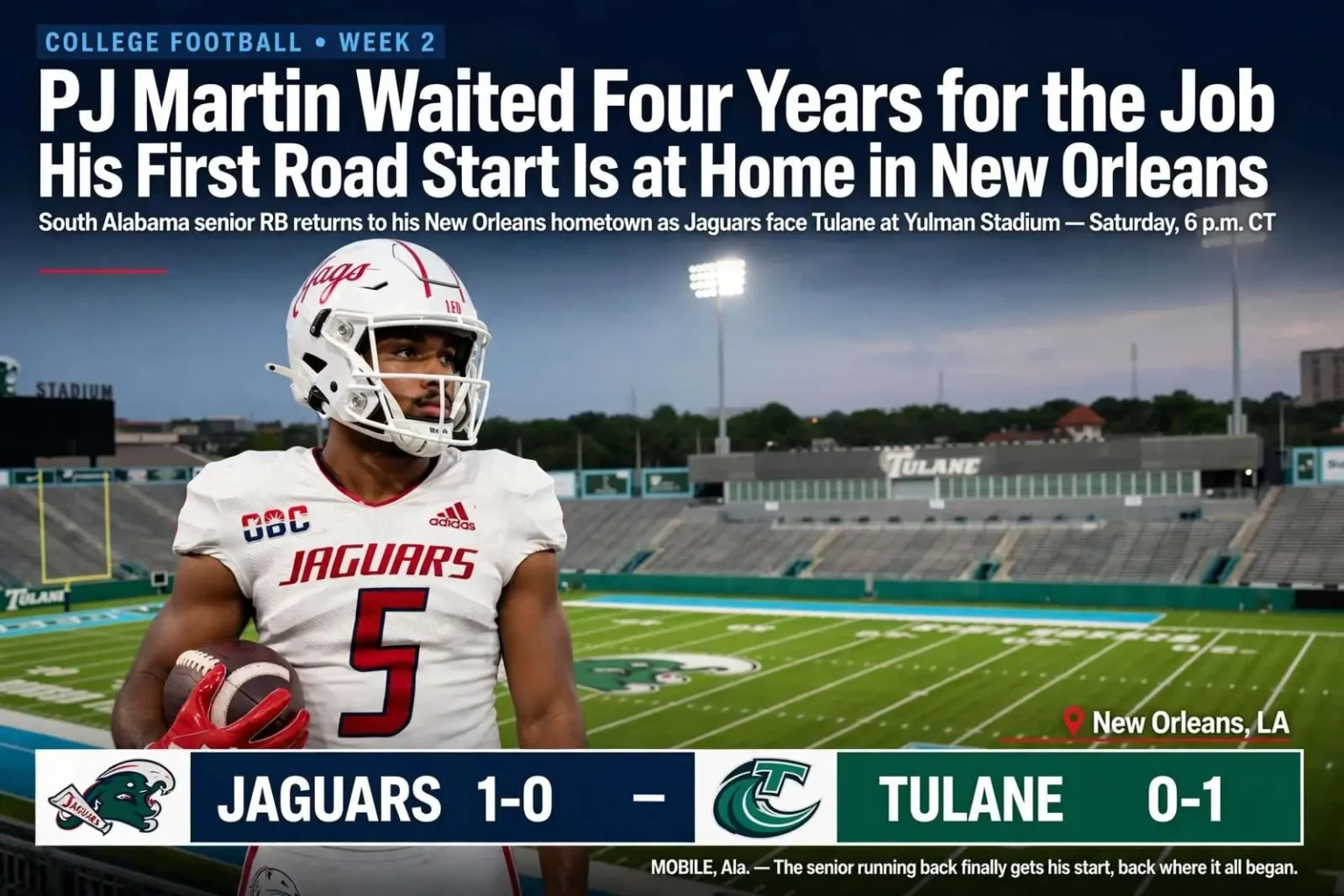
MOBILE, Ala. — PJ Martin waited four years for a starting job at South Alabama. His first road game with it is in the city he grew up in.
The senior running back returns to New Orleans this weekend as the Jaguars (1-0) face Tulane (0-1) at 6 p.m. Saturday at Yulman Stadium.
“It’s going to be major,” Martin said. “Just going back home playing in front of friends and family, and ready to make plays for everybody out there.”
A Long Wait Behind Good Backs
Martin has spent all four of his years at South Alabama, but this is his first as the starter.
The reason is not a lack of ability. He sat behind two 1,000-yard rushers in La’Damian Webb and Kentrel Bullock, as well as Fluff Bothwell, now at Mississippi State.
That is an unusually crowded depth chart to sit behind, and it describes a situation familiar to a great many college running backs. The position has a short useful window, roster spots at the top of the depth chart are limited, and a player can be good enough to start almost anywhere and still be third in his own room.
In the transfer portal era, the common response is to leave. Martin stayed for four years.
What He Did in High School
Martin is an alumnus of De La Salle High School in New Orleans, where he finished with 2,248 rushing yards and 35 total touchdowns. He earned first-team All-State Class 4A honors and led his team to an undefeated regular season.
Returning to New Orleans as a starting college back, in front of the people who watched him produce those numbers, is the kind of homecoming that college schedules occasionally arrange and players remember.
The Previous Trips
Martin did not play when the Jaguars traveled to Tulane in 2023. Last year, at Hancock Whitney Stadium in Mobile, he had three carries for 18 yards. The Green Wave won that one 33-31.
A two-point game a year ago sets the frame for Saturday. These programs have played close, and Tulane comes in 0-1 with the additional motivation that carries.
The Injury and What It Taught Him
Martin missed four games last season and part of spring practice with a back injury.
“It just taught me how to be a pro,” Martin said. “Focusing on taking care of my body, going after practice, doing extra recovery and taking the extra care that I needed.”
That is a specific and unglamorous lesson, and it is the one that determines whether a running back is available in November. The position takes more contact per snap than any other on offense, and the difference between a back who plays twelve games and one who plays eight is frequently what happens in the training room after practice rather than what happens during it.
Week One
In the opener against Southeastern Louisiana, Martin led the team with 18 carries for 69 yards. He also scored the final touchdown of the game on a fourth-and-2 near the goal line.
A 3.8-yard average is workmanlike rather than explosive. The fourth-down carry is the more telling detail — the coaching staff put the ball in his hands in the one situation where a failure ends the drive.
“Very, very pleased with him and really his development so far mentally,” running backs coach Broderick Fobbs said. “And how he approaches the game has probably been the deciding factor in him taking advantage of the opportunity.”
Fobbs’ emphasis on the mental side is worth noting. A back who has waited four years arrives at his opportunity either sharpened by it or diminished by it, and coaches watch closely for which.
A Committee, Not a Bell Cow
Martin shared carries with Keenan Phillips and Trae’von Dunbar, who combined for 126 yards on 26 carries and a touchdown.
Those numbers — 4.8 yards per carry from the backups against 3.8 from the starter — suggest a room with real depth rather than a clear hierarchy.
“They’ve developed and grown a lot,” Fobbs said of the group’s improvement from January.
A three-back rotation has become the norm in college football for practical reasons: it keeps legs fresh through a long season, reduces injury exposure for any single player, and gives a coordinator different skill sets to deploy by situation.
Week 2 Notes
On finishing what they start. Head coach Major Applewhite said he believes he has a tough team and was proud of how it ran the ball against Southeastern Louisiana. He wants that intensity sustained. The Jaguars led 19-0 in the first quarter but were up only 22-14 midway through the third.
That drop-off is the most actionable item on the list. A team that scores 19 unanswered and then plays even for two quarters has a second-half problem that a better opponent will exploit.
On third down. The South Alabama defense did not allow a single third- or fourth-down conversion against Southeastern Louisiana.
“It’s great when you can get people off the field, and that’s the ultimate goal of defense,” Applewhite said.
A perfect third-down defense in a full game is a remarkable statistic and one that will not be repeated against most opponents. But it points to something real about how the unit is playing on the down that decides possessions.
On the kicking game. Junior kicker Davis Little made all three field goals and all four extra points he attempted.
Kicking reliability is the least discussed variable in close games and one of the most consequential. In a series that produced a 33-31 result last year, it is not a small thing.
On the injury report. Senior wide receiver Anthony Eager was still seen in a soft cast at practice but took reps at receiver. Against Southeastern Louisiana he played only on special teams, recording a tackle on a punt.
The Matchup
South Alabama enters at 1-0. Tulane enters at 0-1, having lost its opener.
For the Jaguars, a road win over an American Athletic Conference program would be a meaningful early-season result. For Martin, it would come in front of the people who watched him at De La Salle.
Kickoff: 6 p.m. Saturday at Yulman Stadium, New Orleans.