Plant Barry Unit 8 Reaches Full Operation, Marking Milestone for Mobile County
Alabama Power's Plant Barry Unit 8 is fully operational after successful tests, adding 727 megawatts of natural gas capacity in Mobile County.
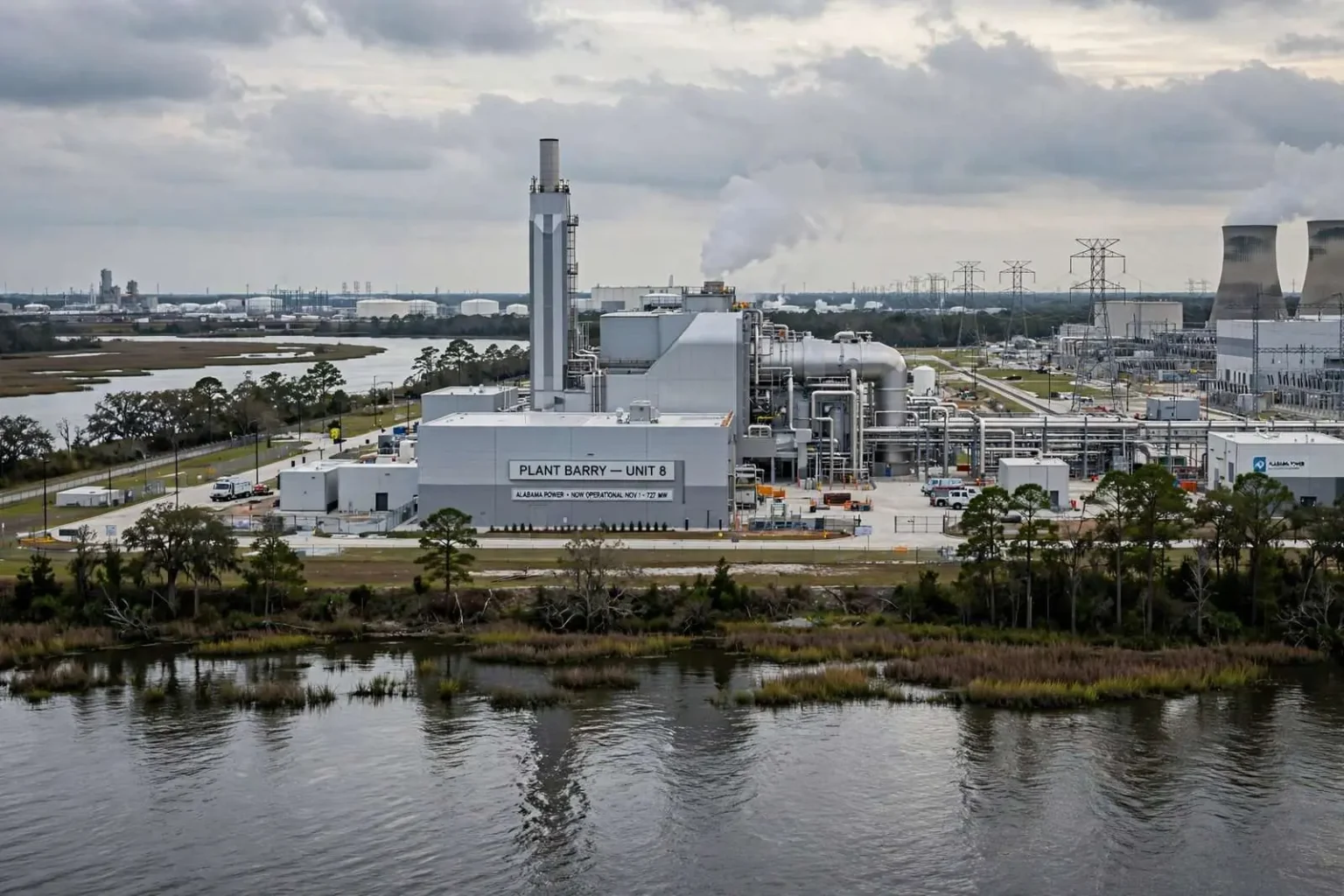
Alabama Power’s newest generator at Plant Barry in Mobile County is now running at full strength. Unit 8, known as Barry 8, became fully operational on Nov. 1 after clearing its final round of testing, capping a construction campaign that spanned several years of pandemic-era obstacles and adding one of the largest single blocks of new generation in the state’s recent history.
A big addition to the grid
The unit pairs a natural gas turbine with a steam turbine in a combined-cycle arrangement, capturing exhaust heat to make additional electricity from the same fuel. In a simple-cycle plant, the hot exhaust leaving a gas turbine simply vents away; in a combined-cycle design, that heat boils water, drives a second turbine and squeezes far more output from every cubic foot of gas burned. The approach has become the industry standard for large new gas plants precisely because it raises efficiency and lowers the cost per megawatt-hour produced.
Barry 8 can generate up to 727 megawatts — enough electricity to serve more than 200,000 homes, according to Beth Thomas of Alabama Power’s Mobile Division. For scale, that single unit approaches the size of some small utilities’ entire systems, and it gives Alabama Power’s dispatchers a flexible resource that can ramp alongside demand on the hottest afternoons and coldest mornings of the year.
“Barry 8 uses the most advanced and efficient technology available to generate electricity from natural gas,” said Brandon Dillard, Alabama Power’s senior vice president and senior production officer. The plant’s operators describe the unit as among the most efficient of its kind in the company’s fleet, an attribute that matters as utilities balance reliability commitments against fuel costs that have swung sharply in recent years.
The unit’s arrival comes as the Southeast’s power demands keep climbing. New manufacturing across the region — from automotive and aerospace plants to data-intensive facilities — has pushed utilities to add capacity faster than they retire older resources, and the Gulf Coast’s industrial expansion has made the Mobile area one of the fastest-growing load centers on Alabama Power’s system.
From approval to full operation
Construction began in 2021 after state regulators approved the project, moving forward despite pandemic-related disruptions and supply chain delays that slowed work across the industry. Crews contended with the same forces that stretched schedules on power projects nationwide: equipment that arrived late, materials that grew more expensive mid-project and workforce constraints that complicated staffing at every stage.
The build required roughly 2 million work hours, according to the utility, which also expects the new unit to contribute about $4 million a year in property taxes that support local schools, roads and services. For the small communities surrounding the plant, that steady annual revenue stream represents one of the most tangible local benefits of hosting major generation infrastructure.
Reaching full operation required more than finishing construction. New units move through a staged testing process that checks turbines, boilers, controls and safety systems under progressively heavier loads, and Barry 8 cleared its final round of testing before the utility declared it fully operational on Nov. 1.
With Barry 8 online, the total generating capacity at the Plant Barry site now stands at 3,246 megawatts. That figure places the complex among the largest power stations in Alabama and cements its role as a backbone resource for the southern part of the state’s electrical grid.
A fixture of the industrial corridor
The plant sits along the Mobile River near Bucks and Axis, a location that has made it a fixture of the region’s industrial corridor for decades. The stretch of north Mobile County around the river hosts paper mills, chemical facilities and heavy industry that share the river, the rail lines and the workforce that make the corridor one of Alabama’s most productive industrial zones.
That geography explains why Barry 8 landed where it did. The site already had transmission ties, gas supply access, cooling water from the river and a trained operating workforce — attributes that can shave years and millions of dollars off a project compared with greenfield construction. Building next to an existing plant also let crews share infrastructure while the older units continued running.
The corridor context matters to residents as well. Mobile County has absorbed generations of industrial growth along the river, and each new project revives familiar conversations about air quality, truck traffic and the balance between the jobs industry brings and the environmental burden it can impose. Natural gas generation generally emits less of the pollutants associated with older coal-fired units, a shift utilities cite as they modernize aging fleets.
What combined cycle means for customers
Efficiency is the word that separates Barry 8 from the units it joins. When a combined-cycle plant converts a larger share of fuel’s energy into electricity, the savings flow into fuel-cost adjustments that appear on customer bills, and the utility gains headroom to serve load spikes without activating its most expensive resources. Grid planners also value units that start relatively quickly and operate cleanly across a wide range of output levels.
The milestone carries planning weight as well. Alabama Power, like utilities across the Southeast, is navigating a period of accelerating demand growth and tightening reserve margins, and large efficient units such as Barry 8 form the core of how the company intends to keep service reliable through that transition.
Dillard called the milestone an important step in planning for customers’ needs for generations to come. That framing reflects the reality that power plants are multi-decade investments: a unit commissioned today will still be on the system in the 2060s, serving customers who have not yet moved to the region and industries that have not yet been built.
The workforce behind the unit
Projects of this scale assemble a small city of trades before the first megawatt flows. The two million work hours behind Barry 8 represent welders, electricians, pipefitters, crane operators and engineers, many drawn from the Gulf Coast’s established industrial labor pool. Construction employment of that kind ripples through local economies in the form of lodging, meals and services purchased across Mobile County during the build.
Once a unit enters operation, the employment story shifts to a smaller permanent staff of operators, maintenance technicians and support personnel, joined by contractors who handle scheduled outages and overhauls. Those steady jobs, combined with the property tax contribution, form the enduring local footprint of a project that otherwise fades from public view once the ribbon is cut.
Where the site fits in Alabama’s fleet
Plant Barry has long been one of Alabama Power’s workhorse facilities, a complex of units that historically leaned heavily on coal before the fleet diversified toward natural gas. The site’s evolution mirrors the broader arc of the state’s generation mix, in which gas has taken a growing share of output while older coal units have been retired or idled.
Sitting the new unit alongside existing infrastructure also strengthens the resilience of the local grid. Multiple units on one site with varied fuel histories and technologies give operators options when equipment trips or demand outstrips forecasts, a lesson utilities across the region absorbed during recent extreme weather events that stressed generation fleets in every state.
For now, the utility’s attention turns to operating the unit and folding its 727 megawatts into daily dispatch. The testing is finished, the regulators’ approval has been seen through to a running plant, and the lights supported by Barry 8’s first full month of service stretch from the Mobile River corridor across more than 200,000 homes that will never know its name — only that power arrived when it was needed.
Looking ahead along the Mobile River
Barry 8’s completion lands during a stretch of remarkable change for the corridor that hosts it. The Port of Mobile has pursued expansions that push more cargo through the nation’s rapidly growing Gulf gateways, manufacturers continue to announce projects across the county, and every increment of that growth eventually shows up as demand on the wires that radiate from stations like Plant Barry.
The property taxes the unit generates will underwrite schools, roads and services in the communities closest to the plant, and local officials have historically pointed to those payments as the quiet dividend of hosting infrastructure that most residents never see. Utility tax base also diversifies rural county budgets that lean heavily on residential property values.
Regulatory filings that cleared the project’s path described the economics plainly: growing demand, an aging fleet and the need for large blocks of efficient capacity all pointed toward a combined-cycle addition at a site that could host one. The completed unit answers that case, and its first months of operation will show how the promised efficiency performs in daily service.
For Alabama Power’s customers in the southern part of the state, Barry 8’s arrival is less a headline than an insurance policy — capacity standing ready for the next record-setting heat wave, the next industrial announcement and the next decade of growth along the Gulf Coast. The unit is tested, the megawatts are flowing, and the plant that has anchored the Mobile River industrial corridor for decades is larger for it.