Poarch Creek Indians Honor Generations of Creek Women During Native American Heritage Month
The Poarch Creek Indians are marking Native American Heritage Month by sharing the stories of four generations of Creek women whose leadership and family ties helped keep the community rooted in Alabama.
ATMORE, Ala. — The Poarch Creek Indians are using Native American Heritage Month this November to turn attention toward a part of their story that history books have often pushed to the margins: the Creek women whose family lines, clan ties and steady leadership kept the community rooted in Alabama through centuries of war, land loss and forced removal.
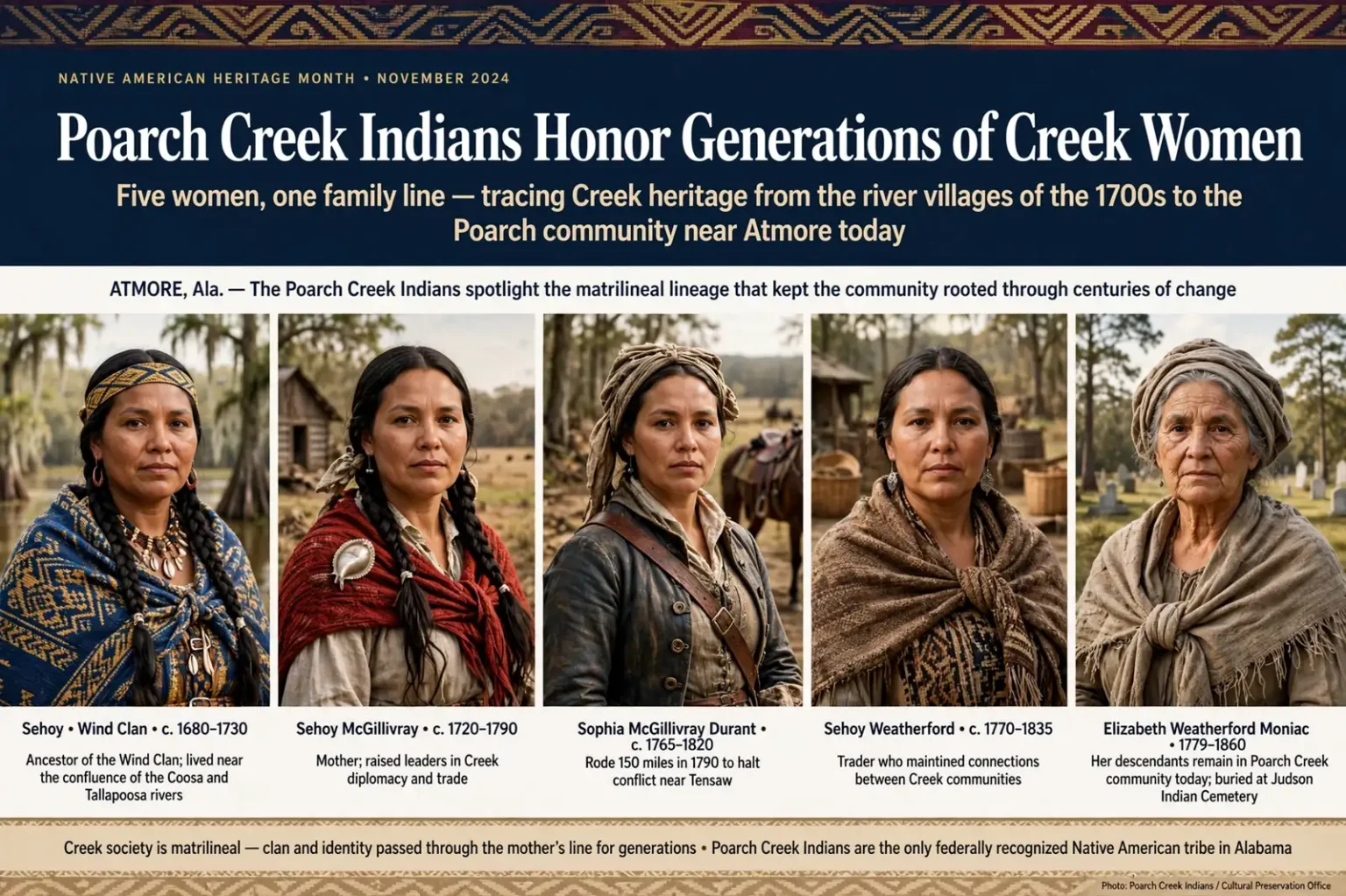
The tribe, the only federally recognized Native American tribe in Alabama, is sharing the life stories of five women whose lives connect one generation to the next. Taken together, their histories trace a single family thread from the river villages of the early 1700s to the Poarch community near Atmore that exists today.
Five Women, One Family Line
The women being recognized by the tribe are:
- Sehoy, a member of the Wind Clan who lived in the late 1600s and early 1700s
- Sehoy McGillivray, her daughter
- Sophia McGillivray Durant, a daughter of Sehoy McGillivray
- Sehoy Weatherford, Sophia’s sister
- Elizabeth Weatherford Moniac, the daughter of Sehoy Weatherford
Their combined lifetimes span the arrival and expansion of European colonial powers in the Southeast, open warfare, the loss of ancestral homelands and the federal removal policies that sent most Creek families west. The tribe presents the women not as footnotes to the better-known men around them, but as the people who held families and communities together while those larger events unfolded.
Why Creek Women Mattered: Clan and Maternal Lineage
To understand why the tribe is focusing on women, it helps to understand how Creek society was organized. Long before Alabama became a state in 1819, Creek towns and families were spread along the Coosa, Tallapoosa and Alabama rivers. Within those communities, a person’s clan and family identity were traced through the mother’s line.
That matrilineal structure meant that mothers, grandmothers and aunts were central to how a person understood who they were, which clan they belonged to and how they were connected to the land. Clan membership also shaped community leadership and obligations. In that sense, the women highlighted by the tribe were not only caretakers of their households; they were the channels through which identity, belonging and ties to place were passed from one generation to the next.
Sehoy and the Wind Clan at the Rivers’ Meeting Point
The family story begins with Sehoy, who the tribe says belonged to the Wind Clan, known in the Creek language as Hotvlkvlke. She lived among the Alabama and Koasati peoples near the place where the Coosa and Tallapoosa rivers come together to form the Alabama River, in what is now central Alabama, during the late 1600s and early 1700s.
That confluence was an important crossroads in the region, and it would soon draw the attention of European powers competing for trade and influence across the Southeast.
The McGillivray Generation: Diplomacy and a Long Ride to the Tensaw
As colonial expansion pressed into Creek country, Sehoy’s daughter, Sehoy McGillivray, raised children who would become prominent in Creek affairs. Among them was Alexander McGillivray, who became a well-known Creek diplomat during the turbulent years that followed the American Revolution, when the new United States, Spain and Native nations were all contending for the region.
Another of her children, Sophia McGillivray Durant, is remembered in the tribe’s account for an act of personal courage. In 1790, as tensions grew near the Tensaw, a settlement area in what is now Baldwin County north of Mobile Bay, Sophia rode more than 150 miles on horseback to intervene. The tribe credits her with helping to head off bloodshed.
The tribe points to Sophia’s ride as an example of the role Creek women often played in shielding their families and neighbors when conflict threatened.
Sehoy Weatherford and Elizabeth Weatherford Moniac
Sophia’s sister, Sehoy Weatherford, worked as a trader and used that role to keep Creek communities connected to one another. She raised children who went on to become significant figures in Creek history.
One of them, Elizabeth Weatherford Moniac, was born in 1779. Her life spanned some of the hardest chapters in Creek history, including the Creek War of 1813 and 1814, the surrender of vast stretches of ancestral territory and the era of Indian removal that followed the Indian Removal Act of 1830.
While many Creek families were forced to leave their homeland, Elizabeth remained in Alabama. The tribe says her descendants include families tied to the Poarch Creek community of today, and she is believed to be buried at Judson Indian Cemetery in Poarch.
A Different Lens on Creek History
Accounts of Creek history frequently center on battles, treaties and the political leaders who negotiated them. The tribe’s Heritage Month focus offers a complementary view, one that places families and kinship at the center of the story.
By raising children, keeping clan connections alive and holding on to their ties to the land through repeated upheaval, the tribe says, Creek women helped make sure that a Creek community would still exist in Alabama after removal. That survival is a direct link to the Poarch Creek Indians of the present day.
Poarch Creek Indians Today
The Poarch Creek Indians now operate as a sovereign tribal nation, with their reservation and tribal community based near Atmore in Escambia County. The tribe received federal recognition in 1984.
The tribe ties the experiences of earlier generations to its present-day work in cultural preservation, community health, education and economic development. Those efforts, the tribe says, create opportunities for tribal citizens and also benefit the surrounding communities in South Alabama.
Native American Heritage Month has been observed nationally each November since 1990, when it was first designated by federal resolution and presidential proclamation. For the Poarch Creek Indians, this year’s observance pairs a look at the tribe’s present-day initiatives with the family histories that made its continued presence in Alabama possible.
More information about the tribe, its history and its programs is available on the official Poarch Band of Creek Indians website. For more local coverage, visit our Poarch news section and our History section.