
Police Chase From Prichard Ends in Shootout on Wolf Ridge Road; Suspect Shot Six Times
A chase from Prichard ended in a shootout on Wolf Ridge Road where a suspect was shot six times; no officers were hurt.
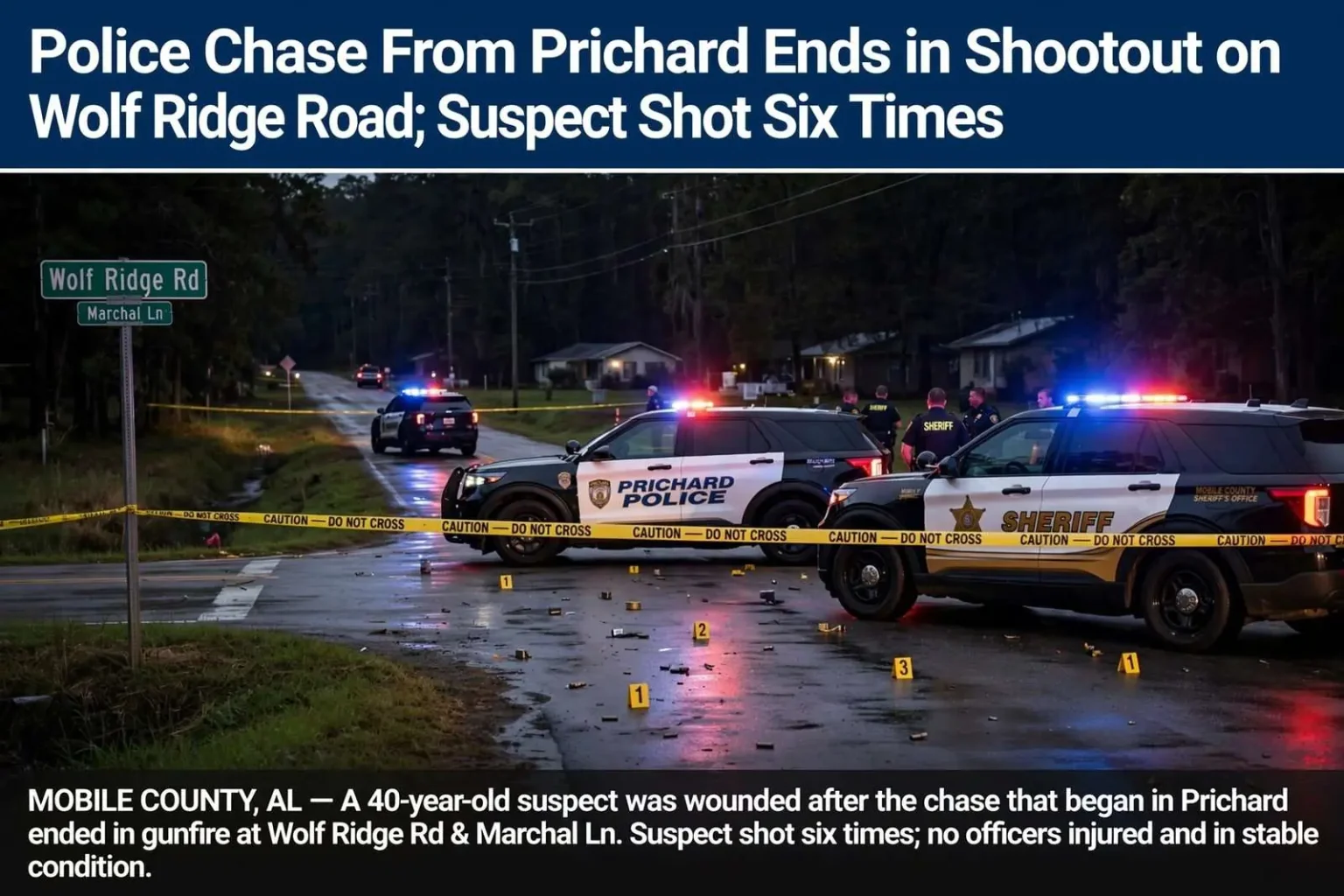
MOBILE COUNTY, Ala. — A vehicle pursuit that began in Prichard ended with an exchange of gunfire that left a 40-year-old suspect wounded, according to the Mobile County Sheriff’s Office. Sheriff’s officials identified the suspect as Cecil Frederick James. Mobile Fire-Rescue said he was shot six times during the confrontation, and the sheriff’s office confirmed his injuries were not life-threatening.
The chase, which began as what authorities described as an attempted traffic stop, stretched across jurisdictional lines and ended in an unincorporated part of the county, drawing in local, county and federal resources before it was over.
How the chase unfolded
Captain Paul Burch of the sheriff’s office said a Prichard police officer tried to stop James’s car when the driver began firing at the officer from his vehicle. The officer returned fire as the pursuit continued until it ended at Wolf Ridge Road and Marchal Lane in unincorporated Mobile County. Shooting at or from a moving vehicle turned what would otherwise have been a routine stop into a deadly-force situation, and the pursuing officer’s decision to return fire while the chase continued will now be examined under the review procedures that follow any officer-involved shooting.
Burch could not confirm why the officer initially attempted the stop, though he noted the car carried an expired tag dating back to 2003. An expired registration is among the most common reasons for traffic stops, but officers cannot always know at the outset of a stop — particularly at night or when a driver refuses to pull over — what they are walking into.
No officers were hurt in the shootout. The FBI and Mobile police assisted with the investigation, a standard step when a pursuit crosses city limits and ends in a shooting that requires independent documentation of the scene.
Federal partners on the streets
Burch explained that FBI agents on scene were supporting Prichard police through VGRIP, an ongoing county operation in which federal agencies help patrol high-crime areas; the FBI did not join the pursuit until after it was underway. The presence of federal agents on a routine evening illustrates how deeply the county’s law enforcement agencies now interlock, with city officers, county deputies and federal partners sharing intelligence and resources in some of the region’s busiest corridors.
Where the pursuit ended
The chase’s ending point, at Wolf Ridge Road and Marchal Lane, lies in unincorporated Mobile County — territory patrolled by the sheriff’s office rather than any city police department. Unincorporated stretches north and west of Prichard mix rural lots, new subdivisions and long, dark roads, and they are a common terminus for pursuits that begin inside city limits. When a chase ends there, the sheriff’s office takes over the scene: securing the vehicle, documenting the shooting and coordinating with the agency whose officer fired.
The intersection itself, far from the residential density of central Prichard, likely spared bystanders from the gunfire. That is a matter of luck as much as anything — pursuits that pass through neighborhoods endanger not only officers and suspects but everyone along the route, which is why agencies weigh the seriousness of the initial offense against the risks of continuing a chase.
The suspect’s history
Jail records show James had an extensive history with the county jail, including multiple domestic violence charges. That record will now become part of the case prosecutors build, and it adds context to the charges he is expected to face — which typically include shooting at an occupied vehicle, attempted assault on a law enforcement officer and eluding, along with any Weapons or drug counts that emerge from the investigation of the car.
Domestic violence cases occupy a significant share of the bookings at Mobile County’s jail, and officers across the region treat calls and stops involving suspects with such histories as inherently higher-risk. Studies of violence against police repeatedly identify domestic disturbance calls and stops of drivers with violent histories among the most dangerous encounters officers face — a reality reflected, authorities say, in the way this stop escalated within seconds.
Prichard’s policing challenge
Prichard, where the attempted stop began, is one of the most challenging policing environments in the region. The city of roughly 20,000 residents sits north of Mobile along the Highway 45 corridor, and for years its small police force has contended with violent crime rates well above state averages, aging equipment and tight budgets. Partnerships like VGRIP were designed precisely for jurisdictions in Prichard’s position — putting federal investigators and agents alongside city officers to concentrate attention on the small number of repeat offenders who drive much of a community’s gun violence.
That a single traffic stop could pull together Prichard police, the Mobile County Sheriff’s Office, Mobile police and the FBI shows the practical effect of those partnerships. Each agency brought a piece of the response: the initiating officer, the sheriff’s jurisdiction where the chase ended, the city’s homicide and shooting expertise, and federal investigative resources that can reach offenses crossing jurisdictional lines.
What happens next
In the days ahead, the case will move through several parallel tracks. The officer’s use of force will be reviewed by his department and, as is customary, presented to prosecutors for a determination on whether the shooting was justified. James, once medically cleared, will face charges connected to the pursuit and the gunfire aimed at the officer. And investigators will document the scene at Wolf Ridge Road and Marchal Lane — shell casings, the vehicle’s path, bullet strikes — to establish the sequence of events with physical evidence rather than memory alone.
The expired tag that apparently prompted the stop is a reminder of how unpredictable routine police work can be. Officers initiate thousands of such stops across Mobile County each year, and the overwhelming majority end with a warning or a citation. The rare stop that turns violent shapes policy debates: when to pursue, when to break off, and how to balance the value of apprehending a driver against the danger a chase poses to everyone in its path.
A county watching for answers
No one was hurt except the suspect, and authorities were quick to emphasize that the outcome — a wounded suspect in stable condition and an unharmed officer — was among the better endings available in an encounter that began with someone firing out of a car window. But the case will remain in the public eye as it moves toward charges and review, both because of the questions it raises about pursuit policy and because of what it reveals about the layered law enforcement network now operating across Mobile County’s most crime-affected neighborhoods. For the residents of Wolf Ridge Road, whose quiet corner of the county became the final scene of a cross-city gunfight, the aftermath is more immediate: the shell casings are gone, the tape has come down, and the ordinary business of a rural road resumes — with a sharper sense of how quickly trouble can travel to it.
The danger of gunfire from moving vehicles
Shooting at an officer from a moving car is among the most dangerous scenarios in American policing, and the fact that no officer was struck in this encounter was a matter of fortune as much as anything. Rounds fired from a vehicle travel in an unpredictable arc, and an officer in pursuit has no cover, no stable footing and only a windshield between himself and the shooter. Departments across Alabama train for exactly this situation — when return fire is justified, when to break off, and how to coordinate other units so the fleeing vehicle is boxed in rather than chased at high speed through traffic.
Prosecutors treat firing at a law enforcement officer as among the most serious felony charges available, precisely because the act endangers not only the officer but everyone else on the road. A conviction can carry decades in prison, and in cases where the suspect has a prior record like the one jail records show for James, prosecutors typically seek sentences that reflect the full history rather than a single incident.
How pursuits are decided in real time
Every pursuit involves a split-second judgment by the initiating officer, followed by a chain of supervisory decisions made over the radio: is the initial offense serious enough to justify a chase, what is the traffic around the fleeing vehicle, does the driver’s behavior indicate a threat beyond the original stop. Once James opened fire, those calculations changed completely — a driver shooting at police presents a danger to the public that generally outweighs the risks of continuing the pursuit, because allowing an armed, aggressive driver to escape creates a far greater hazard.
Agencies across Mobile County have mutual aid agreements that make multi-agency responses routine. When a chase crosses from Prichard into the county, deputies take up positions ahead of the fleeing vehicle, spike strips may be deployed, and the responding agencies coordinate through dispatch to bring the pursuit to a controlled end. That is what the record suggests happened here: a chase that began in Prichard ended with a coordinated response in the county, at Wolf Ridge Road and Marchal Lane, rather than a single officer following a shooter alone into the dark.
Looking at the whole picture
The sheriff’s office has released the outlines of the case and will release more as the investigation allows: the officer’s name once customary procedures allow, the results of the review of the shooting, and the formal charges against James. For Captain Burch and the agencies involved, the accounting to the public is part of the job — explaining how a routine stop became a shootout, and why the officers involved acted as they did. For residents of the county, the episode is a reminder that the deputies and city officers who patrol the corridors between Prichard, Mobile and the rural stretches beyond face genuinely unpredictable danger, and that the layered network of local, county and federal law enforcement built over recent years exists for nights exactly like this one.


