Power and Rubber Supply to Build $7M Mobile County Facility, Add 55 Jobs
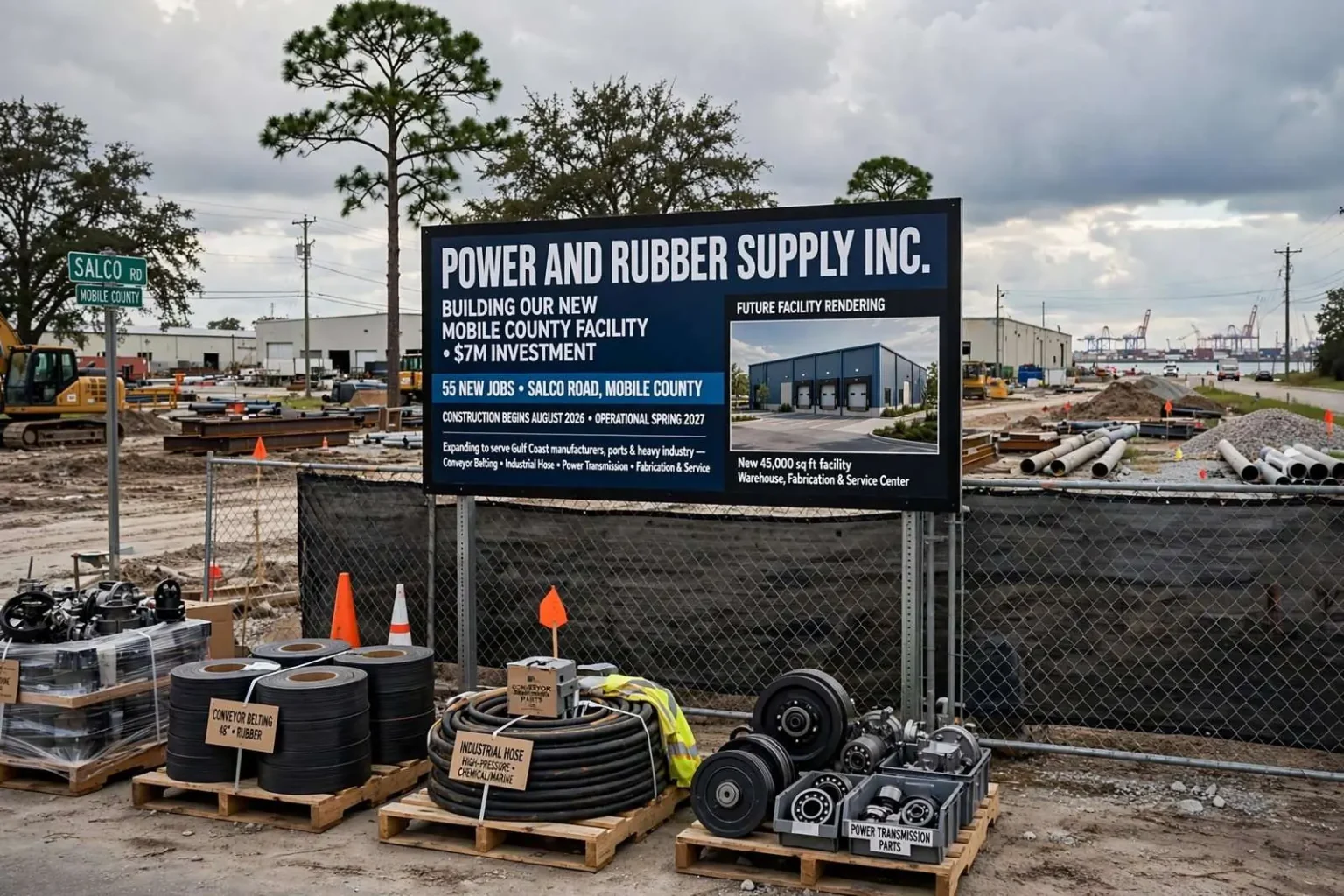
Power and Rubber Supply plans to invest more than $7 million in a new Mobile County facility, creating 55 jobs over the next five years as it relocates from Interstate 65 to Salco Road.
A Tuscaloosa-based industrial supplier is expanding its footprint in Mobile County with a new facility expected to create dozens of jobs over the next several years. The Mobile Chamber announced that Power and Rubber Supply Inc. plans to invest more than $7 million to build a new facility in Mobile County, a move expected to add 55 jobs over the next five years. The announcement adds another name to the roster of companies expanding along Mobile’s industrial corridors, where suppliers to the region’s manufacturers, ports and heavy industries have been steadily growing their presence.
The company currently operates out of a leased building near Interstate 65 in the city of Mobile. It plans to relocate those operations to a newly built facility on Salco Road, giving it more room for product assembly, fabrication and maintenance work. Moving from leased quarters into a purpose-built plant gives the company control over floor space, loading access and equipment layout that a leased industrial building cannot easily accommodate, and positions the operation for the kind of heavy fabrication work its industrial customers demand.
What the new facility will do
The expanded location will continue to provide power transmission products, conveyor belting, industrial hoses and other rubber products, along with related services. It will also support conveyor belt fabrication, installation and maintenance. Those product lines sit at the heart of industrial operations across the Gulf Coast: conveyor belts move everything from wood chips and aggregates to containerized cargo, power transmission components keep motors and drives running, and industrial hoses serve chemical, marine and manufacturing applications where failure is not an option.
Customers for this kind of operation are typically plants and facilities that cannot afford extended downtime. When a conveyor belt tears or a drive component fails, repair crews need replacement parts and skilled installers within hours, not days. Power and Rubber Supply’s model pairs product distribution with field service — fabricating belts to specification, installing them on site and maintaining them over time — which is why floor space for fabrication and a larger service workforce are central to the expansion plan.
The 55 positions to be added over the next five years span the range of work the facility performs: warehouse and distribution staff, fabrication technicians, service crews who install and maintain equipment at customer sites, drivers and administrative personnel. Industrial supplier jobs of this kind tend to pay above the general service-sector average and require skills — mechanical aptitude, welding, rigging, commercial driving — that the company can develop through on-the-job training.
Company and community leaders weigh in
“This is a great opportunity for Power and Rubber Supply. We look forward to expanding our operations in Mobile and deepening our roots in the community. We plan to continue to grow to meet our customers’ needs,” said Power and Rubber Supply President Chris Jacobs. Jacobs’ comments framed the move as a long-term commitment rather than a relocation of convenience, with the company trading a flexible lease for an owned facility — a step companies generally take only when they intend to stay.
Mobile Chamber President and CEO Bradley Byrne said the investment reflects the strength of the area’s industrial base. “Power and Rubber Supply’s decision to expand its operations in Mobile County reflects the strength of our industrial economy and the continued demand for the specialized services that support it,” Byrne said. “This investment will create quality jobs, give the company room to grow and strengthen the network of suppliers serving manufacturers and industrial employers across our region.”
Byrne’s reference to the supplier network points to a dynamic economic developers in Mobile have worked to cultivate for years. Major employers — shipbuilders, chemical plants, paper mills, port operations and aerospace facilities — depend on a web of smaller specialized firms that supply parts and services on demand. Every time one of those suppliers expands, the region’s case for attracting and retaining the larger industries grows stronger, because reliability of the support network is a core factor in industrial site selection.
Mobile County Commission President Connie Hudson said the project is a vote of confidence in the local workforce. “Every new job matters, but so does the confidence behind an investment like this,” Hudson said. “Building a new facility in Mobile County says Power and Rubber Supply believes in our workforce, our community and our future. We’re proud to see another company choosing to grow here and create new opportunities for our residents.”
A company built on the industrial supply chain
Power and Rubber Supply grew up serving Alabama’s industrial corridor out of Tuscaloosa, an area anchored by manufacturing and the state’s energy and automotive sectors. Industrial distributors of this type typically operate regionally, stocking product lines from major manufacturers while providing the custom fabrication and emergency service work that national catalog suppliers cannot match. Expanding into Mobile County puts the company within reach of one of the Southeast’s densest concentrations of industrial customers along the Gulf.
The Mobile-area industrial market has expanded considerably over the past two decades, with the Port of Mobile’s container terminal, a major Aerospace corridor, chemical and paper operations, and a growing shipbuilding and repair sector all drawing suppliers to the region. Distributors that serve those customers often cluster near interstate interchanges and rail lines, and the Salco Road area offers the combination of industrial zoning, truck access and proximity to the customers the company serves.
Timeline for the move
Construction on the new facility is expected to begin in August 2026, with the site anticipated to be operational by spring 2027. That schedule gives the company roughly two years to complete site work, building construction and equipment installation before relocating operations from the leased Interstate 65 location. Industrial construction timelines of this kind are typical for a facility of the planned scale, and the company’s current site will continue serving customers while the new plant comes together.
The hiring ramp-up tied to the 55 new positions will unfold alongside the construction schedule, with staffing expected to build gradually as the facility comes online and additional service territory comes within reach. Companies announcing multi-year job commitments of this kind typically phase hiring around capacity: first the core fabrication and warehouse crew, then service teams as the facility’s reach extends, then support staff as volume grows.
For west Mobile’s industrial districts, the project adds another modern facility to an area that has seen steady reinvestment. Suppliers, freight operations and light manufacturers along the corridor benefit from each other’s presence, sharing customers, contractors and a labor pool experienced in industrial work. The company’s decision to build rather than lease also removes a parcel from the area’s industrial land inventory and puts it into permanent, productive use.
Chamber officials said the project came together through the organization’s ongoing work with existing industry — the retention and expansion side of economic development that receives less attention than headline recruiting but often delivers more reliable job growth. Companies already rooted in a community, officials note, expand where they know the workforce, the customers and the costs, and their reinvestments compound over time in a way that one-time recruitment wins frequently do not.
For workers in Mobile County’s industrial trades, the new facility represents 55 more reasons to stay in the region. For Power and Rubber Supply, it represents a bet that the Gulf Coast industrial economy will keep demanding the belts, hoses, drives and service crews that keep its plants moving. Construction begins in August 2026; by spring 2027, the company plans to be running — and growing — on Salco Road.
Salco Road sits within Mobile’s established industrial belt, an area chosen for exactly the reasons suppliers like Power and Rubber Supply need: heavy truck routes, industrial-scale utilities, and quick access to the interstate system that connects the city’s plants, terminals and job sites. For a company whose crews respond to breakdowns at customer facilities, location is measured in drive time, and the new site keeps the firm within a short run of most of the major industrial customers in the county.
The products the company distributes may be unglamorous, but they are the connective tissue of nearly every heavy operation on the Gulf Coast. A paper mill, a chemical plant, a bulk terminal and a shipyard all move material by conveyor, transfer fluids through hose assemblies and depend on power transmission components to keep rotating equipment running. Suppliers in this niche compete less on catalog price than on availability, fabrication speed and the quality of the crews they send into the field, which is why the company is pairing its building investment with a steady hiring ramp.
The five-year hiring horizon also mirrors how industrial distributors grow: service territory expands customer by customer, and each new account adds crews and warehouse capacity. By committing to 55 jobs across five years rather than in a single burst, the company is aligning its workforce growth with the facility’s actual operating tempo — a structure that tends to make the job commitments durable, since each hire supports revenue that already exists.
Local officials have pointed to the project as an example of the quiet, compounding kind of growth that builds a regional economy. Headline manufacturing recruits attract attention, but the everyday expansions of suppliers and service firms — new buildings, added crews, extended shifts — account for a large share of job creation across Mobile County. Each such project also widens the base of specialized skills available locally, making the next expansion easier for the next company.
When the Salco Road facility opens in spring 2027, it will replace a leased building with an owned plant built around the company’s exact workflow, from receiving docks to fabrication bays to the dispatch desk that sends service crews across the region. For a Tuscaloosa-born firm that has spent years serving Mobile customers from a distance, the move amounts to planting a flag: this is where the Gulf Coast customers are, and this is where the company plans to grow with them.