Prayer vigil planned in Clarke County to honor George Floyd
A prayer vigil to honor George Floyd is planned for Friday night at the Clarke County Courthouse in Grove Hill, with Jackson Police Chief Jerry Taylor.
Clarke County Prepares for Prayer Vigil
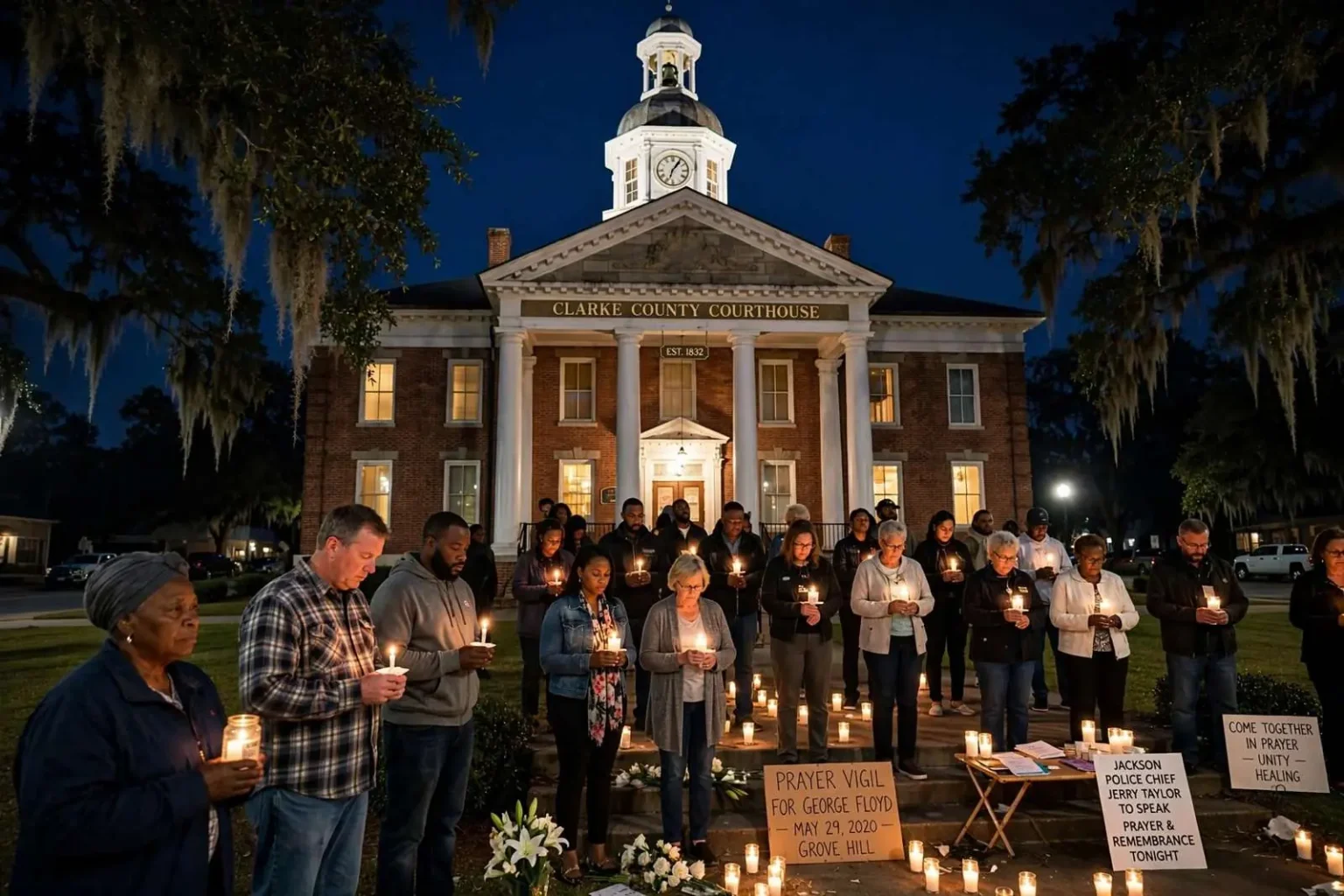
GROVE HILL, Ala. — A prayer vigil is planned for Friday night in Clarke County to remember George Floyd, who died earlier this week in Minneapolis. The event is meant to honor Floyd and bring the community together during a difficult time. Jackson Police Chief Jerry Taylor is scheduled to speak, and the vigil will take place at the Clarke County Courthouse.
The vigil comes at the end of a week in which Floyd’s death in Minneapolis had set off grief and soul-searching across the country, reaching into communities of every size — including the small towns of southwest Alabama. Organizers in Clarke County set out to give residents a place to gather, pray and mourn together, choosing the courthouse square in Grove Hill, the traditional center of civic life in the county, as the setting.
George Floyd died in Minneapolis earlier in the week after a white police officer knelt on his neck for several minutes during an arrest, an encounter captured on video that spread nationwide within hours. His death ignited protests in cities large and small, renewed a national conversation about police accountability and racial justice, and prompted vigils like Clarke County’s in towns across the South. For many communities, the first response was not protest but prayer — a gathering at a courthouse or church where neighbors could stand together, grieve, and look for a way forward.
The choice of Grove Hill as the site carries its own weight. The Clarke County Courthouse has stood at the center of the town for generations, the place where the county’s public business is done and its public moments — celebrations and commemorations alike — are held. A vigil on its grounds places Floyd’s memory squarely in the civic heart of the county, where the whole community, black and white, is invited to stand together.
Police Leadership and the Meaning of Presence
Jackson Police Chief Jerry Taylor’s scheduled remarks give the vigil a significance that reaches beyond Clarke County. Jackson sits just across the county line as the largest city in neighboring places in the region, and its police chief standing before a crowd gathered to honor a man who died at the hands of police is itself a statement — of willingness to listen, to share grief, and to acknowledge the questions Floyd’s death raised about policing in America. A chief who speaks at such a gathering places himself in conversation with his own community at a moment when that conversation matters most.
Across Alabama and the nation that week, law enforcement leaders faced the same choice. Some departments joined vigils, knelt with demonstrators, or opened themselves to dialogue; others stayed silent, and the difference was noticed. Chief Taylor’s presence on the program put the Jackson Police Department, and by extension Clarke County’s law enforcement community, on the side of engagement. In small Southern towns, where police and the communities they serve know each other by name, that kind of presence carries a meaning that press releases cannot.
The vigil’s format — prayer, reflection and remarks — reflects the religious character of the region. Clarke County’s communities are anchored by their churches, and a gathering built around prayer is the most natural form a commemoration can take here. Organizers described the event as a way to honor Floyd and bring the community together during a difficult time, language that emphasizes unity over division: the vigil is not a protest but a place to grieve and to hope.
Grove Hill and the County Around It
Grove Hill, the county seat of Clarke County, is a town of roughly fifteen hundred people along U.S. Highway 43, an hour’s drive north of Mobile. The courthouse at its center dates to the county’s nineteenth-century origins, and the square around it hosts the county’s public gatherings — from holiday celebrations to memorial services. On Friday night, it became the place where Clarke County answered a moment of national grief with a local act of mourning.
Clarke County’s population is roughly a third black, a legacy of the plantation economy that shaped the Alabama River counties, and its communities have lived the long history of race in the South in close quarters — neighbors, schoolmates, church members and coworkers across the color line. A vigil for George Floyd in Grove Hill happened in that context: not a distant echo of a distant city’s events, but a moment felt personally in a county where the ties between black and white families run back generations.
The week that produced the vigil had been one of mounting tension nationwide. Protests grew in size from Minneapolis to Atlanta to Washington, some turning destructive, most peaceful, and the country’s attention fixed on questions of police conduct, accountability and racial equality. In Clarke County, the response organizers chose was deliberately quiet: pray, remember, and stand together. The presence of a police chief on the program reinforced the possibility that the conversation Floyd’s death opened could be conducted with mutual respect even in small towns.
The logistics of the vigil reflected its purpose. Organizers set the event for Friday night, when working families could attend after the week’s obligations, and word spread through the channels that carry news in Clarke County — church announcements, social media posts and word of mouth. Residents were asked to bring what such gatherings call for: prayers, and a willingness to stand with neighbors. The courthouse square, with its open lawn and its place in the town’s civic geography, needed little preparation to become what the moment asked of it.
What a Vigil Does for a Community
Vigils serve purposes that are easy to underestimate. They give grief a public form; they let people who feel helpless do something concrete; and they create a moment of shared witness that a community can look back on. For Clarke County, the Friday night gathering at the courthouse was all of those — a chance to mourn a man most residents never met, to pray for his family, and to stand visibly with a national moment of mourning from a courthouse square in rural Alabama.
The act of gathering also builds the relationships a community needs for harder conversations. The people who stand together in prayer on a courthouse lawn are the ones who will talk afterward — in church lobbies, at ballgames, across kitchen tables — about what Floyd’s death means and what their own community should do. Small towns conduct their reckoning differently than cities do: not through mass demonstrations but through the slow accumulation of conversations, and a vigil is often where those conversations begin.
Chief Jerry Taylor’s scheduled remarks promised to anchor that beginning. When a police chief addresses a crowd gathered for a man who died in police custody, the words matter, but so does the act — the willingness to stand before the community in a moment when policing itself is the subject. Whatever he said from the courthouse steps, his presence signaled that the Jackson Police Department intended to be part of the dialogue rather than its subject alone.
Remembering George Floyd
George Floyd, who died earlier that week in Minneapolis, was mourned across the country in gatherings exactly like Clarke County’s — vigils of prayer, song and silence held in churches, parks and courthouse squares. His name became, within days, known worldwide, and the circumstances of his death became the catalyst for one of the largest periods of protest and reflection in American history. In towns like Grove Hill, the response took the form the community knows best: neighbors gathering to pray.
The Friday night vigil at the Clarke County Courthouse was scheduled with that purpose — to honor Floyd and bring the community together during a difficult time. Those goals, stated plainly, describe what small-town Alabama does best. The county’s residents arrived at the square as they have for public moments for generations, and the gathering stood as Clarke County’s answer to a national tragedy: grief shared, prayers offered, and a community resolved to face hard questions together rather than apart.
The event also joined Clarke County to the wider story of that spring in the South, when communities from Mobile to Montgomery held their own vigils and services for Floyd. In each place, the form was local and the meaning was shared. For Grove Hill and Clarke County, the Friday night gathering — with Chief Taylor scheduled to speak and the community invited to pray — was the moment the county added its voice, quiet and earnest, to a conversation the whole country was having.
What remained after the candles went out was the work the vigil set in motion. Communities that grieve together do not automatically resolve the questions that grief raises, but they start from a different place than communities that grieve alone. The courthouse square in Grove Hill hosted an hour of prayer for a man who died a thousand miles away, and in doing so it gave Clarke County a common reference point for every conversation about justice, policing and neighborliness that followed. That, in the end, is what the organizers meant when they said the vigil was meant to bring the community together during a difficult time.