Prichard Councilman to Propose Ordinance Requiring Face Coverings in Public
Councilman Lorenzo Martin will propose an ordinance requiring face coverings in Prichard at the city's public safety committee meeting.
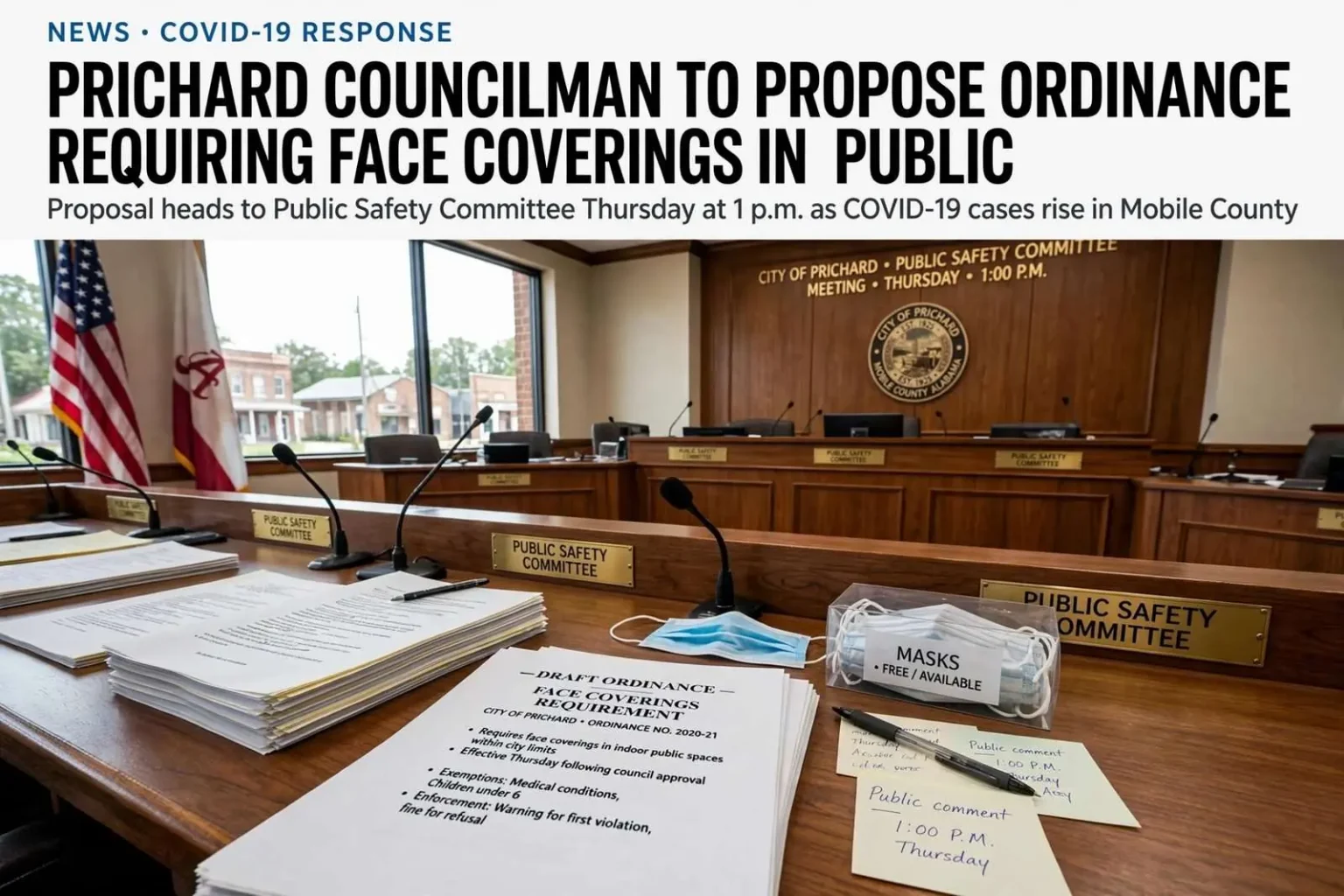
A Prichard councilman is pushing to make face coverings a requirement inside the city limits as coronavirus cases climb across the region. Councilman Lorenzo Martin is sponsoring an ordinance that would mandate wearing a face covering in Prichard, and he plans to bring the proposal before the city’s public safety committee at its meeting Thursday at 1 p.m., the first step toward a vote by the full city council. If adopted, Prichard would join a growing number of Alabama communities weighing their own mask rules during the summer surge of the COVID-19 pandemic.
The proposal arrived at a moment when Alabama’s infection numbers were rising sharply, with hospitals across the state reporting growing caseloads and public health officials urging residents to cover their faces in public. Cities and counties that wanted a local requirement had to write their own rules, since no statewide mandate was yet in force, and the result was a patchwork of local ordinances across Alabama, some enforcing masks with fines, others relying on education and voluntary compliance. Martin’s ordinance would put Prichard, one of Mobile County’s largest cities, in the company of communities that chose the mandate route.
Prichard’s path to a mask ordinance
The legislative mechanics in Prichard follow the standard sequence for Alabama municipalities. A sponsoring councilman introduces the draft to a committee, in this case the public safety committee meeting Thursday at 1 p.m., where the text is reviewed, amended if necessary and voted on for recommendation. Only then does the measure reach the full city council for a vote, with public comment typically part of the process. The committee stage exists precisely for proposals with enforcement implications, and a mask mandate touches policing, business regulation and public health all at once, making the committee’s scrutiny more than a formality.
Enforcement is the practical question every Alabama city confronted with these ordinances. Police departments that were already managing pandemic-era responsibilities had to decide how, or whether, to cite residents for uncovered faces, and most cities emphasized persuasion first, reserving penalties for refusals in businesses and public buildings. Retailers added their own requirements, and the local ordinance served in large part as the legal backing that let businesses and institutions insist on compliance. Cities also had to consider the limits of enforcement against people with medical conditions that make masking difficult, an exemption most ordinances included.
Prichard’s pandemic context
Prichard, a city of roughly 20,000 residents north of Mobile, entered the pandemic with the health vulnerabilities that make respiratory disease most dangerous. The city’s population skews older than the state average, its household incomes are among the lowest in the metropolitan area, and rates of the chronic conditions that worsen COVID-19 outcomes, diabetes, hypertension, kidney disease, run higher in its neighborhoods than in surrounding suburbs. Mobile County’s case counts during the summer surge rose steeply enough to prompt emergency declarations from area governments, and Prichard’s city leadership had already adjusted municipal operations, closing facilities and restricting public meetings, before the mask question reached the council.
The city’s demographics also shaped the urgency behind the proposal. Prichard’s residents are predominantly Black, a community that has borne a disproportionate share of COVID-19 hospitalizations and deaths nationwide, and local officials across Alabama’s majority-Black cities spoke openly during the surge about protecting residents whom the disease was hitting hardest. A mask ordinance in that context was framed less as a bureaucratic measure than as a direct intervention in a public health emergency afflicting the city’s own households, churches and workplaces.
Whether the ordinance passes depends on the committee’s recommendation and the full council’s vote, but the proposal’s placement on Thursday’s 1 p.m. agenda signals that Prichard intends to act while the surge is still climbing. The debate in the council chamber mirrors one happening in city halls across Alabama, between the public health argument for a mandate and the practical and political questions of enforcement, exemptions and business burden. Councilman Lorenzo Martin’s sponsorship puts Prichard squarely in that statewide conversation, with the city’s summer hanging on how its residents answer the mask question in the weeks ahead.
The summer of Alabama’s COVID-19 surge placed every municipality in the position of weighing health policy against the limits of local government. Cities had no authority over the state’s health orders, but they retained police powers over their own limits, and the mask ordinances that spread across the state in that stretch were the exercise of those powers in a public health emergency. Birmingham, Montgomery, Tuscaloosa and smaller cities all adopted requirements of varying strictness, and the debate in each was similar: what the local numbers showed, what businesses would accept, and how police would enforce a rule that turned a health recommendation into law.
Mobile County’s larger governments watched the same numbers. Mobile city and county officials encouraged masking and issued emergency proclamations, while the county’s smaller municipalities made their own calls. Prichard’s position in the metro area, a distinct city with its own council, police department and health burdens, made a local ordinance both more feasible and more meaningful than waiting on county or state action. The city’s residents shop, work and worship across municipal lines, so a Prichard requirement also functioned as a signal to neighboring communities about the seriousness of the moment.
What a mask ordinance contains
Typical Alabama mask ordinances from that period shared a common structure. They defined the covered spaces, indoor public areas and businesses, sometimes outdoor settings where distancing was impossible, they set exemptions for medical conditions, children under a certain age and activities where masks were impractical, and they specified penalties that ranged from warnings to modest fines for refusal. The ordinances leaned on businesses to enforce the rule at their doors, giving store owners the legal footing to turn away uncovered customers, and they included sunset provisions or renewal requirements so the mandate would end with the emergency that justified it.
The public safety committee’s role in reviewing such a text is to work through exactly those details: who enforces, where it applies, what the penalty is and how long it lasts. Martin’s choice of the committee route, rather than a direct floor vote, put the ordinance’s mechanics through the slower examination that enforcement-heavy proposals require, and the Thursday 1 p.m. meeting gave residents and business owners notice to attend and be heard. Committee action in Alabama city governments is often where controversial measures are amended into passable form, and the mask mandate was the kind of proposal whose enforceability depended on that refinement.
The question Prichard’s council faced was the same one being asked in every Alabama city that summer, whether a local government could move the behavior of enough residents to slow a virus that was filling hospital beds across the region. The evidence available at the time indicated that masks reduced transmission, and the communities that adopted requirements did so on that basis while acknowledging the enforcement limits of a small police force. Prichard’s deliberation, sponsored by Councilman Lorenzo Martin and set for Thursday’s public safety committee at 1 p.m., was the city’s formal engagement with that question, and its outcome would place the city among Alabama’s communities that answered with an ordinance rather than only with advice.
Prichard’s municipal government operates with the full complement of departments that a mask ordinance would touch, and the city’s experience with emergency management gave the proposal a practical grounding. The city runs its own police department, fire service and public works, and its council meets regularly with committee structures that handle public safety matters before they reach the full body. City leadership had navigated the pandemic’s first months with closures and adjusted operations, and the mask proposal arrived as the second phase of that adaptation, moving from managing city facilities to shaping behavior across the whole city.
The relationship between Prichard and the Mobile County Health Department shaped the local response to the pandemic as well. The county health department, one of Alabama’s longest-established county health agencies, tracked cases, conducted testing and delivered public guidance to all of the county’s municipalities, and its daily numbers were the material before every council in the county. Prichard’s officials also coordinated with the city of Mobile and the county commission on regional measures, since the metro area’s residents move constantly among the jurisdictions, and a rule that stops at one city line has limits that every council member understood.
The council’s deliberation
City council deliberations over mask mandates drew the era’s full range of voices. Supporters, including health professionals and residents with vulnerable family members, argued that a requirement was the least intrusive tool that had demonstrable effect, and that a city with Prichard’s health profile could not afford the voluntary approach. Opponents raised enforcement concerns, personal liberty arguments and questions about the burden on small businesses, and some questioned whether an ordinance could be applied fairly by police already stretched thin. The public safety committee’s Thursday meeting was structured to hear exactly those positions before the text advanced.
The statewide picture gave Prichard’s council both company and contrast. Neighboring jurisdictions were adopting their own rules on their own schedules, and the differences among them became a map of local decision-making during a health emergency. Cities that acted early said they were buying time for hospitals; cities that waited cited compliance questions and the expectation of state action, which did arrive later in the summer when a statewide mask order was issued. Until then, local ordinances like the one proposed in Prichard were the only enforceable requirements in much of Alabama, and their adoption was the concrete expression of municipal authority during the crisis.
What remains clear from the record is the sequence: a rising surge, a sponsoring councilman, a draft ordinance, a public safety committee meeting at 1 p.m. on Thursday, and a full council vote ahead. Prichard’s residents, whose city has weathered decades of economic hardship with its institutions intact, watched their government take up the central public health question of the moment through the ordinary machinery of committee and council. The ordinance’s fate would be decided in that room, and its effect, whatever the vote, would depend on the compliance of the same residents the measure was written to protect.