Prichard Couple Attacked With Tire Iron at Gas Station; Clerk Allegedly Refused to Call 911
A Prichard couple was attacked with a tire iron at a gas station on Highway 45. The victim says the clerk refused to call 911 during the assault.
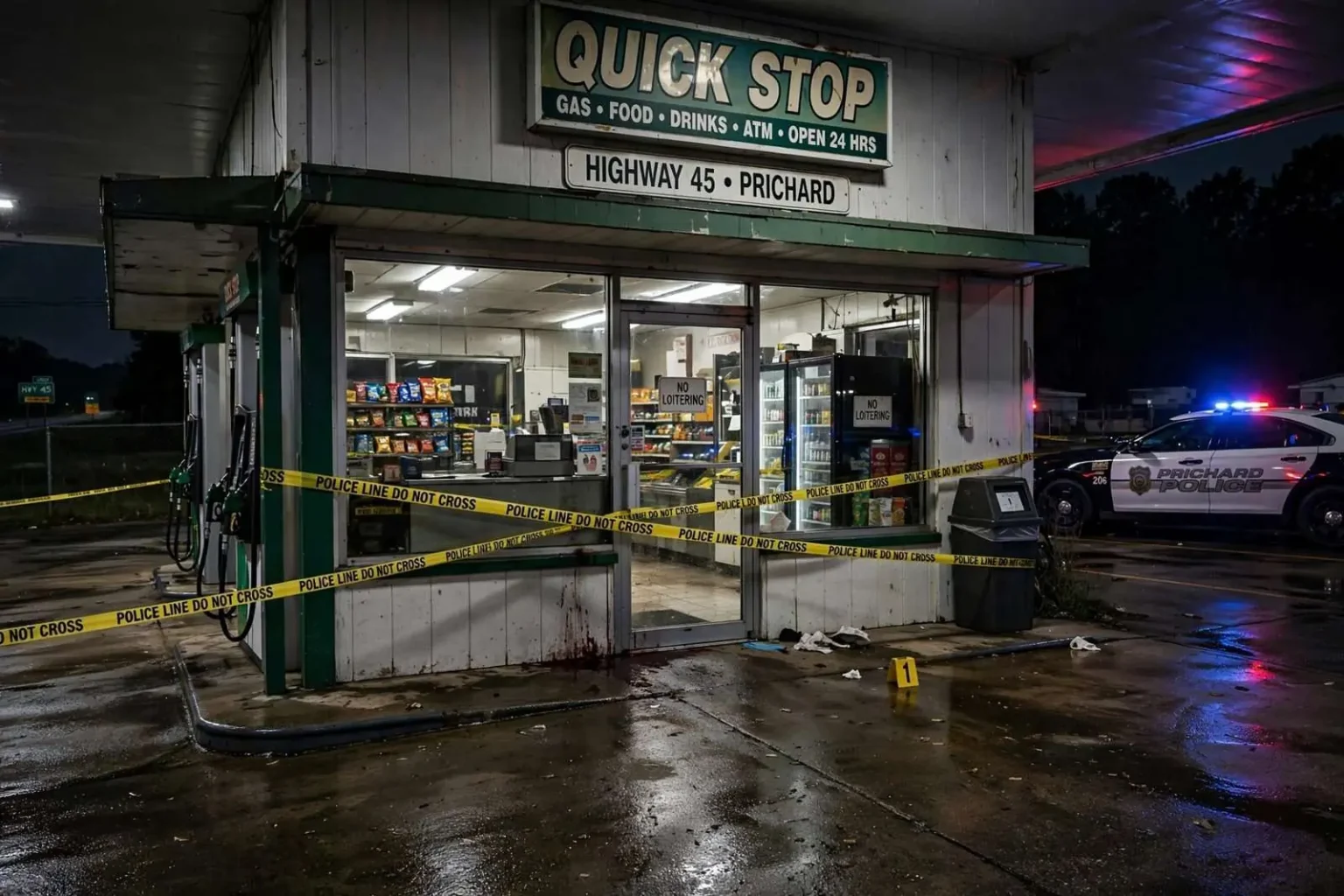
A 20-year-old woman and her fiancé were attacked at a gas station on Highway 45 in Prichard after a man claiming to know the woman confronted them inside the store and later returned with a tire iron, according to the victim. The woman, who asked not to be identified, said the man approached her and her fiancé inside the gas station, claiming she lived near a nearby Texaco and owed him $60. She said she repeatedly told him she did not know him and asked the store clerk to call 911. After about five minutes, the man left the store but returned shortly afterward armed with a tire iron. He struck the woman's fiancé in the back and then hit her in the head, causing a significant laceration.
"He swung at my head and busted my head open. There was blood everywhere," the victim said. She said the clerk refused to call police during the attack. "The girls and the guys were laughing and I kept telling him, 'Call 911,' and he said, 'I can't do that,'" the victim said. The couple went directly to the hospital for treatment of their injuries. When reporters visited the gas station following the incident, a clerk behind the counter said he was "not really" the manager and claimed to have no knowledge of the attack. The Prichard Police Department said the police report had not yet been completed and that the responding officer had three to five days to finalize it.
The victim said she provided police with a description of the attacker, but that information has not been publicly released. Anyone with information about the attack is asked to contact the Prichard Police Department. A NIGHT THAT TURNED VIOLENT The victim's account paints a disturbing picture of an ordinary stop at a Prichard gas station escalating into a brutal assault. According to her, a man she did not recognize approached her inside the store, insisted they were acquainted, and demanded $60 he claimed she owed. When she denied knowing him and asked for help, the situation only intensified.
His return minutes later with a tire iron – and the blows that followed – left her with a head wound severe enough that she described blood "everywhere." QUESTIONS ABOUT THE RESPONSE Among the most troubling elements of the victim's story is her claim that the store clerk declined to call 911 while the attack was underway. Whether a business has a legal duty to summon help varies by circumstance, but the episode has nonetheless raised questions in the community about what responsibility fell on those behind the counter that night. The clerk's later statement to reporters – disclaiming knowledge of the incident – adds a layer of uncertainty about what was known inside the store.
THE INVESTIGATION The Prichard Police Department has acknowledged the report but noted that the formal paperwork was still being finalized in the days after the assault, a routine window that allows the responding officer time to complete documentation. The victim said she supplied investigators with a description of her attacker, though authorities have not released it. As the case develops, detectives will likely review any available surveillance footage from the station and canvass for witnesses who were on the lot that evening. A CALL FOR INFORMATION Anyone who witnessed the assault or has information about the attacker is urged to contact the Prichard Police Department.
Background and Context
Tips from the public often prove decisive in identifying suspects in cases where the victim and perpetrator are not previously acquainted, as the victim in this instance maintains she was.
Institutional stakeholders including hospital, Police Department play pivotal roles in shaping the trajectory of community development across South Alabama These entities operate within a framework of state enabling legislation, federal grant programs, and intergovernmental agreements that determine everything from infrastructure investment priorities to environmental regulatory compliance The collaborative and sometimes competing mandates of these organizations create a complex governance landscape where decisions about land use, water quality, transportation corridors, and workforce development require sustained coordination across jurisdictional boundaries The historical development patterns of coastal and inland South Alabama reveal a
region in transition From the indigenous Creek and Choctaw territories through the colonial Spanish, British, and French periods, to the antebellum cotton economy, the timber boom of the late nineteenth and early twentieth centuries, and the post-World War II industrial expansion, each era has left its imprint on the landscape and communities Contemporary growth pressures—particularly along the Gulf Coast corridors of Baldwin and Mobile counties—intersect with longstanding rural character in ways that make planning and preservation conversations especially consequential for the region's future identity Local government operations in this part
of the state typically involve a layered structure of county commissions, municipal councils, and special-purpose districts that together deliver services ranging from road maintenance and solid waste collection to public safety and parks programming Revenue streams rely heavily on a mix of property taxes, sales and use taxes, gasoline taxes dedicated to transportation, and intergovernmental transfers from Montgomery and Washington For residents, the practical effect is that decisions made in county commission chambers and city halls—often on technically complex matters such as zoning variances, capital improvement programming, and emergency services
funding—directly shape daily quality of life, property values, and the long-term desirability of the region as a place to live and do business Civic participation in South Alabama communities frequently centers on neighborhood associations, volunteer fire departments, and faith-based organizations that supplement the formal work of government These grassroots structures often serve as the first point of contact for residents navigating local services, and they play an outsized role in disaster preparedness and recovery given the region's exposure to hurricanes and severe weather The durability of these networks—strengthened through repeated
Background and Context
cycles of response to storms such as Hurricane Sally in 2020 and Hurricane Zeta in 2020—has become a defining feature of regional resilience, reinforcing the social fabric that formal institutions alone cannot fully provide The cultural character of South Alabama blends deep Southern traditions with the distinct influences of Gulf Coast geography Storytelling, music, and foodways rooted in African American, Creole, and European heritages coexist with the contemporary rhythms of a region attracting new residents from across the country Festivals celebrating everything from bluegrass and seafood to Mardi Gras parades
in the Mobile tradition reflect a community that values both continuity and reinvention This cultural richness, alongside the area's natural assets such as white-sand beaches, freshwater rivers, and the biodiverse delta, underpins a quality of life that many residents cite as the primary reason they choose to stay or relocate to the region Transportation infrastructure serves as the circulatory system of the regional economy, linking ports, military installations, manufacturing sites, and tourism destinations Interstate 10 traverses the northern Gulf Coast, connecting the Mobile area to Pensacola, New Orleans, and beyond,
while the Baldwin County corridor has seen sustained investment in widening and interchange improvements to accommodate explosive population growth The proposed Interstate 10 Mobile River Bridge and Bayway project, the expansion of Mobile Regional Airport, and ongoing rail and short-line railroad improvements each represent multi-decade bets on connectivity that supporters argue are essential to maintaining the region's competitive edge Debates over funding mechanisms, tolling, and environmental impact continue to animate public discussion around these large-scale initiatives Healthcare delivery and educational attainment are increasingly recognized as twin pillars of regional prosperity
The University of South Alabama, the University of Mobile, Spring Hill College, and a network of community colleges and career technical schools anchor a developing health sciences and research cluster that complements the clinical care provided by the region's major hospital systems Access to primary care, mental health services, and maternal health support remains uneven across rural counties, prompting investment in telehealth, mobile clinics, and federally qualified health centers Coordinated efforts between K-12 systems, four-year institutions, and industry partners are producing a more seamless pathway from classroom to employment, addressing
long-standing gaps in workforce readiness The military and defense sector provides an outsized economic and cultural footprint across the Gulf Coast Naval Air Station Pensacola, NAS Whiting Field, Eglin Air Force Base, and the Mobile Coast Guard complex collectively account for tens of thousands of active duty, civilian, and contractor positions, while retired service members constitute a significant share of the population along the coastal corridor Defense spending and federal contracting opportunities ripple through local supply chains, supporting shipyards, aviation services, information technology firms, and construction trades Annual air shows,
change-of-command ceremonies, and veterans' events punctuate the regional calendar, reflecting the integration of military communities into the broader social fabric of South Alabama Tourism, recreation, and the outdoor economy are foundational to the South Alabama brand, drawing visitors to Gulf Coast beaches, Mobile Bay, the Tensaw Delta, and the historic streets of downtown Mobile and Fairhope White-sand beaches in Gulf Shores and Orange Beach support a robust hospitality and short-term rental market, while ecotourism opportunities including paddling, birding, and fishing attract nature travelers who increasingly seek out authentic, less-developed destinations.