Prichard Funeral Home Under Investigation Was Operating on Expired License
The Mobile County Sheriff's Office is investigating Heritage Funeral Home in Prichard over an expired license, burials and a possible illegal cemetery.
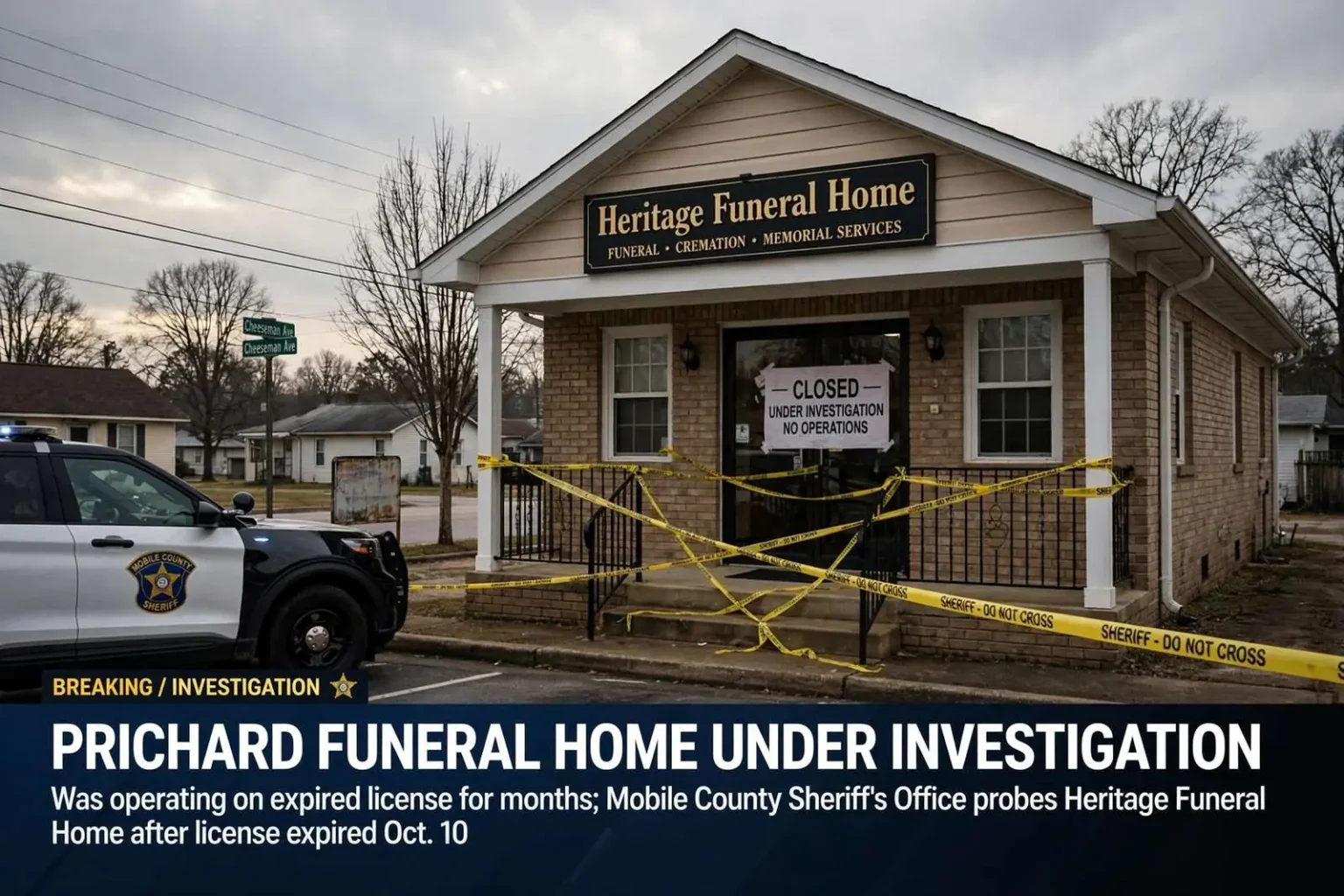
A Prichard funeral home under investigation by the Mobile County Sheriff’s Office was operating for months after its state license had expired, according to records reviewed in the case, raising questions about just how many families the business served while unlicensed.
Heritage Funeral Home’s license expired October 10, yet the business listed more than 130 obituaries on its website in the months that followed — a volume of services that investigators are now working to reconstruct as the criminal case against the home’s operator unfolds.
That gap between the license expiration and the continued operation of the business is at the center of the sheriff’s office’s inquiry, which began with complaints from families and expanded into a review of the funeral home’s records, its finances, and a piece of Prichard property that may have been used as an unauthorized cemetery.
The Operator Turns Himself In
Cedrick McMillian, who operates Heritage Funeral Home, turned himself in at Metro Jail Wednesday morning after investigators leveled a charge against him. Investigators said the charge stems from a violation of Alabama’s SORNA law — the state’s version of the federal Sex Offender Registration and Notification Act — which barred McMillian, a registered sex offender, from working within 2,000 feet of a daycare.
The charge does not directly concern the funeral home’s burial practices, but its placement — a business operating near a childcare facility — put McMillian in violation of the residency and employment restrictions that apply to registered offenders in Alabama. Authorities have not detailed how long the alleged violation persisted.
Turning himself in rather than being arrested is a familiar path in cases where investigators notify an attorney ahead of time, and it suggested that McMillian, through counsel, was aware of the mounting investigation before he walked into the jail.
Families Raise Questions About Burials
The sheriff’s office also plans to interview McMillian about a possible illegal cemetery on Cheeseman Avenue in Prichard, a follow-up inquiry that emerged as deputies dug into the funeral home’s operations. Authorities have not released details about what was found on the property or how many burials may be involved.
Deputies raided the funeral home earlier this week after multiple families came forward saying they paid for caskets but were not certain their loved ones were buried in them. Those accounts — among the most serious allegations that can be made against a funeral business — triggered the search warrant and the broader review of Heritage’s records.
For the families involved, the uncertainty is agonizing: the possibility that a relative’s remains were not handled as promised strikes at both grief and trust, and investigators face the delicate task of verifying burials that may have occurred months or years ago.
One family that used Heritage for services this month said they were stunned to learn of the investigation, and that problems on the day of the service forced them to redo the viewing a second time — an unusual disruption that, in retrospect, the family said now looks like a warning sign of deeper trouble at the business.
The sheriff’s office has not said what additional charges, if any, may result from the cemetery and burial inquiries, leaving the criminal case in a holding pattern while investigators work through documents, property records, and witness interviews.
What an Expired License Means
Funeral homes in Alabama are regulated by the state, with licenses required to operate and periodic renewal requirements meant to ensure ongoing compliance with state standards for facilities, record-keeping, and the handling of remains. An expired license means a business is legally barred from providing the services it continues to advertise and sell.
More than 130 obituaries posted in the months after the October 10 expiration represent 130 or more families who may have paid for services from an unlicensed operator — a number that, if confirmed, would make the Heritage case one of the larger funeral home investigations in recent Alabama history.
Regulators and prosecutors treat continued operation on an expired license seriously because funeral service involves both consumer protection and public health rules: the handling, storage, and disposition of human remains are governed by state law precisely because mistakes and misconduct are so devastating to grieving families.
Prichard: The Setting of the Case
Prichard, a city of roughly 20,000 residents just north of Mobile, has faced decades of economic hardship, including a nationally notable pension crisis that pushed the city into bankruptcy in the 2000s. Its neighborhoods sit between Mobile and the industrial corridors of north Mobile County, and small, family-run businesses like funeral homes have long served as neighborhood anchors.
Cheeseman Avenue, where investigators are probing the possible illegal cemetery, runs through one of the city’s older residential districts. Unauthorized burials are rare but not unheard of in Alabama’s history, and resolving them requires investigators to establish what remains are interred, under what authority, and with what documentation — work that can involve coroner’s records, property deeds, and in some cases excavation.
Alabama’s SORNA Law and the Charge
The charge that brought McMillian to Metro Jail stems from Alabama’s adoption of SORNA, the Sex Offender Registration and Notification Act framework that governs where registered offenders may live and work. The law includes buffer zones — typically 2,000 feet — around schools, daycares, and other facilities where children gather, and working or residing within those zones is a criminal offense.
Enforcement of those buffer zones falls to local law enforcement, and violations are prosecuted as felonies under Alabama law. In this case, investigators determined that the funeral home’s location placed McMillian within the restricted distance of a daycare, turning a regulatory question into a criminal charge.
The charge gave the sheriff’s office a legal handle on McMillian while the more complex inquiries — the expired license, the families’ complaints, and the Cheeseman Avenue property — continued to develop. Additional charges in cases like this typically come in waves as investigators complete their work and present evidence to prosecutors.
How Funeral Home Investigations Unfold
Investigations of funeral businesses are among the most sensitive law enforcement undertakings, involving grieving families, human remains, and a regulatory record that may stretch back years. Deputies executing a search warrant at a funeral home must balance evidence collection with respect for the remains and records in their custody.
Typically, investigators will subpoena financial records to establish what families paid for, cross-reference burial and cremation logs with cemetery and coroner records, and interview families to build a picture of whether services were performed as promised. The obituaries published on the funeral home’s website serve as a public ledger of sorts, listing the names and service dates that investigators can use to reach families.
The families’ complaints that triggered the raid — paying for caskets without certainty that loved ones were buried in them — represent the gravest form of funeral home misconduct alleged in Alabama in recent memory. Proving such claims requires physical verification, which is why the Cheeseman Avenue inquiry matters so much to the overall case.
What Families Should Know
Authorities have encouraged any families who used Heritage Funeral Home’s services to come forward with contracts, receipts, and documentation of the services they purchased. In investigations of this kind, family accounts are often the decisive evidence, both for prosecutors building charges and for regulators working to protect consumers.
Families with concerns about a loved one’s burial can also request records from the cemetery involved and consult the state board that regulates funeral service in Alabama, which maintains licensing records and complaint histories. When a home operates unlicensed, contracts it signed may be void or unenforceable, complicating families’ attempts to recover payments — another reason regulators treat unlicensed operation as a serious offense.
The Community Impact in Prichard
News of the investigation has reverberated through Prichard’s close-knit neighborhoods, where funeral homes are trusted institutions and the names of the families they serve are known throughout the community. The allegations — families unsure whether their relatives are buried where they were told — have produced anger, grief, and demands for answers from city leaders.
Local pastors and community organizations have called for a thorough accounting, and families who used Heritage have begun comparing notes about the services they received. The account of one family forced to redo a viewing a second time has circulated widely as a symbol of the disarray investigators allege they found inside the business.
The case also renews attention on oversight of Alabama’s funeral industry, which is regulated at the state level but relies heavily on complaints to trigger investigations. The Heritage case began, like most, with families speaking up — a pattern investigators hope will continue as more people learn of the inquiry.
What Comes Next
The interview of McMillian about the possible illegal cemetery on Cheeseman Avenue is the next major step, followed by the sheriff’s office’s decisions about additional charges in consultation with the district attorney’s office. The expired-license findings and the families’ complaints about burials could each support separate counts, meaning the eventual case file may be substantially larger than the SORNA violation that started the jail paperwork.
For now, Heritage Funeral Home is not operating, and the families it served during the unlicensed period are left to piece together what was promised and what was done. The sheriff’s office has pledged to keep the public informed as the investigation progresses — a commitment that, for the more than 130 families reflected in those obituaries, cannot come soon enough.
The case stands as a stark reminder of why funeral service is licensed and regulated at all: families at their most vulnerable place their loved ones, their money, and their trust in the hands of a business, and the law’s most basic promise is that the person taking that trust is qualified, accountable, and watching over the dead as promised.