Prichard Mayor Carletta Davis Seeks State Funding to Restore Prichard Stadium
Prichard Mayor Carletta Davis is pursuing a state environmental assessment that could open the door to funding for a Prichard Stadium restoration.
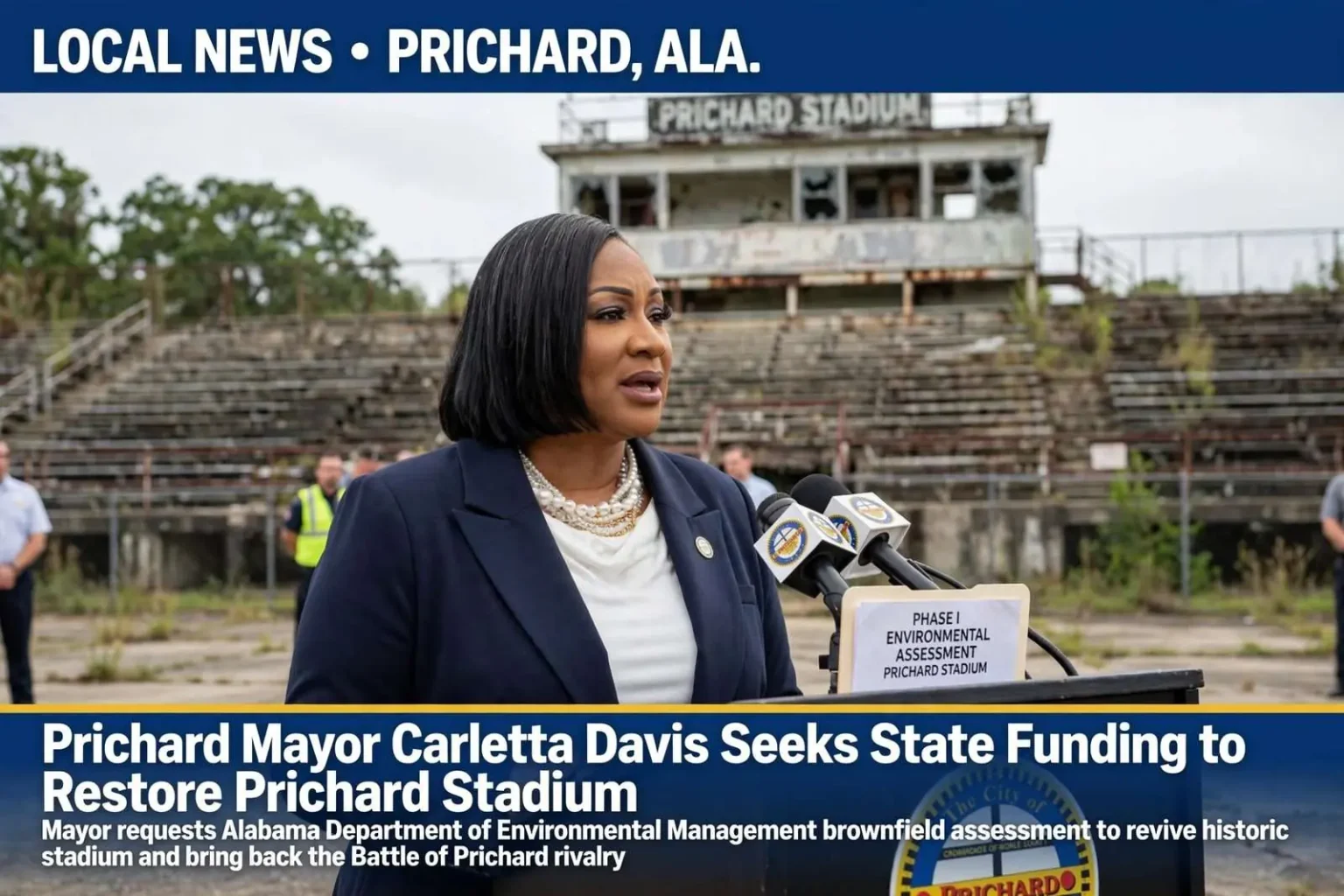
PRICHARD, Ala. — Prichard Mayor Carletta Davis says she wants the state of Alabama to help fund a restoration of Prichard Stadium, with hopes of eventually restoring the annual “Battle of Prichard” football rivalry between Blount and Vigor high schools to the venue.
In a video posted to Facebook, Davis said she has contacted the Alabama Department of Environmental Management about conducting a Phase I environmental assessment of the stadium property. That assessment could qualify the site for a brownfield designation, a status that identifies environmental and development challenges at a property and can open the door to state financial support for cleanup and redevelopment.
“This is only the beginning,” Davis said in the post, “but every restoration starts with a first step. Prichard Stadium has been an important part of our history, and I believe it can be part of our future, too.”
The announcement marks the most concrete step yet by city leadership toward addressing a facility that once anchored community life in Prichard and now sits largely idle. By beginning with an environmental review rather than a construction proposal, the mayor’s office is following a sequence familiar to redevelopment professionals: document the site’s condition first, then pursue the funding streams that become available once that documentation exists.
What a Brownfield Designation Means
A brownfield designation typically allows municipalities to pursue state and federal grant programs aimed at returning idle or underused properties to productive use, often as a first formal step before larger redevelopment funding becomes available. The designation itself does not clean up a site or fund construction, but it formally catalogs environmental and development obstacles — from soil and groundwater concerns to aging infrastructure — and puts a property on the map for assessment grants and cleanup support.
The Alabama Department of Environmental Management administers environmental assessment and cleanup programs in partnership with federal agencies, and communities across the state have used the process to convert shuttered industrial parcels, old schools and vacant public facilities into new uses. For a city like Prichard, which has worked for years to attract reinvestment with a limited budget, the pathway matters: a documented, state-recognized assessment gives funding agencies a defined project to consider rather than a general request.
Davis’ office has not released a timeline for when the environmental assessment might be completed or when a broader restoration plan could be presented to the city council. Environmental assessments of this type generally involve records review, site inspection and, where warranted, sampling work, and the findings shape what any eventual restoration would need to address.
The Battle of Prichard
The Battle of Prichard rivalry between Vigor High School and Blount High School has long been one of the most storied local matchups in Mobile County football, and Davis’ comments suggest city leadership sees reviving the venue as tied to restoring that tradition. For generations of Prichard families, the annual game was more than a football contest — it was a citywide homecoming that filled the stands with alumni from both schools and gave the community a shared event on the fall calendar.
Blount and Vigor high schools have played their annual “Battle of Prichard” football game at Ladd-Peebles Stadium since at least 2020 because of long-standing issues with Municipal Stadium’s facilities. The move to Ladd-Peebles kept the rivalry alive but moved it out of the city whose name it carries, sending ticket revenue, concession sales and the game-day atmosphere across town to Mobile.
In a 2020 letter to city leaders, then-Vigor principal Gerald Cunningham said the school would not host games at the stadium until its scoreboard, sound system and other issues were repaired, calling conditions there “extremely embarrassing.”
“Every time we host an out-of-town team, I find myself humbly apologizing to the principal or his/her designee because of the subpar condition of the stadium,” Cunningham wrote.
A Stadium’s Role in a City’s Life
Prichard Stadium has served the city as a gathering place for football games, band exhibitions, graduations and community events across the decades, and its decline has been felt well beyond the athletic calendar. When a city’s signature public facility falls into disrepair, residents see the message in it, and city leaders have often found that restoring such a landmark does as much for civic confidence as for recreation.
The mayor’s framing of the restoration as history and future intertwined speaks to that. Prichard, a city of neighborhoods just north of Mobile, has weathered significant economic challenges over the decades, and its leadership has pursued a range of redevelopment and public safety initiatives aimed at stabilizing the city’s finances and rebuilding its tax base. A working stadium would give the city back a venue for youth sports, high school athletics and large community gatherings that currently have to travel elsewhere.
Restoration advocates in cities across Alabama have similarly argued that public stadiums and school facilities function as economic anchors: game nights bring crowds that support nearby businesses, and functioning venues help schools and community groups host events without rental fees and travel to other municipalities.
Why the Schools Left
The conditions Cunningham described in his 2020 letter — a failed scoreboard, an inadequate sound system and a list of other unresolved maintenance issues — illustrate the practical gap between the stadium’s past role and its recent condition. High school football is a Friday night production that depends on working infrastructure: functioning lights, operable restrooms, safe bleachers, a public-address system that can broadcast rosters and announcements, and a scoreboard that keeps fans informed.
When any of those elements fail, schools face a choice between playing in conditions they consider embarrassing and taking their games to a venue that works. Blount and Vigor chose Ladd-Peebles Stadium, Mobile’s long-standing large-capacity football venue, ensuring that the rivalry survived even as its home sat in limbo. But each season played away from Prichard reinforces the gap the mayor now wants to close.
Davis’ comments suggest city leadership views the environmental assessment as the mechanism that reconnects those threads — the stadium’s restoration, the rivalry’s return and the broader revitalization of a property the city already owns.
How State Funding Pathways Work
The sequence Davis has begun — assessment first, designation second, funding requests third — mirrors how brownfield redevelopment typically unfolds in Alabama. A Phase I assessment establishes what is known and unknown about a property’s environmental condition. If the findings warrant it, a site can move into state and federal programs that help pay for cleanup planning and, eventually, the cleanup itself. Only after those steps do larger capital projects, such as stadium reconstruction, become candidates for the grant programs and appropriations that require documented site conditions.
The approach also reflects a fiscal reality for small cities: restoration projects compete for limited state dollars, and applications backed by completed assessments, clear scopes of work and demonstrated local commitment stand a better chance than aspirational requests. By starting with ADEM, Davis has positioned Prichard Stadium as a project moving through the formal pipeline rather than a wish list item.
No cost estimate for a full restoration has been made public, and city officials have not said what elements a restored stadium would include beyond addressing the facility issues that drove the schools away. The scoreboard, sound system and general repair needs Cunningham outlined in 2020 remain the most specific public list of the facility’s deficiencies.
What Comes Next
For now, the city awaits the assessment process it has set in motion, and residents of Prichard await word on whether the stadium that once hosted the Battle of Prichard can realistically be returned to service. Davis’ message to the community — that every restoration starts with a first step — frames the environmental review as exactly that: a first step on a path the mayor hopes leads back to Friday nights in Prichard, with Blount and Vigor on the field and the stands full again.
A Rivalry Worth the Effort
High school rivalries of the Battle of Prichard’s vintage are rare assets, and communities that lose them to failing facilities often spend years trying to get them back. The matchup between Blount and Vigor draws families with generations of allegiance on both sides, and its annual return is the kind of tradition that binds a city’s identity together. Keeping the game at Ladd-Peebles preserved the contest itself, but every season away from Prichard dilutes the hometown character that made the rivalry what it was.
The venue question also reaches down to younger players. Middle school and youth football programs in the area typically look up to the high school stadiums where the city’s best-known games are played, and a restored Municipal Stadium would give youth leagues, middle school teams and marching bands a local stage that currently does not exist in workable condition.
Brownfield-driven restorations elsewhere in Alabama have followed a similar arc: an assessment identifies what a property needs, grant funding addresses the environmental and structural groundwork, and the finished site returns to public use in a form the original could not offer. Whether Prichard Stadium follows that path depends on the assessment results, the funding the city can assemble and the decisions the city council makes as a restoration plan takes shape.
What is clear from the mayor’s announcement is the order of operations. The state has been asked to help; the property is entering the environmental pipeline; and the city’s leadership has publicly tied the stadium’s future to the rivalry’s return. For the families, alumni and players who have followed the Battle of Prichard from one venue to another, the first step toward bringing it home is finally underway.