Prichard Plans Drive-Through Food Pantry Giveaway at A.J. Cooper Municipal Complex
Prichard and its Community Development Council will hold a drive-through mobile food pantry giveaway Saturday at the A.J. Cooper Municipal Complex.
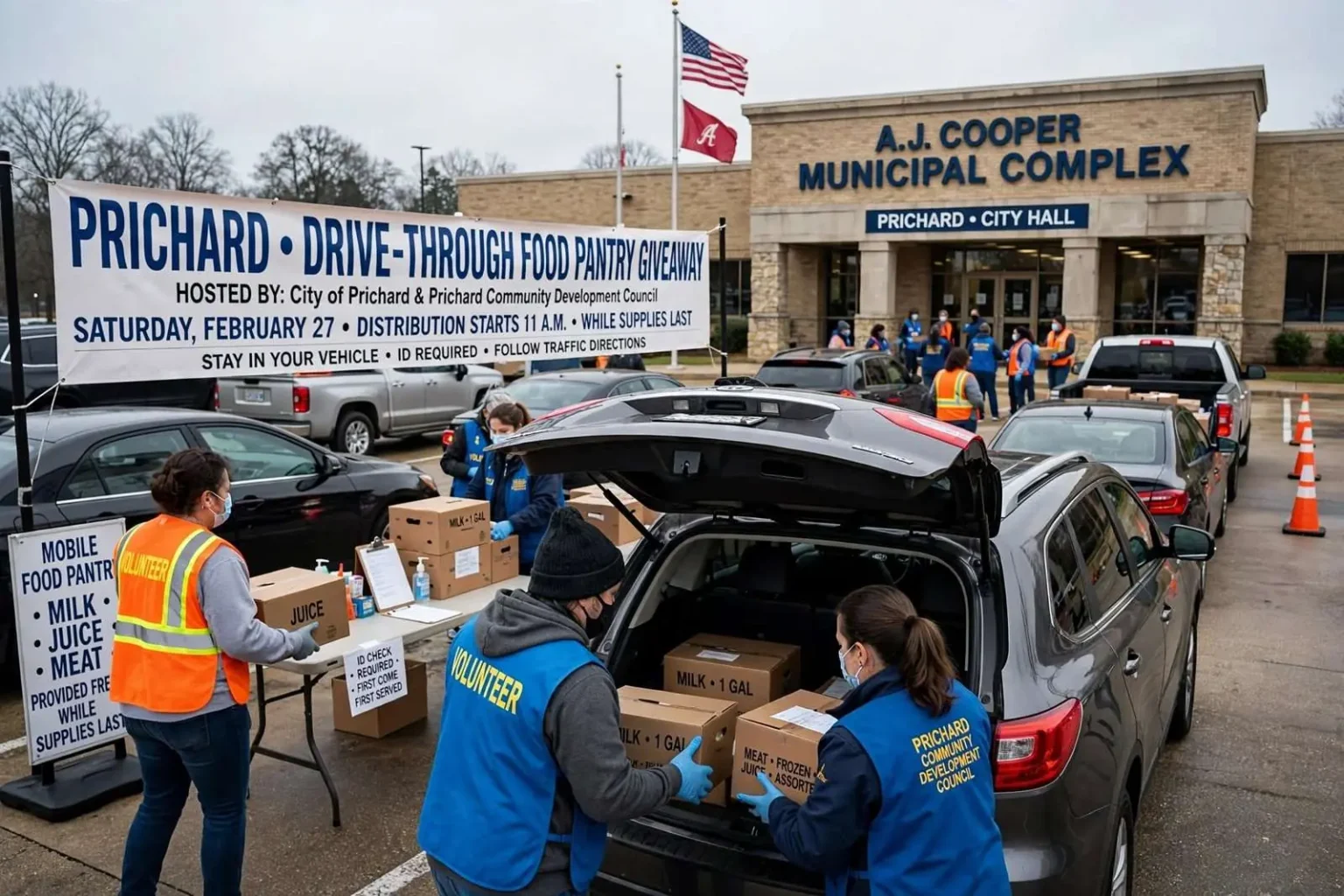
PRICHARD, Ala. — The City of Prichard and the Prichard Community Development Council are teaming up for a mobile food pantry giveaway set for 11 a.m. Saturday, February 27, at the A.J. Cooper Municipal Complex.
Organizers plan to hand out a truckload of milk, juice and assorted meats on a first-come, first-served basis while supplies last. Residents will need to show identification to receive food.
The distribution will run as a drive-through operation: families stay inside their vehicles and follow the line while city staff and volunteers load the groceries for them, an approach meant to keep the line moving and limit close contact during the pandemic.
Mobile pantry events of this kind have become a fixture of life in cities like Prichard over the past year, as the economic fallout of the coronavirus pandemic pushed demand for food assistance well beyond what local food shelves typically see. Loading groceries directly into trunks and truck beds keeps the process fast and lets volunteers serve hundreds of households in a matter of hours without anyone leaving their car.
City officials have encouraged residents who need food to arrive early, since a single truckload is finite and the line at drive-through giveaways regularly forms well before the advertised start time. Residents should also have their identification ready to show when they reach the distribution point.
Prichard and the challenge of food access
Prichard, a city of roughly 19,000 people in northern Mobile County, sits between Mobile and Chickasaw along the U.S. Highway 45 corridor. It is one of the older communities in the region, built up in the mid-20th century around shipbuilding and industrial jobs, and like many such cities it has worked for years against the effects of disinvestment, an aging housing stock and the loss of neighborhood grocery stores.
When full-service grocers pull out of a city, residents are left to travel for fresh food or rely on corner stores with limited selections and higher prices, and perishables like milk and fresh meat become the hardest items to keep on hand. That is why the menu for a giveaway like Saturday’s matters as much as the quantity: milk, juice and meats are staple proteins and staples of a household refrigerator that food-insecure families most often go without.
Pandemic-era conditions sharpened those long-running gaps. Job losses, reduced hours and school closures that cut off children’s access to school meals all combined to strain household food budgets, and community organizations across Mobile County responded by scaling up mobile distributions throughout 2020 and into the following year.
How a mobile food pantry works
The mobile pantry model is simple: a truck loaded with food arrives at a set location, and volunteers set up a line of traffic rather than a line of people. At the A.J. Cooper Municipal Complex, drivers will follow the route marked out by staff, and volunteers will walk the line taking down information and loading boxes of milk, juice and meat directly into each vehicle.
The format offers advantages beyond infection control. Elderly residents and people without reliable transportation can be served by a relative or neighbor driving them through, and households do not have to stand in a parking lot for an hour in whatever the weather brings. The first-come, first-served structure also means there is no application process at the window — just the identification organizers request — which removes one of the barriers that keeps some families from seeking help.
Organizers generally ask participants to follow a few courtesies: stay in the vehicle at all times, keep engines off in line when directed, and open the trunk or back window when volunteers approach so food can be loaded without face-to-face contact.
The A.J. Cooper Municipal Complex
The giveaway site is a fitting one for a citywide event. The A.J. Cooper Municipal Complex serves as Prichard’s civic center, housing city government functions and hosting public meetings, community programs and emergency-related distributions. It bears the name of A.J. Cooper, the longtime mayor who led the city for much of the late 20th century and remains one of the most prominent figures in Prichard’s history.
Situated along city thoroughfares with parking and drive space to spare, the complex can accommodate the kind of vehicle queue a drive-through distribution requires. City staff are familiar with the logistics from prior events, having staged distributions and public services there during the pandemic, and the location is easy for residents across the city to reach.
For residents unfamiliar with the site, organizers typically advise entering the line the way signage directs and following police or volunteer traffic control, both to keep the queue orderly and to avoid blocking nearby streets.
The Prichard Community Development Council
Partnering with the city is the Prichard Community Development Council, a community-based organization focused on improving quality of life in the city. Organizations of this type work on the ground between government services and residents, coordinating donations, volunteers and programs, and their local knowledge is what turns a donated truckload of food into an orderly distribution that reaches the households that need it.
Partnerships between city hall and community organizations have defined much of the pandemic response in small cities across Alabama. Municipal government brings staff, equipment, traffic control and a trusted point of public communication; the community partner brings volunteers, fundraising reach and relationships with the families who most need the help. Neither alone can put together a citywide giveaway on short notice.
Events like Saturday’s also serve a second purpose that organizers rarely emphasize: they connect residents to resources beyond the day’s groceries. Households that show up for a food distribution often learn about utility assistance, senior programs, health screenings and other services offered through the same network of organizations.
What residents should know before Saturday
The giveaway begins at 11 a.m., but the practical advice from organizers of events like this is consistent: come early, come in a vehicle, and bring identification for the person receiving the food. Supplies are limited to the single truckload, so once the food runs out, the line closes even if some cars are still waiting.
Residents should expect the process to move quickly once it starts. Volunteers load the food for them, so there is no need to leave the car or help carry boxes, and the drive-through design keeps everyone moving through in a steady stream rather than idling for long stretches.
Anyone with questions about the distribution — eligibility, the location’s entrance, or what items will be included — can contact Prichard City Hall, which has publicized the event through its regular channels. City officials and the Community Development Council have said the effort is part of ongoing work to support residents through the pandemic, and similar distributions have been staged as food and funding allow.
For a city that has weathered hard economic decades with its community institutions intact, a Saturday morning line of cars winding through the A.J. Cooper Municipal Complex parking lot is a familiar sight by now — and, organizers hope, a sign of a network that will keep working for Prichard families long after the pandemic ends.
Volunteers make the distribution work
Behind every drive-through pantry is a corps of volunteers, and Saturday’s event is no exception. City staff will direct traffic and manage the line, while volunteers from the Community Development Council and partner groups will take down household information, carry boxes and load each vehicle. On distributions of this size, dozens of people work the line, many of them residents of the city itself.
Volunteering at a food distribution is also the way many people first see the scale of need in their own city. Organizers report that first-time volunteers frequently return, and that the events build the roster of helpers that makes future distributions possible.
The food itself typically arrives through regional food bank channels. A truckload giveaway means a partner truck has been loaded and routed to Prichard for the morning, with the cost of the food and transport covered through donations and organizational budgets — a reminder that every box handed through a car window on Saturday represents contributions from donors across the region.
Food security remains an ongoing effort in Prichard
One Saturday truckload will not resolve a city’s food-security needs, and organizers do not pretend otherwise. What events like this do is bridge specific households through a hard stretch — a week’s worth of staples that frees up grocery money for bills — while the longer-term work of attracting grocers, supporting community gardens and strengthening the local economy continues in the background.
City leaders in Prichard have made a point of keeping residents informed about where and when help is available, publicizing distributions through city channels and encouraging churches and neighborhood associations to spread the word. That communication has been especially important for elderly residents and homebound families who may not see event notices online.
Residents who miss Saturday’s giveaway because of the supplies running out should not assume they have missed their only chance. Mobile distributions have recurred across Mobile County throughout the pandemic, and organizations including the Community Development Council have staged events in the city before. Keeping identification on hand and watching for the city’s announcements is the most reliable way to catch the next one.
For now, the essentials are the ones organizers stress every time: 11 a.m. Saturday at the A.J. Cooper Municipal Complex, stay in your vehicle, bring identification, and come early enough to reach the front of the line before the truck is emptied.