
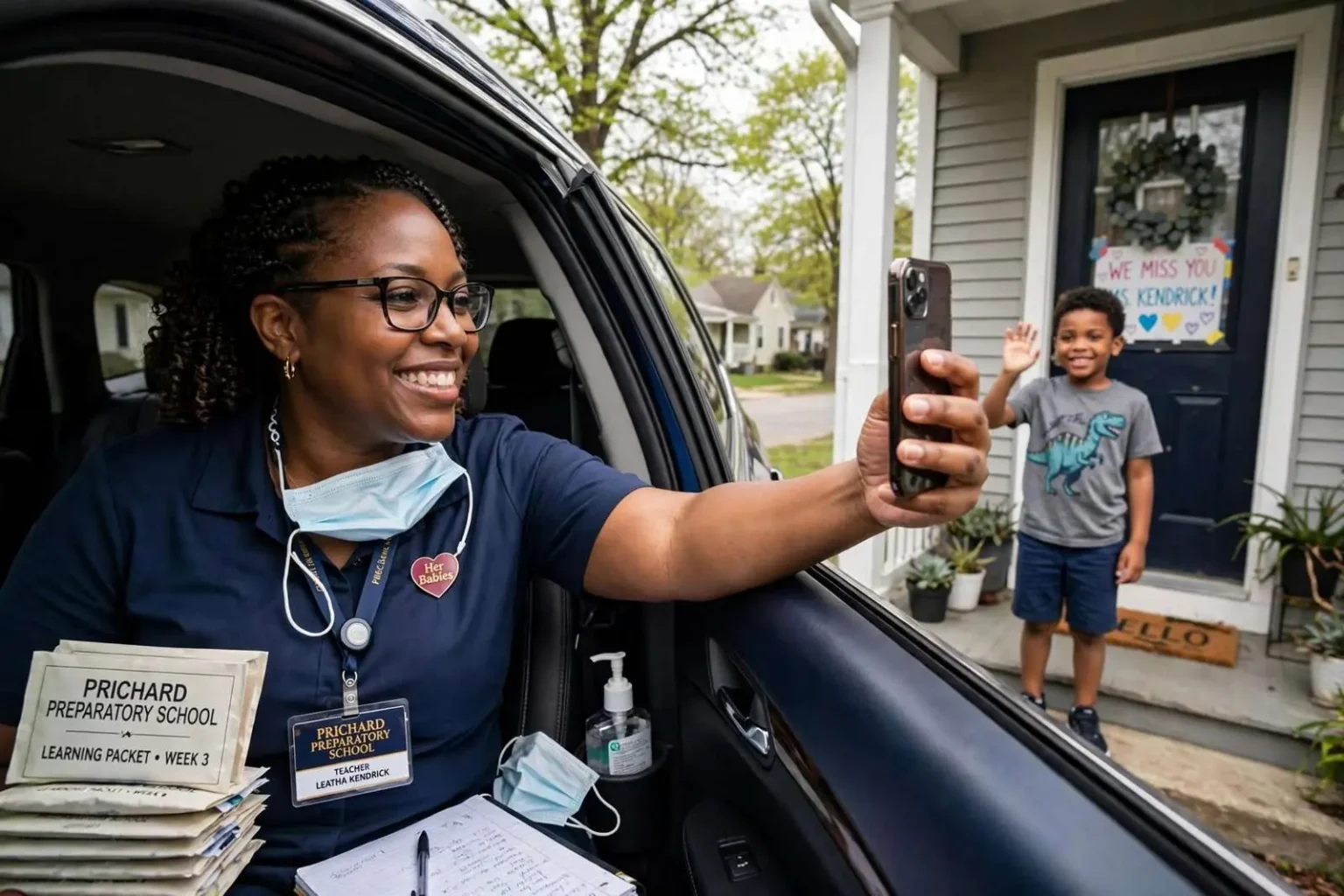
PRICHARD, Ala. — Leatha Kendrick, a teacher at Prichard Preparatory School, said staying away from her students during the coronavirus shutdown has been hard. With schools closed for what was then the third week, she was missing the children she calls “her babies” — and they, no doubt, were missing her too.
So Kendrick did what any teacher separated from her classroom by a pandemic might dream of doing: she got in her car and drove to her students’ homes to surprise them and let them know she was thinking of them. She could not greet them with a hug under social-distancing guidance, but a big smile and a selfie taken from her car window made their day, one porch and one driveway at a time.
A School Year Interrupted
The coronavirus shutdown that emptied Alabama’s classrooms in March 2020 left teachers across the state scrambling to reinvent their work overnight. Lesson plans written for a shared classroom had to be rebuilt for screens and paper packets, and the daily rhythms of attendance, recess, and read-alouds disappeared in the space of a weekend. What teachers reported missing most, though, was rarely the curriculum — it was the children.
By the third week of the closure, the novelty of remote learning was wearing thin for students and teachers alike. Young children in particular struggled to understand why school had stopped, why they could not see their friends, and why the adults in their lives were suddenly keeping everyone at arm’s length. Kendrick’s drive-by visits answered those questions in the most direct way possible: her students saw, with their own eyes, that their teacher had not forgotten them.
Prichard and Its School
Prichard Preparatory School serves the city of Prichard, a community just north of downtown Mobile in Mobile County. Prichard has faced decades of economic challenges, and the school’s mission centers on giving its students a rigorous, supportive education that opens doors regardless of family circumstances. Small class sizes and close relationships between teachers and families are part of the school’s identity — the kind of environment where a teacher knows every child by name and where “her babies” rings true.
The shutdown hit communities like Prichard especially hard. Families there were more likely to lack reliable internet access for remote learning, more likely to include essential workers who could not stay home, and more likely to feel the economic shock of closures that swept through the Gulf Coast in the spring of 2020. In that context, a familiar face showing up in the neighborhood carried meaning well beyond a photo opportunity.
Social Distancing Changes the Script
The visits required a new script. Under public health guidance issued as the virus spread across Alabama, teachers could not knock on doors, hand out materials, or embrace their students. Kendrick kept her distance, waving and smiling from the car window and capturing selfies with students who came out to see her — small gestures that preserved the connection while honoring the rules meant to slow the virus.
Health officials at the time were urging residents statewide to stay at least six feet apart, wash hands frequently, and avoid gatherings, guidance that reshaped everything from grocery runs to funerals. For school communities, it meant that the simplest expressions of care — a high-five, a hug, a desk-side word of encouragement — were suddenly off the table, and teachers had to find creative substitutes.
Teachers Across Mobile County Adapt
Kendrick’s visits were a small, personal version of what teachers across Mobile County were doing while campuses were shut down. Educators recorded read-aloud videos, mailed letters and care packages, drove through neighborhoods with signs and honking horns, and kept in touch with families by phone and text. School districts distributed learning packets and meals, and teachers worked to keep students engaged from a distance that none of them had chosen.
Alabama’s statewide school closures, ordered in mid-March 2020 and later extended through the end of the school year, meant students would not return to their classrooms before summer. The distance learning that replaced in-person instruction varied widely from household to household, and teachers like Kendrick became, for many families, the most visible sign that the school itself still existed — still cared, still counted them in.
Why the Small Gestures Matter
Child development researchers have long noted that young children cope with disruption through relationships as much as through routine. A familiar teacher’s face, even across a car window, provides reassurance that the world still holds predictable, caring people. For a first grader or a kindergartner whose entire school year ended abruptly, that reassurance can ease anxiety that children that age often cannot put into words.
Teachers, too, have been coping with the loss of their classrooms. Many describe the shutdown as a kind of grief — the abrupt loss of daily purpose and of the children who give the work its meaning. Kendrick’s decision to get behind the wheel and visit her students’ streets worked on both ends of that relationship at once, giving her students a surprise and giving herself the contact she was missing.
The Wider Story of Spring 2020
The scene in Prichard was repeating across the Gulf Coast that spring. Mobile County’s public schools, the largest district in Alabama, shuttered campuses along with the rest of the state, and private and charter schools did the same. In neighborhoods throughout Mobile, Prichard, Saraland, and the surrounding communities, drive-by teacher parades, porch photos, and yard signs became the season’s signature images, substitutes for the endings a normal school year would have provided.
The closure also transformed how schools fed their students. Districts across the state organized meal pickups at school sites and bus-route drop-offs, recognizing that for many children school meals are a daily necessity. Teachers and staff volunteered to pack and distribute those meals, another thread in the makeshift safety net that schools became almost overnight.
Looking Toward an Uncertain Fall
As spring turned toward summer, Alabama educators and families were left to wonder what school would look like when classrooms reopened. State officials weighed remote options, staggered schedules, and health protocols, while teachers like Kendrick prepared for whatever came next. The one certainty was that the relationships built between teachers and students would be the foundation of whatever form school took.
For now, the students of Prichard Preparatory School have a story to tell about the spring they learned at home — and the day their teacher drove down their street, rolled down her window, and proved that “her babies” was never just a saying. The selfies from that afternoon now sit on family phones across the neighborhood, small tokens of a year when a smile from a car window was enough to make a child’s day.
Distance Learning in the Early Weeks
The third week of the shutdown marked a turning point in how schools approached remote instruction. In the first days after campuses closed, districts focused on triage — making sure students had devices, packets, and meals. By the third and fourth weeks, the effort shifted toward establishing genuine routines: scheduled video lessons, posted assignments, and regular check-ins between teachers and families. Teachers found themselves learning new software in real time, often while managing their own children at home.
For elementary teachers, the challenges were distinctive. Younger students cannot sit through long video sessions or manage online platforms without adult help, which puts parents in the role of classroom aide. Teachers responded with shorter lessons, recorded videos that families could watch at convenient times, and generous flexibility on deadlines — an approach built on the recognition that every household’s circumstances were different.
The Role of Parent Communication
Regular contact between teachers and families became the backbone of remote schooling. Teachers sent weekly updates, held phone conferences, and answered questions about assignments well into the evenings. The families that stayed in closest contact with their children’s teachers generally navigated the shutdown most successfully, a lesson educators carried with them into the next school year’s planning.
Kendrick’s home visits took that communication to its most personal expression. Rather than waiting for a scheduled video call, she brought the connection to her students’ front yards, giving parents a chance to speak with her directly and giving children a memory that no worksheet could provide.
Prichard’s Resilient Spirit
Prichard has weathered more than its share of hardship over the decades, from economic disinvestment to municipal financial troubles, and its residents have built a reputation for resilience and community self-reliance. The response to the pandemic followed that pattern: churches organized food distributions, neighbors checked on elderly residents, and schools worked to stay tethered to the families they serve.
In that setting, a teacher’s drive down a residential street was more than a feel-good story. It was a demonstration of the bond that holds a small school community together when the building itself is closed — evidence that the school’s culture lives in its people, not in its classrooms. Students who saw their teacher wave from the car window saw the mission of Prichard Preparatory School made visible on their own block.
A Lasting Lesson
When schools eventually returned to normal operations, teachers across the region pointed to moments like these as reminders of what matters most in education. Technology, curriculum, and assessment all have their place, but the foundation is the relationship between the adult and the child. Leatha Kendrick’s trips through her students’ neighborhood put that foundation on display — and gave Mobile County one of the small bright spots of a difficult spring.


