Prichard Public Works Employee Finds Body Off Cochran Road
A Prichard Public Works employee found a body off Cochran Road Friday. Police are investigating; the man's identity and cause of death have not been.
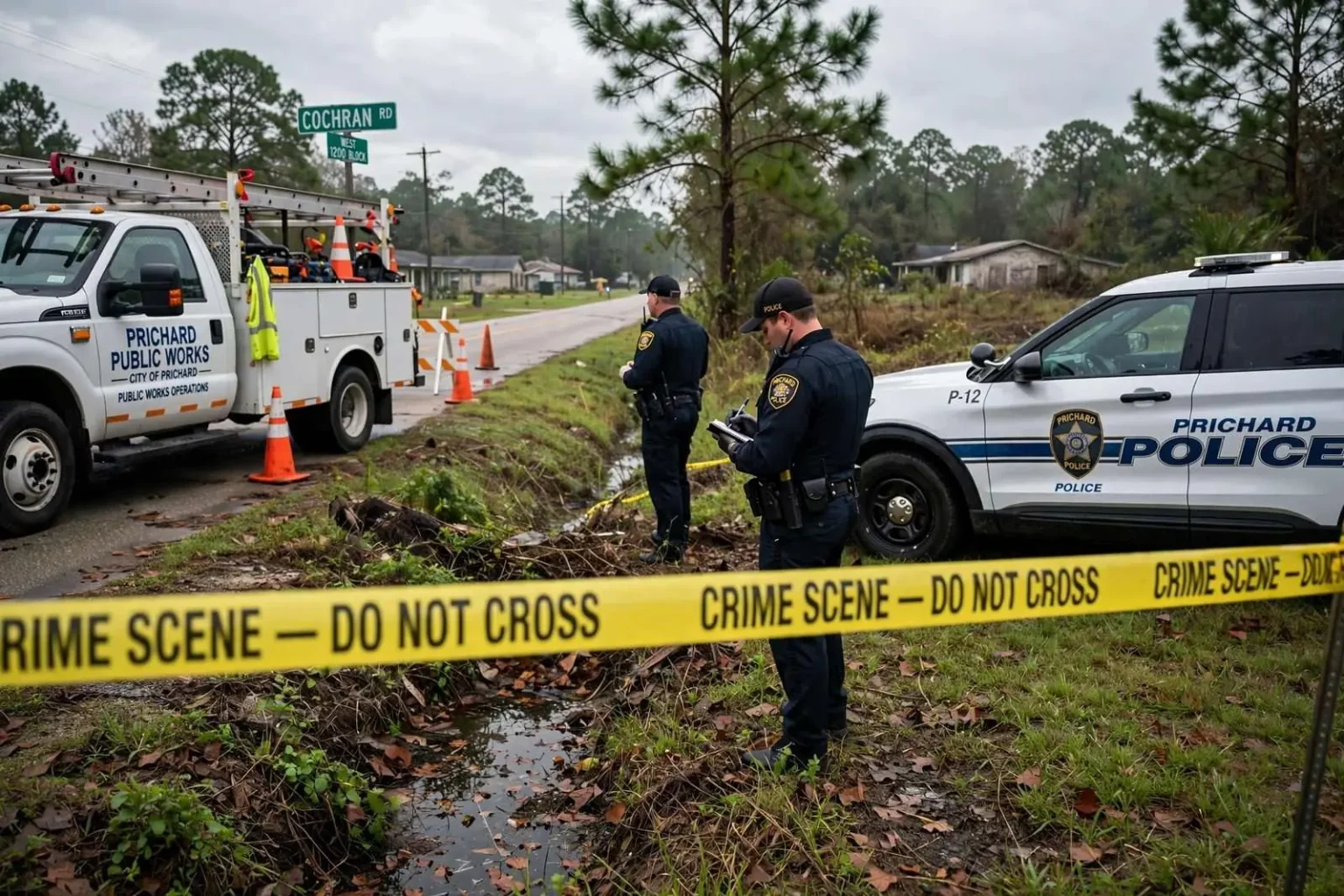
PRICHARD, Ala. — A routine morning of municipal work took a grim turn Friday when a Prichard Public Works employee discovered a body off Cochran Road, prompting an investigation by Prichard Police into the man’s death.
The employee, who was in the area performing duties connected to the city’s public works operations, came upon the body and immediately called Prichard Police to the scene. Officers responded and secured the location as they began the process of documenting the scene and working to establish the circumstances of the discovery.
As of Friday, authorities had not released the man’s identity or the cause of death. That silence is standard practice in the early stages of an investigation, particularly before family members have been located and notified. Police departments in Mobile County and across Alabama typically withhold the names of deceased individuals until next of kin can be reached, and they avoid speculating publicly about a cause of death until medical examiners have completed their work.
The discovery added Prichard to a list of South Alabama communities confronting unexplained deaths in public or semi-public spaces, cases that place significant demands on smaller municipal police departments. Investigators in situations like this work to answer a sequence of basic questions: who the person was, when they died, whether anyone else was involved, and whether the death resulted from foul play, an accident, a medical event, or something else entirely.
How the Morning Unfolded
Public works crews begin their days early, often before sunrise, and they work in the less visible corners of a city — drainage ditches, utility rights-of-way, road shoulders, and vacant lots that regular traffic passes without a second glance. Those out-of-the-way areas are precisely why public works employees are sometimes the first to encounter things that no one else has reported.
That dynamic appears to be what played out on Friday. The employee’s discovery off Cochran Road led directly to the call to Prichard Police, and the department’s response set the investigation in motion. First responders arriving at a death scene face a disciplined checklist: confirm that the individual is beyond help, protect the area from disturbance, photograph and document everything in its original condition, and begin canvassing for anyone who may have seen or heard something relevant.
The area off Cochran Road, like many corridors on Prichard’s west side, combines residential stretches with commercial parcels, wooded tracts, and drainage features. Terrain of that kind can conceal a great deal, and it can also complicate an investigation, because foot traffic in such areas is sporadic and witnesses are few. Investigators often spend the first hours simply establishing the boundaries of what is known.
The City of Prichard and Its Police Department
Prichard sits in Mobile County, just north of Chickasaw and northwest of Mobile proper, making it part of the greater Mobile metropolitan area. Once a bustling industrial city whose population climbed past forty thousand in the mid-twentieth century, Prichard has faced decades of economic and demographic change that have strained its municipal finances and its public services. Today the city’s population is a fraction of its peak, but it remains a community of long-established neighborhoods, churches, and families with deep roots.
The Prichard Police Department operates with the resources of a mid-sized municipal agency in a small city. Departments of that scale handle the full range of calls that larger agencies do — from traffic accidents and property crimes to death investigations — but with fewer investigators, less specialized equipment, and heavier reliance on outside partners when cases grow complex. A death investigation of uncertain cause is among the most demanding types of cases any department handles.
In cases like Friday’s, municipal police typically work alongside the Mobile County authorities whose roles are defined by state law. The Mobile County District Attorney’s Office is notified when a death may involve criminal conduct. The Alabama Department of Forensic Sciences performs autopsies that establish the medical cause and manner of death, findings that can take days or weeks to finalize. Identification may depend on fingerprints, dental records, or other means when the deceased carries no documentation.
None of those steps is instantaneous, which is why police departments so often have little to say publicly in the first hours and days. Early statements can compromise an investigation or cause pain to a family that has not yet been reached, so investigators generally confirm only the bare facts — that a body was found, where, when, and that the death is under investigation — exactly the posture Prichard authorities maintained through Friday.
Public Works: The City’s Eyes in Unlikely Places
The discovery also highlighted the underappreciated role that municipal public works employees play in city life. Crews responsible for streets, drainage, sanitation, and grounds maintenance fan out across every part of a city, including the vacant lots, ditch banks, and utility corridors where problems accumulate unnoticed. They clear storm drains after heavy rain, cut grass on public property, patch potholes, and haul away debris.
Because of that reach, public works employees frequently serve as informal first reporters — spotting anything from dumping and water leaks to crash debris and, in cases like this one, far more serious discoveries. For the employee involved, coming upon a body is a jarring experience, and departments generally treat the discovery itself as part of the day’s events while investigators focus on the scene and the deceased.
Prichard’s public works operations reflect the realities of an older city with aging infrastructure. Drainage ditches line many streets, and keeping them clear is a constant task in a Gulf Coast climate where heavy rain arrives in torrents. Maintenance routes take crews down industrial remnants, residential side streets, and wooded edges of the city limits — the full geography of a place where a body could go undiscovered without the attention such crews provide.
The Investigation Ahead
In the hours after such a discovery, investigators work to reconstruct a timeline. They will seek to determine how long the body had been where it was found, using conditions at the scene, environmental factors, and the eventual autopsy findings. They will check for missing persons reports from Prichard, Mobile County, and surrounding jurisdictions that might match the man. They will canvass nearby homes and businesses for cameras and witnesses.
The autopsy and toxicology work performed by the Alabama Department of Forensic Sciences will be central to determining the cause and manner of death. Until those results arrive, and until the man’s identity is confirmed and his family notified, public statements from investigators will likely remain limited to updates that do not compromise the case.
For residents of the neighborhoods near Cochran Road, the sight of police activity on Friday raised the questions that such scenes always raise, and answers will come only as the investigation progresses. Prichard Police, like departments across the region, typically ask anyone with information relevant to an open death investigation to come forward, since even small details — a vehicle seen at an odd hour, a stranger walking through the area — can help investigators place the pieces of a timeline.
Friday’s discovery remains, for now, an open case with more questions than answers: a man found dead off Cochran Road by a city worker doing his job, an investigation underway, and a community waiting to learn who he was and what happened to him.
How Identification and Notification Work
Withholding a name, as Prichard authorities did through Friday, reflects procedure rather than secrecy. Before a law enforcement agency releases a deceased person’s identity, two things generally must happen: the person must be formally identified through reliable means, and the next of kin must be notified so that they do not learn the news from a broadcast or a headline. When identification depends on forensic methods, or when locating family takes time, the public wait can stretch past the first day.
Mobile County families who lose someone to an unexplained death often wait on the same sequence of steps: confirmation of identity, notification, and then the slow arrival of answers from the autopsy. The Alabama Department of Forensic Sciences handles medical examiner work for the region, and its findings on cause and manner of death — whether natural, accidental, suicide, homicide, or undetermined — become the official record on which any further legal action would rest.
That process moves at the pace of science rather than the pace of news cycles. Toxicology results in particular can take weeks. Departments bridge that gap by continuing to investigate quietly, running down leads from the scene while awaiting the forensic conclusions that will tell them what kind of case they have.
The Setting: Cochran Road and West Prichard
Cochran Road runs through the western portion of Prichard, an area of the city where residential streets, aging commercial strips, and undeveloped land sit close together. The corridor connects neighborhoods that have been part of the city since its industrial heyday, when workers at nearby plants and shipyards filled its homes. Decades of economic change have left their mark, with vacant parcels interspersed among occupied houses and active businesses.
Geography matters in a case like this. West Prichard’s mix of accessible roadway and undeveloped acreage means that areas just off the pavement can see very little routine traffic. Drainage channels and tree lines screen much of it from view. It is the kind of landscape where something out of the ordinary can go unnoticed until someone whose job takes them off the beaten path happens upon it — which is, by all appearances, exactly how Friday morning’s discovery occurred.
What Neighbors Can Expect in the Days Ahead
For the community around Cochran Road, the visible signs of the investigation — patrol cars, scene tape, investigators coming and going — will fade as the case moves from the field to the office. What follows is less dramatic but equally important: interviews, records checks, forensic analysis, and the patient work of building a factual account of what happened.
Police departments generally ask for the public’s help in exactly these cases. Anyone who noticed anything unusual in the area in recent days — a person, a vehicle, a sound — is encouraged to contact investigators, because information that seems trivial to a witness can be decisive to a detective. Tips can be provided even when a witness is unsure whether what they saw was connected to anything at all.
Meanwhile, the man whose body was found will be identified in due course, his family will be reached, and the findings of the forensic examination will establish what caused his death. Those outcomes will determine whether the case closes quietly as a personal tragedy or becomes something with broader legal consequences. Until then, Prichard authorities have confirmed only what can be confirmed: a discovery, a call, and an investigation that continued through Friday.
A City Long Familiar with Hard News
Prichard has weathered more than its share of difficult headlines over the decades, from economic dislocation to fiscal crisis, and its institutions — city government, churches, schools, and neighborhood networks — have developed a resilience that outsiders sometimes overlook. A death investigation of this kind touches that fabric directly: the person found was somebody’s son, somebody’s neighbor, someone who lived within the same web of relationships that holds the city together.
The circumstances also underscore the interlocking nature of municipal work. A public works employee’s attentiveness brought the discovery to light; a police department’s response set the investigative machinery moving; county and state forensic resources will supply the scientific answers. No single agency handles a case like this alone, and the small city’s ability to draw on the wider Mobile County system is what allows even its limited staff to conduct a competent investigation.
As of Friday, the facts available to the public remained few and simple. A Prichard Public Works employee found a body off Cochran Road on Friday morning. The employee called Prichard Police, who responded and began their work. The man’s identity and the cause of his death had not been released. In a case like this, those few facts are the honest sum of a first day — and the rest will be learned, as such cases always are, one confirmed detail at a time.