
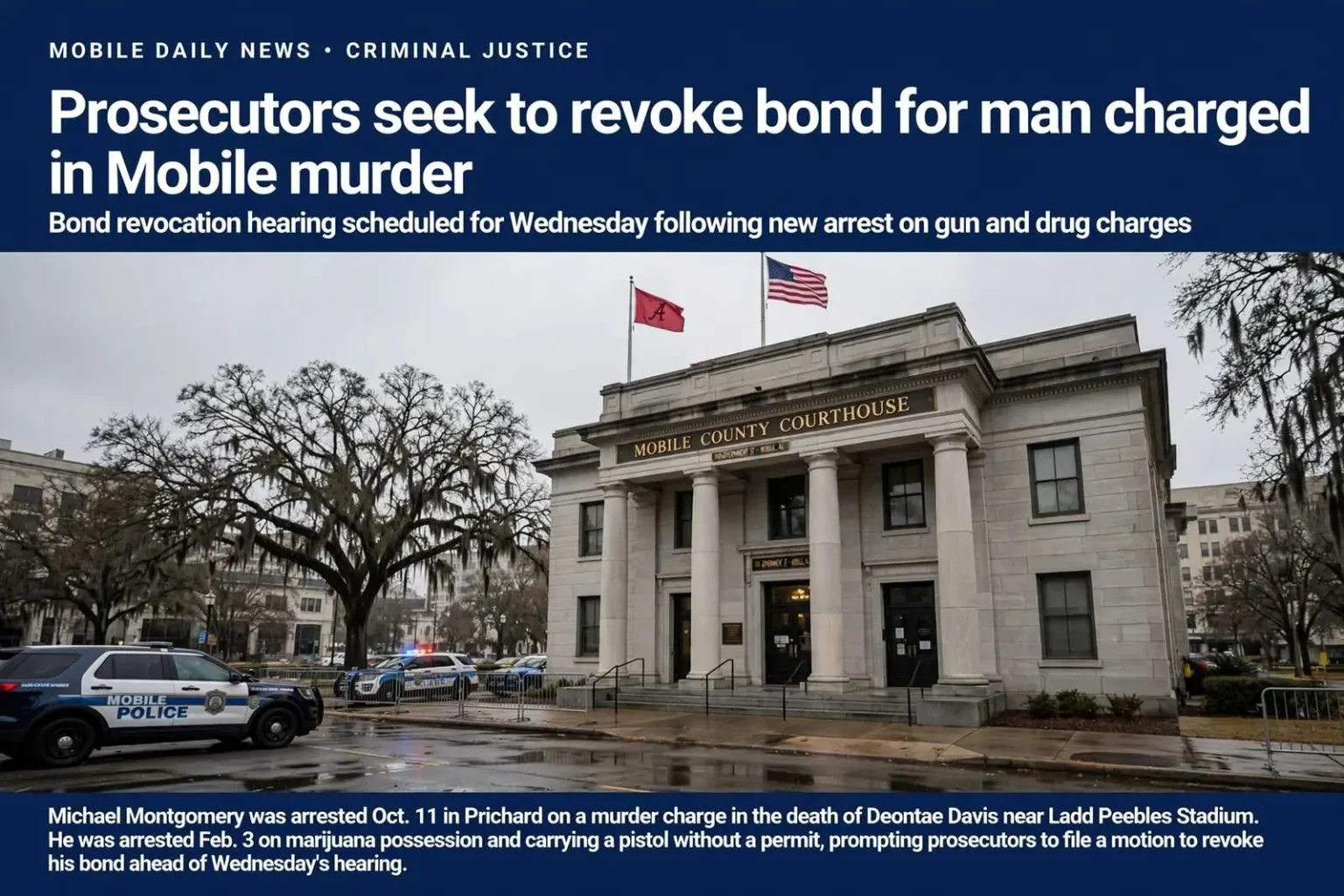
Prosecutors have filed a motion to revoke bond for a man accused in an October murder near Ladd Peebles Stadium in Mobile, after authorities say he picked up new charges while free on the murder charge. Michael Montgomery was arrested in Prichard on Oct. 11 and charged with murder in the death of Deontae Davis, who was shot and killed on Dexter Avenue near the stadium days earlier. Now, following a second arrest, the Mobile County District Attorney’s Office is asking a judge to send Montgomery back to jail to await trial.
Court documents lay out the sequence. Montgomery was granted bond on the murder charge on Nov. 3, roughly three weeks after his arrest, allowing him to remain free while the case moved through the court system. Just three months later, on Feb. 3, Montgomery was arrested by Mobile Police and charged with marijuana possession and carrying a pistol without a permit. According to the documents, the state has asked that his bond be revoked as a result of that arrest, arguing that the new charges show he should no longer be trusted to remain in the community before trial.
A hearing on the motion is set for Wednesday, when a judge will hear arguments from prosecutors and the defense before deciding whether Montgomery’s bond should be revoked and the murder charge converted into a hold without bond. For now, Montgomery is being held in the Mobile Metro Jail pending the outcome of the hearing.
The case that led to the bond
The underlying case stems from the shooting death of Deontae Davis on Dexter Avenue, a residential street in the neighborhoods just east of Ladd Peebles Stadium in Mobile. Davis was shot and killed there days before Montgomery’s arrest, and investigators with the Mobile Police Department built the case that led to the Oct. 11 arrest in Prichard, the city that borders Mobile to the north. Murder cases of this kind typically rest on witness statements, forensic evidence, and physical evidence collected from the scene, and the arrest came after that investigative work was presented to prosecutors and a warrant was issued.
Ladd Peebles Stadium, the longtime home venue for major high school football games and other large events in Mobile, anchors the area where the shooting occurred. The surrounding neighborhoods, like much of the city, have dealt with recurring gun violence, and homicides in the area are worked by the Mobile Police Department with support from the District Attorney’s Office, which prosecutes the cases that result from those investigations.
How bond works in Alabama murder cases
Under Alabama law, most defendants charged with a crime are entitled to bond, allowing them to remain free — with conditions — while awaiting trial. Murder is an exception in certain aggravated circumstances, but in many cases, including this one, a judge has discretion to set a bond amount after considering the seriousness of the charge, the defendant’s criminal history, and ties to the community. Montgomery’s bond was granted on Nov. 3, putting him back in the community under the expectation that he would appear for court and avoid any further criminal conduct while the case was pending.
That expectation is the legal basis for the state’s motion. When a defendant on bond is arrested for a new offense, prosecutors routinely ask the court to revoke the original bond, arguing that release has not served its purpose. Courts weigh the nature of the new charges — in this case, marijuana possession and carrying a pistol without a permit — against the defendant’s conduct on bond and the strength of the original case before deciding whether to leave the bond in place, raise it, or revoke it entirely.
What happens at a revocation hearing
At Wednesday’s hearing, the judge will consider evidence and arguments from both sides. Prosecutors are expected to point to the Feb. 3 arrest and the new charges as grounds for revocation, while Montgomery’s defense will have the opportunity to respond, questioning the evidence in the new case or arguing that conditions short of jail — a higher bond amount, electronic monitoring, or stricter supervision — would address the state’s concerns. Revocation hearings are typically brief, but the outcome matters enormously for the defendant: a revocation means returning to jail for the duration of the case, potentially for months or longer before trial.
Judges in these situations weigh several factors: whether the new arrest involved violence or weapons, whether the defendant has complied with other bond conditions, the defendant’s record of appearing in court, and the interest of public safety. The presence of a pistol charge in the new arrest is likely to figure prominently, since firearm offenses by a person awaiting trial on a murder charge strike at the heart of the argument for continued release.
The significance of new arrests while on bond
Re-arrest on new charges while awaiting trial creates complications that extend beyond the bond question. The new charges — marijuana possession and carrying a pistol without a permit — become a separate case that will proceed in parallel with the murder case, and a conviction in either could affect the other. Prosecutors also factor re-arrest into their handling of the original case, and judges considering any future bond requests will have the pattern in mind. For defendants, staying out of trouble while on bond is both a legal obligation and, practically speaking, the best way to preserve any chance of remaining free until trial.
The Mobile Metro Jail, where Montgomery is being held pending the hearing, houses pretrial detainees from across the county, including defendants whose bonds have been revoked or who are awaiting bond hearings. The facility serves the sheriff’s office, Mobile police, Prichard police, and other agencies, functioning as the central jail for the county’s criminal justice system.
The broader context in Mobile
The case reflects the challenges Mobile County’s criminal justice system faces in managing violent crime and pretrial release. Judges must balance a defendant’s legal right to bond against the community’s interest in safety and the integrity of the court process, and prosecutors’ revocation motions are one of the main tools for revisiting that balance when circumstances change. Each motion is decided case by case, on the record, at a hearing like the one scheduled for Wednesday.
For the family of Deontae Davis, the hearing is another step in a process that began with his death on Dexter Avenue near Ladd Peebles Stadium in October. The murder case against Montgomery will proceed in the months ahead regardless of the bond outcome, but whether the accused spends that time in custody or in the community is what Wednesday’s hearing will decide.
The Mobile County District Attorney’s Office and the Mobile Police Department have not released additional details about the new arrest beyond the charges listed in court documents, and further information may emerge at the hearing. Montgomery remains in the Mobile Metro Jail as the court considers whether his release on the murder charge should come to an end.
Prichard arrest and the county’s law enforcement network
Montgomery’s Oct. 11 arrest took place in Prichard, the city directly north of Mobile that operates its own police department within the county’s network of law enforcement agencies. Arrests of suspects sought in Mobile cases frequently cross municipal lines in this way, since the Mobile area’s jurisdictions abut one another and suspects move freely among them. Coordination between the Mobile Police Department’s investigators and neighboring departments, along with the U.S. Marshals Service’s Gulf Coast Regional Fugitive Task Force in many cases, is how warrants in violent felony cases are typically served.
The Feb. 3 re-arrest, by contrast, was made by Mobile Police, and the resulting charges — marijuana possession and carrying a pistol without a permit — are handled in the same district court system that is managing the murder case. The two cases will now share a docket history, with Wednesday’s bond hearing the first place the connection will be argued.
What the pistol charge means in context
Carrying a pistol without a permit is a misdemeanor under Alabama law, but its presence in this case carries weight beyond the charge’s classification. A person accused of murder who is alleged to have possessed a handgun while on bond presents exactly the scenario prosecutors cite when arguing that pretrial release poses a risk. Alabama’s pistol permit system, long administered by county sheriffs, requires a permit for carrying a handgun on one’s person in public, and violations are routinely charged in cases where officers recover handguns during arrests for other offenses.
The marijuana possession charge adds a second data point for the court. While possession cases are common, a new drug arrest during release on a murder charge is the kind of development that undermines a defendant’s argument that he is complying with the conditions and expectations of his release. Together, the two charges give the state a straightforward narrative for Wednesday’s hearing: release has not worked.
The defense’s position and the judge’s options
Montgomery’s defense will present the other side of that argument. Defense attorneys in revocation hearings typically stress that new charges are only accusations, not convictions, and that the standard for revoking bond should account for the strength of the state’s evidence in the new case. They may also emphasize ties to family, employment prospects, and willingness to accept additional conditions. Judges, for their part, have a middle path available: rather than a simple choice between release and revocation, a court can set a higher bond, add reporting requirements, order electronic monitoring, or impose other restrictions designed to manage the risk while preserving some freedom.
Wednesday’s hearing will settle that question for now, though bond decisions can be revisited later as cases develop. If bond is revoked, Montgomery will remain in the Mobile Metro Jail through trial unless a future motion succeeds. If conditions are modified instead, his release will continue under stricter terms. Either way, the murder case — the death of Deontae Davis on Dexter Avenue near Ladd Peebles Stadium, and the prosecution of the man accused in it — moves forward on the timetable of Mobile County’s courts, with Wednesday’s hearing setting the terms of that journey.


