Public Official Kennon Declines Comment on Upcoming Ethics Hearing
A public official named Kennon has declined to comment ahead of an upcoming ethics hearing involving them.
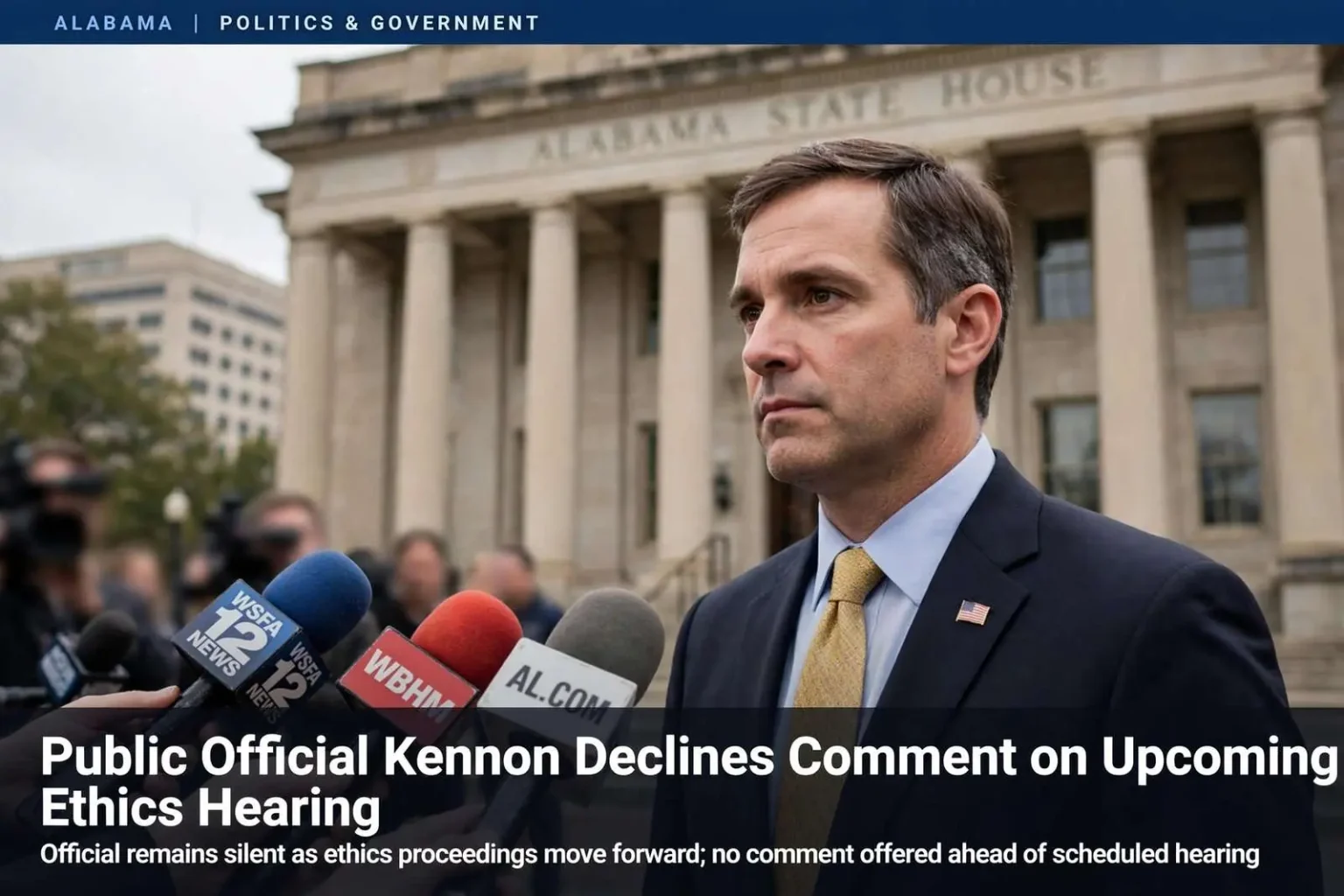
A public official identified as Kennon has declined to comment on an upcoming ethics hearing that involves them, leaving questions about the proceeding unanswered while the process moves forward through official channels. The decision to remain silent ahead of an ethics hearing is a familiar one in Alabama public life, where attorneys routinely advise officials under review to say nothing that could complicate their defense. For residents, the absence of comment can be frustrating, but it also reflects how the state’s ethics process actually works, with details often shielded until formal findings are made public.
Ethics proceedings occupy a distinctive corner of government accountability. They are not criminal trials, though they can lead to criminal referral, and they are not elections, though they can end careers. An ethics hearing examines whether a public official violated the state’s ethics laws, which govern conflicts of interest, the use of public office for private gain, and the disclosure of financial interests. Officials who appear before such proceedings face real consequences, and the advice they receive from counsel is almost always the same: decline to comment publicly, because anything said outside the hearing room can be quoted back inside it.
The silence of an official under review should be understood in that context. Declining comment is not, by itself, an admission of anything, and it does not signal guilt or innocence. It is a procedural posture, adopted on the advice of lawyers, that preserves every legal option while the matter is pending. Members of the public and the press, meanwhile, are left to rely on the official record of the ethics process, the limited statements that agencies are permitted to make, and whatever documentation has entered the public domain through filings or prior reporting.
How Alabama’s Ethics Process Works
Alabama’s ethics framework centers on the state’s ethics commission, the body charged with receiving complaints, investigating allegations, and holding hearings when evidence warrants. The commission’s jurisdiction covers the state’s ethics law, which prohibits public officials and employees from using their positions for personal gain, requires disclosure of financial interests, and restricts dealings between officials and entities they regulate or do business with on the state’s behalf. Complaints can originate from many sources, including members of the public, fellow officials, and whistleblowers within government agencies.
The process unfolds in stages. After a complaint is filed, commission staff screen it for jurisdiction and substance, and matters that pass that threshold move into investigation. Investigators gather documents, interview witnesses, and prepare findings that are presented to the commission itself. If the commission finds probable cause to believe a violation occurred, the matter proceeds toward a hearing, where evidence is presented and the official has the opportunity to respond with counsel present. The commission can dismiss a matter, negotiate a settlement, or refer evidence to prosecutors if it believes a crime may have been committed.
At every stage, officials under review retain due process protections. They are entitled to notice of the allegations against them, to legal representation, to present evidence, and to challenge the case assembled against them. Those protections are the reason public comment is discouraged during the pendency of a matter. Statements made to the press before a hearing can be used by the other side, can create inconsistencies with later testimony, and can prejudice potential proceedings beyond the ethics process itself. For an official, the disciplined course is usually patience, and that is what declining to comment represents.
The confidentiality of the process also shapes what the public knows. Ethics complaints and investigations are generally not open to the same degree as court files, and the commission is limited in what it can say about pending matters. This design is intended to protect both complainants and officials from reputational damage based on unproven allegations, but it has a cost in public understanding. Residents following an ethics case often find that the official record is thin until a hearing produces findings, which leaves room for speculation in the interim and makes the eventual hearing itself the first moment of genuine public clarity.
Why Officials Decline Comment
Attorneys who represent public officials in ethics matters describe a consistent set of reasons for the no-comment posture. First, there is the risk of legal inconsistency: a statement to a reporter is not made under oath, but it can be compared against sworn testimony later, and any mismatch becomes its own problem. Second, there is the risk of prejudicing other proceedings, since ethics matters can intersect with civil litigation or criminal investigation. Third, there is the practical matter of negotiation, because ethics cases are sometimes resolved through settlements whose terms are easier to reach when neither side is litigating the case in the newspapers.
There is also a political dimension that officials weigh alongside the legal one. In a state where public trust in government has been shaped by a long history of ethics prosecutions, an official facing a hearing knows that public statements will be scrutinized for tone as much as content. Expressions of confidence can be read as arrogance if findings later go badly; expressions of contrition can be read as admission if findings later go well. Silence, though it frustrates constituents and reporters, avoids those traps and leaves the official’s eventual account, if one is ever required, to be delivered in the setting where it carries legal weight.
For the constituents an official serves, the period before a hearing is one of limited information and competing interpretations. Supporters often emphasize the presumption of innocence and the official’s record of service, while critics point to the seriousness of the process itself. Local news coverage tends to reflect that split, laying out what is known about the hearing while noting what remains unknown. In that environment, the official’s silence becomes the most newsworthy fact available, which is why decisions to decline comment so often appear in headlines about ethics matters across the state.
What an Ethics Hearing Involves
When an ethics matter reaches the hearing stage, it takes on many of the attributes of a formal legal proceeding. Evidence is presented, witnesses may testify, and the official responds with the assistance of counsel. The standard applied is not the criminal standard of proof beyond a reasonable doubt, and the consequences at stake range from dismissal to settlement terms to referral for prosecution, depending on what the evidence shows. Hearings are serious business for everyone involved, and preparation typically consumes weeks of work by both the agency’s staff and the official’s attorneys.
The aftermath of a hearing can take several forms. If the commission concludes that no violation occurred, the matter ends and the official is free to speak publicly about the experience. If the commission finds violations, outcomes have historically included agreed resolutions involving fines or restitution, public reprimands, and referrals to the attorney general or district attorneys where the conduct may be criminal. Whatever the outcome, it becomes part of the public record at that point, replacing the secrecy of the investigative phase with documented findings that residents can read and evaluate for themselves.
Ethics cases also carry consequences that no hearing can measure. An official under review operates under a cloud that affects legislative committees, public contracts, and everyday working relationships, regardless of how the matter ends. Colleagues grow cautious about association, constituents divide, and the official’s capacity to lead is diminished until the question is resolved. That reality is part of why the process exists, since the credible possibility of public exposure is itself a deterrent, and it is also why officials under review so often choose silence, minimizing the additional damage while the process runs its course.
As the hearing involving Kennon approaches, the public record remains what it has been: a proceeding is scheduled, an official has declined to comment, and no further details have been made available. Residents watching the matter unfold can expect the same sequence that governs ethics cases across Alabama, a process built to be deliberate precisely because the reputations and careers at stake are significant. When the hearing produces results, the silence surrounding the matter should give way to findings that the public can examine, and until then, the absence of comment will remain the disciplined answer of an official following the advice that the process itself makes prudent.
Alabama’s experience with ethics enforcement gives residents a framework for interpreting cases like this one. Over the past several decades, the state has seen ethics matters reach officials at every level of government, from city halls to the Statehouse, and several high-profile prosecutions have grown out of commission referrals. That history has made ethics compliance a standing concern for anyone who holds public office in Alabama, with training, disclosure requirements, and legal review now routine parts of serving in government. It has also made the public attentive to the process, because residents have seen how seriously the state treats these questions.
The press has its own role to play in the period before a hearing. Local reporters typically document what can be confirmed, describe the process that governs what comes next, and resist drawing conclusions that the record does not yet support. That kind of coverage serves readers in two ways: it keeps the matter visible so it is not quietly resolved out of sight, and it models the patience that due process requires. An official’s decision to decline comment does not end scrutiny, it simply moves the burden of information to the institutions and documents that will eventually speak for the process.
For the constituents an official represents, the practical effect of a pending ethics matter is often uncertainty about representation itself. Questions about who is minding the public’s business, whether the official can continue to participate fully in official duties, and how a resolution might change local government all circulate in the community. Some officials continue working their full schedule while a matter is pending, on the theory that the presumption of innocence applies; others step back from certain roles until questions are resolved. Either choice draws commentary, and the official’s silence on the underlying matter rarely extends to questions about the day-to-day work of the office.
When the hearing arrives, the discipline of the preceding weeks will be tested against the demands of a public process. Findings will be rendered on the record, and the official’s position will be documented in a form that no amount of preliminary commentary could substitute for. Until then, the most accurate summary of where things stand is also the shortest: a hearing is scheduled, an official has chosen not to comment, and the process that Alabama law provides will determine what the public ultimately learns. In a matter governed by rules of evidence, confidentiality, and due process, that patience is not evasion. It is procedure working as designed.