Purple Heart Recipients Honored at Daphne Ceremony, Including Korean War Soldier Laid to Rest After 75 Years
Around 50 Purple Heart recipients gathered in Daphne for a Purple Heart Day ceremony that also honored a Korean War soldier laid to rest after 75 years.
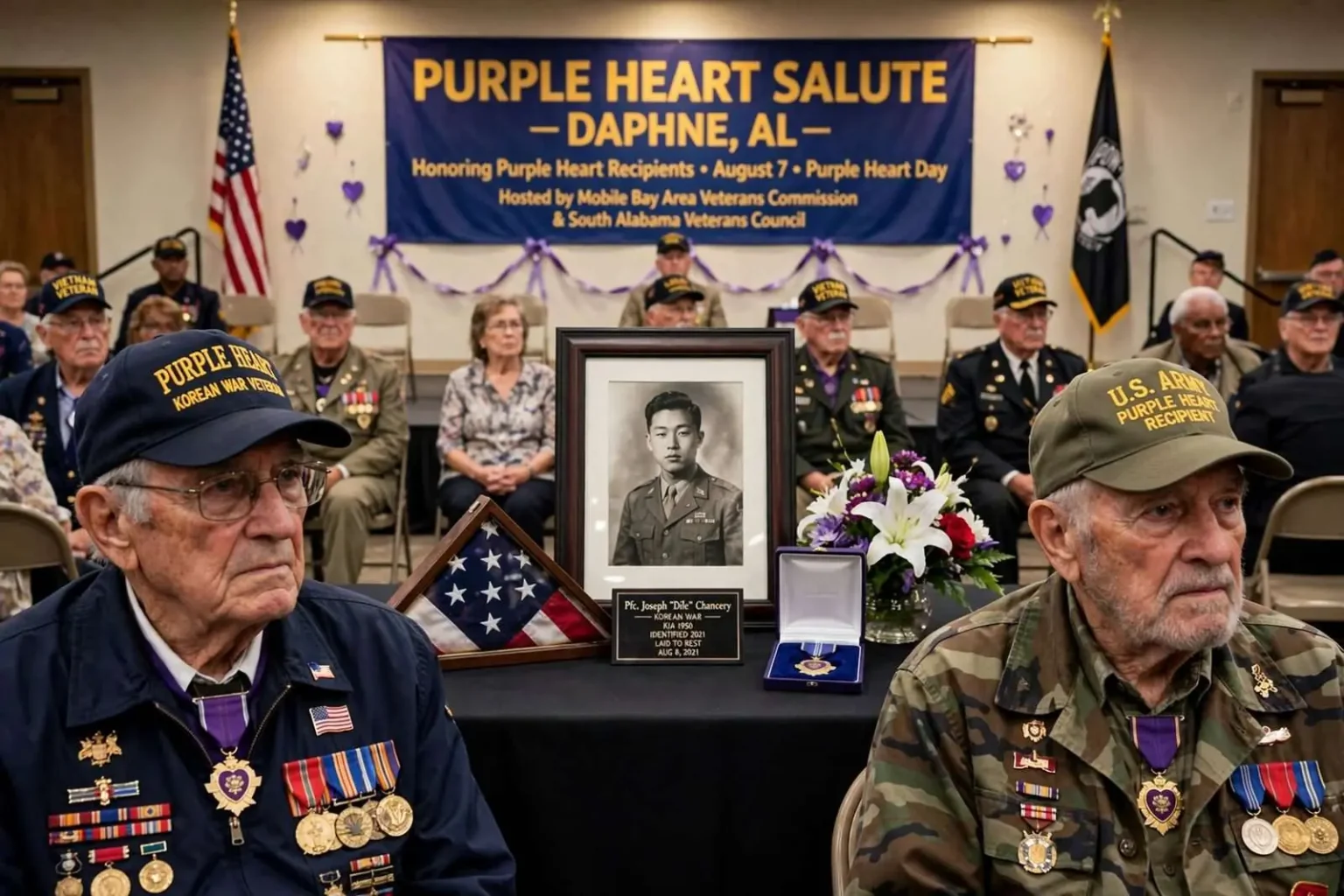
DAPHNE, Ala. — Veterans organizations, local leaders and residents gathered at the Daphne Civic Center the evening of Friday, Aug. 7, to honor Purple Heart recipients and their families at a “Purple Heart Salute” ceremony held on Purple Heart Day. The event was hosted by the Mobile Bay Area Veterans Commission and the South Alabama Veterans Council, two organizations that have made the recognition of wounded and killed service members a central part of their work across the central Gulf Coast.
Roughly 50 Purple Heart recipients attended, traveling from Alabama and several other states, including Florida, Louisiana, Texas, Wisconsin and New York. For many of those in attendance, the ceremony offered an uncommon opportunity to sit among others who carry the same distinction, a decoration that can only be earned through the personal experience of being wounded or killed in action against an enemy of the United States. Families filled the seats alongside the recipients, and the crowd reflected the wide reach of the region’s veteran community, drawing participants from across Baldwin and Mobile counties as well as from far beyond state lines.
An Evening Built Around Brotherhood
The evening featured a keynote address from Jack Hawkins, the longtime chancellor of Troy University and a two-time Purple Heart recipient himself. Hawkins has led Troy for decades and has been a familiar figure in Alabama civic life, and his dual perspective as both an educator and a wounded veteran gave the address a personal weight that resonated with the audience.
“What I think about tonight is first of all, I’m proud to be an American,” said retired U.S. Army Col. Phil Quigley, vice president of marketing for the Mobile Bay Veterans Commission. “What’s awesome about this too is it brings everyone together. Unites everyone together, and as Dr. Jack Hawkins, the chancellor of Troy [University], said, it doesn’t matter, we’re a brotherhood, sisterhood, and we should all be proud to be Americans, and that’s the way I felt sitting up there on stage.”
Quigley’s words captured the tone that organizers said they hoped the ceremony would strike. Rather than a solemn memorial alone, the event was designed as a gathering — an evening in which recipients could share stories, families could be publicly thanked, and a community that benefits from their sacrifice could express that gratitude face to face. Organizers have long argued that recognition ceremonies serve a practical purpose as well, connecting veterans who might otherwise remain isolated with the benefits counselors, service organizations and peer networks that operate across the Mobile Bay area.
A Soldier Missing for 75 Years Comes Home
Among those honored was Army Pfc. Joseph “Dile” Chancery, who was killed during the Korean War at age 20 and was listed as missing in action for 75 years. His story gave the evening a focus that went beyond the medal itself, reminding those present that behind every Purple Heart is a family that has carried the loss, in some cases for generations.
In 2021, as part of the Defense POW/MIA Accounting Agency’s Korean War Disinterment Project, remains were exhumed from the National Memorial Cemetery of the Pacific in Honolulu and sent to the DPAA laboratory for forensic examination. The project targeted sets of remains that had been buried as “unknowns” for decades, applying modern science to cases that older methods could never resolve. The cemetery in Honolulu, known as the Punchbowl, holds thousands of American service members from the Pacific conflicts of the twentieth century, and it has been the starting point for many of the agency’s most significant identifications.
Through DNA analysis, anthropological review, dental records and corroborating historical evidence, scientists identified the remains as Chancery’s. The process can take years, combining laboratory work on the remains themselves with archival research into unit records, battle reports and personal effects. Family reference samples supplied by relatives are often the decisive piece, allowing scientists to make comparisons that were impossible when the remains were first recovered.
He was returned home and laid to rest with full military honors on Saturday, Aug. 8, at Lottie United Methodist Church Cemetery just outside Atmore. The burial came one day after the Daphne ceremony, giving Chancery’s family a weekend that spanned both public recognition and private farewell. Full military honors typically include the presentation of a folded flag to the next of kin, the playing of taps and a rifle volley, traditions that in this case closed a chapter that had remained open since the early 1950s.
Leaster Kelly, Chancery’s niece, said the return of her uncle’s remains has helped bring her family closer together.
“Everybody loved him and he always wanted to be a soldier, and he did get to do that,” Kelly said at Friday’s ceremony. “I just wished I had grown up with Dile, but we didn’t get to do that. That wasn’t in the cards for us, but it’s so wonderful, him being home. It’s going to bring so much closure, and we’re just looking forward to seeing all the stories about him tomorrow.”
Her words reflected what families of the missing often describe after an identification is confirmed: a mixture of grief renewed and relief finally earned. For relatives who never met the fallen, the return of remains provides a grave to visit, a date to gather around and, at last, answers to questions that were handed down through the family for three-quarters of a century. In Escambia County communities like Atmore, where family churches and cemeteries anchor generations of local history, the homecoming carried a meaning that extended well beyond the immediate relatives.
What Purple Heart Day Represents
Purple Heart Day, observed annually on Aug. 7, recognizes U.S. service members wounded or killed in action. Communities across the country mark the date with ceremonies, proclamations and moments of silence, and the Daphne event has become one of the central Gulf Coast’s regular observances. Unlike decorations awarded for achievement or valor in a specific engagement, the Purple Heart is conferred as a result of being wounded or killed, which gives the medal a meaning that recipients and their families often describe as bittersweet.
The medal itself dates back to George Washington’s 1782 Badge of Military Merit, making it the oldest military decoration still in use today. Washington created the badge to honor enlisted soldiers for “any singularly meritorious action,” and it was awarded sparingly during the Revolutionary War before falling into disuse. The modern Purple Heart was revived in 1932, on the bicentennial of Washington’s birth, and reconnected to the spirit of the original badge. The profile of Washington and the purple heart shape on today’s medal remain a direct echo of that Revolutionary-era predecessor.
For the recipients gathered in Daphne, that lineage mattered. The medal they carry ties them to more than two centuries of American service members wounded in conflicts from the Revolutionary War to the present day, a continuity that no other American decoration can claim.
A Region That Turns Out for Its Veterans
The Mobile Bay Area Veterans Commission and the South Alabama Veterans Council have spent years building the kind of partnership that made Friday’s ceremony possible. The two organizations coordinate veteran recognition events, connect former service members with benefits and support resources, and serve as a bridge between individual veterans posts and the local governments of Mobile and Baldwin counties. Events like the Purple Heart Salute depend on that coordination, pulling together honor guards, keynote speakers and volunteers drawn from posts across the two-county area.
Baldwin County itself is home to a substantial veteran population, drawn in part by the region’s military heritage and its network of bases and installations along the upper Gulf Coast. Communities from Daphne to Fairhope to Foley host veterans organizations that participate in memorial services throughout the year, and local schools routinely invite veterans to speak around Veterans Day and Memorial Day. A ceremony at the Daphne Civic Center, one of the largest public gathering spaces on the Eastern Shore, fit both the scale of the crowd and the significance of the occasion.
The Daphne observance also carried particular weight this year because of the Chancery homecoming. Korean War families across South Alabama have watched the Defense POW/MIA Accounting Agency work through the backlog of unresolved cases from that conflict, and each identification that reaches a family in the region is felt by the wider community of veterans and relatives who have followed these cases for decades. The accountings serve as a reminder that the promise to leave no one behind does not expire when the guns fall silent.
The Korean War’s Long Shadow
The Korean War, fought from 1950 to 1953, claimed the lives of tens of thousands of Americans and left thousands more missing, many of them along the shifting front lines of the peninsula’s first year of fighting. Pfc. Chancery was among the young soldiers sent to that conflict at the very start of their adult lives — he was just 20 when he was killed. The armistice that ended active fighting in 1953 did not resolve the fates of the missing, and for decades families like the Chancerys lived without certainty about what had happened to their loved ones.
The Defense POW/MIA Accounting Agency’s Korean War Disinterment Project, launched to reexamine remains buried as unknowns in places like the National Memorial Cemetery of the Pacific, has allowed scientists to revisit those cases with tools that did not exist when the war ended. Advances in DNA extraction, combined with improved forensic anthropology and digitized military records, have steadily converted old mysteries into confirmed identifications, and each one is delivered to a family with the same care that accompanied Chancery’s return to South Alabama.
For the organizers of the Purple Heart Salute, the pairing of the ceremony with Chancery’s burial the following morning underscored everything the event stands for: honor for those who shed blood in uniform, support for the families who carry the cost, and a community willing to show up, in person, when a soldier finally comes home. As the recipients left the Daphne Civic Center Friday night, the weekend ahead held both a reunion for the living and a long-delayed farewell for one of their own.