Q&A: Painter Lauren Woods on Dreams, Dance and Mobile’s Art Scene
Mobile painter Lauren Woods discusses her Skinny Gallery show, ballet-trained imagery, dream-inspired work and Mobile's art scene.
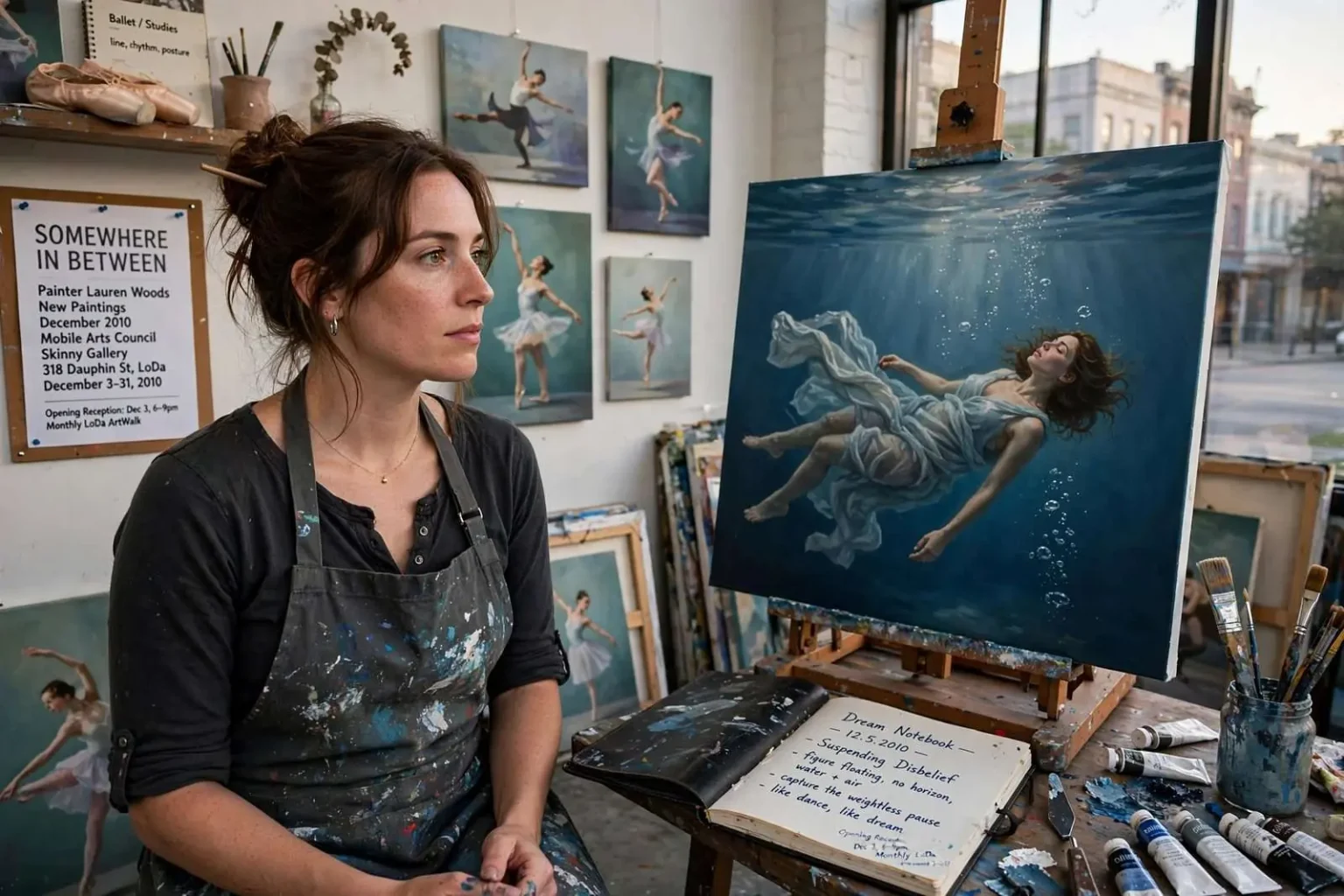
Painter Lauren Woods brought her exhibition Somewhere In Between to the Mobile Arts Council’s “Skinny” Gallery in December 2010, and sat down during the run of the show to talk about how a Spring Hill College graphic design student became one of Mobile’s most disciplined young painters. The exhibition gathered her figures in suspended, theatrical spaces — bodies floating, reaching and poised as though caught mid-performance — and it arrived at a moment when downtown Mobile’s gallery district was working hard to establish itself as a destination for original art. For Woods, the show was both a milestone and a statement of intent from an artist who had come to painting relatively late in her formal education but had trained her eye for movement and composition since childhood.
The Mobile Arts Council, located at 318 Dauphin Street in the heart of the LoDa entertainment district, has functioned for decades as the central staging ground for Mobile’s visual arts community. Its galleries host rotating exhibitions by area artists, coordinate the monthly LoDa ArtWalk that draws crowds down Dauphin and Conti streets, and give emerging painters a professional venue that few other local institutions can match. Exhibiting in its gallery spaces places a young artist in front of the collectors, educators and fellow painters who shape the local scene, and Woods’s December exhibition put her work on display during a holiday season when foot traffic through downtown galleries was at its peak.
From Graphic Design to the Canvas
Woods began painting seriously during her junior year at Spring Hill College, where a first painting class derailed her original plan to pursue a graphic design degree. The switch was not a small one. Spring Hill, the Jesuit liberal arts college in Mobile’s Spring Hill neighborhood and the oldest institution of higher learning in Alabama, had provided the structure of her artistic training, and its studio program gave her the first sustained exposure to paint as a medium rather than as a tool for commercial layout. What began as a single required or elective course in the studio curriculum quickly reorganized her ambitions, pulling her away from screens and typography and toward the physical, slow, additive process of building an image in oil on canvas.
Before that turning point, her creative life had centered on dance. Woods started ballet at age three and has studied it for more than two decades, accumulating the kind of bodily literacy that most painters never develop. Alongside dance, she drew for fun — sketching as an amateur pleasure rather than a professional ambition — so that by the time she first stood in front of a canvas in a college studio, she arrived with years of physical discipline and an informal drawing habit already in place. The combination proved decisive. Painting asked for exactly the mix she possessed: patience, control of the line, and an intuition for how a body occupies space.
A Dancer’s Eye for Line and Rhythm
That dance background still shapes her work in visible ways. Woods concentrates on line and rhythm, often placing figures in theatrical spaces as though they were on stage. In her paintings, the human form is rarely static; it leans, floats, twists or hovers, arranged against backdrops that read like sets waiting for lights to come up. The connection is more than thematic. Dancers think in terms of extended lines through the body, the arc of a gesture, the tension between balance and release, and Woods translates that vocabulary directly into composition — the sweep of a painted contour doing the work a choreographer assigns to an arm or a spine.
The stage-like settings also do conceptual work. By isolating figures in spaces that suggest performance without depicting an audience, her paintings invite viewers to consider what it means to be watched, and what it costs to hold a pose. The titles and images in Somewhere In Between pushed that idea further, presenting bodies caught between states — between water and air, groundedness and weightlessness, self-possession and display. It is a sensibility that could only come from someone who spent decades in studios and rehearsal halls learning how much discipline hides inside an apparently effortless movement.
Influences Beyond Painting
Woods cites literature, music, dance and dreams as her primary influences, a list that places her closer to the symbolist tradition than to the purely formal concerns of much contemporary painting. She reads widely — comparative mythology, semiotics, and the 19th-century Decadent movement among them — and the range shows in the way her pictures treat the figure as a carrier of meaning rather than simply a model to be rendered. Comparative mythology supplies the archetypes: figures in transit, threshold moments, transformations. Semiotics, the study of signs and symbols, gives her a framework for thinking about how an image communicates. The Decadent movement, with its lush surfaces and fascination with beauty in artificial, heightened states, offers a historical precedent for paintings that are unapologetic about sensuality and mood.
Music and dance function as working tools rather than background atmosphere. The rhythms she absorbs from both find their way into the pacing of a canvas — where the eye accelerates, where it rests. And dreams supply raw material of a different kind entirely. Woods keeps a notebook documenting vivid dreams, treating it the way a writer treats a journal of fragments: as a stockpile of images too strange to invent deliberately. The practice reflects a conviction that the unconscious produces compositions the waking mind would censor, and that the painter’s job is partly one of faithful transcription.
The Centerpiece Image
The exhibition’s centerpiece, Suspending Disbelief, makes that debt to the dream notebook explicit. The painting shows a figure floating upright in water, viewed from an impossible vantage point — an angle no observer in the scene could actually occupy. Woods has said the image came to her in a dream, and that she decided to preserve it as an emblematic, instantly memorable picture. The choice of title frames the whole exchange between artist and viewer: the painting asks the audience to set aside physics and plausibility and accept the image on its own terms, the way a dream is accepted while it is happening.
An impossible viewpoint is a deliberate technical challenge as much as a poetic one. Rendering a figure from an angle the eye never sees requires the painter to reason through foreshortening, reflection and the behavior of light in water without the shortcut of direct observation. That a young artist would build an entire exhibition around such a picture signals both confidence and ambition — a willingness to let one strange, durable image stand for the whole body of work.
The Work Ethic
The discipline behind the images is considerable. Woods paints three to four hours a night on weekdays and longer on weekends — at least 20 hours weekly when a show approaches — while also teaching private painting lessons to earn a living and stay connected to the fundamentals of her craft. The schedule resembles an athlete’s more than a hobbyist’s, and it reflects the reality of building a painting career outside a major market: the work happens in the evenings, after the day’s obligations, sustained by routine rather than inspiration.
Not everything survives that routine. Woods says many paintings “die” when overworked — a familiar hazard for figurative painters, whose surfaces can be pushed past the point where fresh marks still read as fresh. Some pieces get painted over entirely; others are revisited and reworked into new pieces, their failed passages feeding later successes. She keeps a sense of humor about the casualties. A few of the rejects live on in a running bad-art collection traded among school friends, a private joke that doubles as a reminder that not every canvas needs to matter.
Her proudest moment so far did not happen at an easel. It was leaving her comfort zone for graduate school in New York, where defending her thesis before ten instructors and a full room of classmates tested her nerve more than any canvas had. The episode is telling. For an artist whose work is full of figures on stage, the genuinely exposed moment came not in making the work but in standing behind it, alone, before a room of experts.
On Mobile’s Art Scene
Woods is encouraged by the direction of Mobile’s art scene, particularly the way the city’s art walks keep drawing newcomers into galleries that might otherwise go unvisited. The monthly LoDa ArtWalk, centered on Lower Dauphin Street, has become the reliable engine of that exposure — an evening each month when studios, galleries and odd retail spaces open their doors, musicians and performers appear on sidewalks, and a crowd that includes plenty of first-time gallery visitors moves between venues. For a working painter, that recurring traffic is not a small thing. It converts casual strollers into eventual collectors and gives young artists an audience that grows a little more literate with each cycle.
Still, Woods wishes the scene would evolve faster. “Sometimes it seems like we get too set in our ways as both artists and patrons here in Mobile,” she said. The observation cuts in two directions at once. Artists, in her view, can settle into producing the work the local market already rewards, while patrons can settle into expecting the familiar — safe landscapes, recognizable names, the same venues showing the same sensibilities. A city the size of Mobile has a finite circle of buyers and exhibition spaces, and habits form quickly inside a small circle. Her critique amounts to a challenge to both sides of that equation: for artists to keep taking risks the way Somewhere In Between does, and for audiences to keep rewarding them.
What Comes Next
The December 2010 exhibition caught Woods at a natural inflection point. She had completed graduate school in New York and returned to a hometown whose art infrastructure — the Mobile Arts Council, the art walks, a handful of commercial and alternative galleries — was energetic but still maturing. The path ahead involved the same discipline that had produced the show: nightly hours at the easel, private students, a dream notebook filling up with images that might someday need to be painted, and a growing pile of canvases that would not all survive.
For local viewers, the show offered a case study in how an artist is actually formed — not by a single breakthrough but by an unusual accumulation of trainings. Ballet from age three gave her the line and rhythm that organize her compositions. A graphic design track at Spring Hill College gave way, in her junior year, to a painting class that reset her career. Literature, mythology and semiotics gave her images intellectual weight. New York tested her nerve. And Mobile gave her a place to exhibit, an audience still learning what it likes, and a scene she is candid enough to criticize because she expects it to do better. Somewhere In Between, with its floating figures and impossible vantage points, was both a record of that formation and a wager that Mobile audiences would follow her somewhere stranger than they were used to going.