Rainwaters Endorses Nodine, Handing Him a Bloc of Anti-Establishment Votes in the Runoff
Third-place finisher Austin Rainwaters endorsed Stephen Nodine in the 2004 Mobile County Commission District 2 runoff, saying his supporters were unanimous in rejecting Ralph Buffkin.
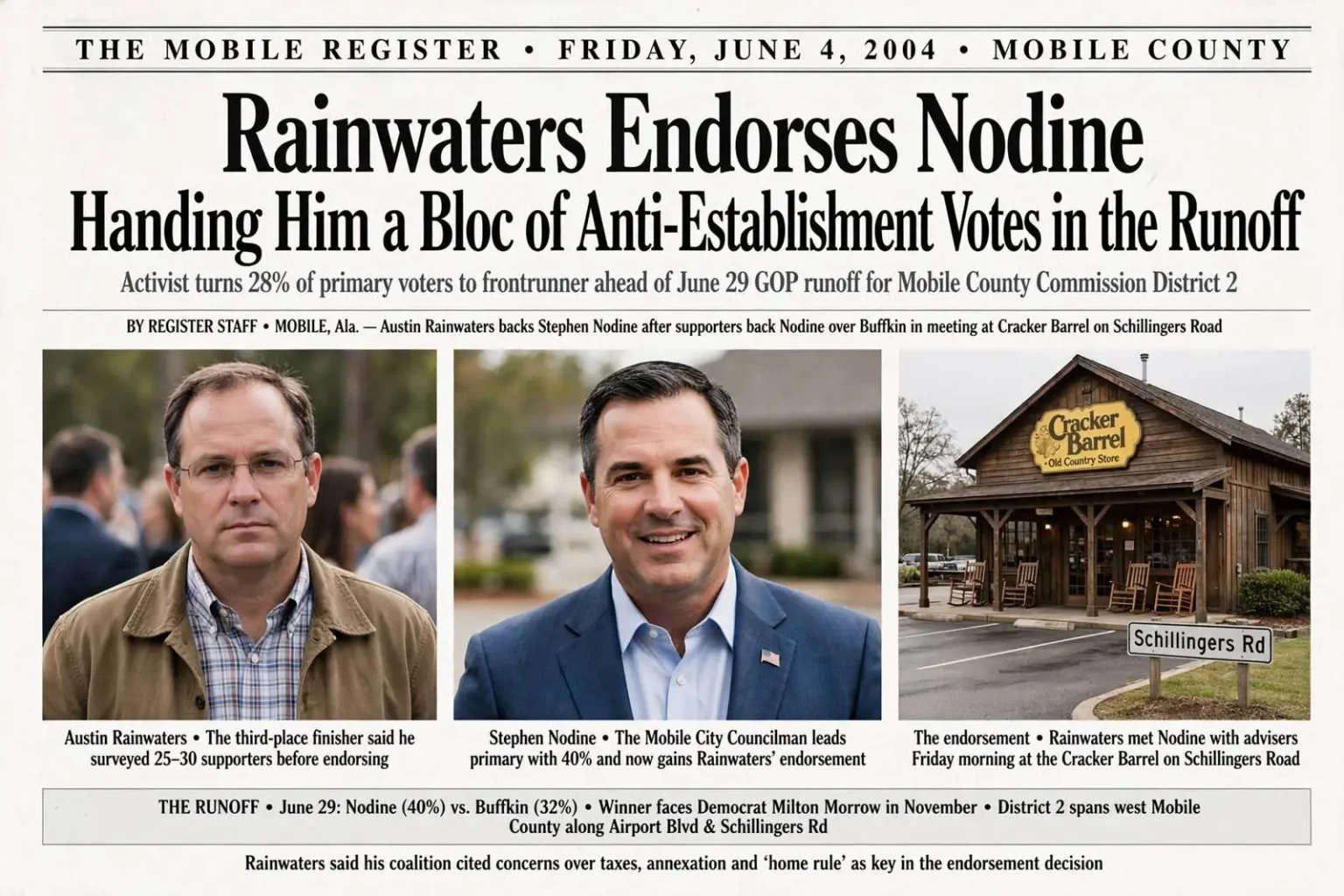
Austin Rainwaters, the conservative activist who finished third in the June 1 Republican primary for Mobile County Commission District 2, endorsed frontrunner Stephen Nodine on Friday, June 4, 2004, delivering to the Mobile city councilman the one thing he most needed heading into a June 29 runoff: a claim on the 28 percent of the electorate that had gone somewhere else. Nodine had led the primary with 40 percent to retired businessman Ralph Buffkin’s 32 percent in an exceptionally light turnout. The winner of the runoff would face Democratic nominee Milton Morrow in November.
The arithmetic of the primary made Rainwaters’ blessing consequential. Neither Nodine nor Buffkin had come close to the majority that would have ended the race outright, which meant the campaign now entered a three-week sprint for a runoff in which turnout would be even smaller than the 15 percent that turned out in June — typically a fraction of the party’s most reliable, most motivated voters. In a contest like that, a bloc of anti-establishment voters with an organized leader could be decisive, and Rainwaters’ voters were precisely that.
District 2, which spans much of west Mobile County, was the part of the county where that anti-establishment sentiment ran strongest. The district’s population had pushed steadily outward along Airport Boulevard, Schillingers Road and the county’s western growth corridors through the 1990s, filling with subdivisions whose residents commuted into the city but paid county taxes, sent their children to county schools and watched city annexation creep toward their doorsteps. The farther west the voters lived, the more skeptical they tended to be of downtown Mobile’s political establishment.
An endorsement made by committee
What made the endorsement notable was how Rainwaters said he arrived at it. Rather than announce a preference on his own, he went to his supporters.
“The night of the election I asked my supporters to think about what we should do,” Rainwaters said. “Should we remain neutral or could we endorse one of the other candidates?”
The phone calls came in — 25 or 30 of them, by his count — and the verdict was lopsided. “Not a single person endorsed Buffkin,” he said. “Two or three it didn’t make much difference to. There was a predominance for Nodine.”
Rainwaters said the response surprised him. He had expected something mixed, perhaps with no clear consensus, given that the campaign’s sharper exchanges had been with Nodine rather than Buffkin. The result illustrated a recurring truth of Alabama primary politics: personal exchanges between candidates often matter less to the voters watching them than the alliances and enemies that form around the race.
Why his voters chose as they did
Two reasons emerged, Rainwaters said, and they were tangled together. The first was resentment. His backers believed the local media had unfairly smeared him in an effort to boost Buffkin, and they did not want to reward what they regarded as a hit job.
The second, close behind, was suspicion of the establishment. “The people believe Buffkin was the choice of the mayor, the chamber and the paper,” Rainwaters said — a reference to Mayor Mike Dow, the Mobile business community and the daily newspaper.
In a district whose voters lived increasingly west of the city and grew more skeptical of downtown the farther out they went, that perception was politically radioactive. Buffkin, a retired businessman running an establishment-flavored campaign, inherited a coalition that included much of the city’s traditional business and civic leadership — the same circles that had shaped Mobile politics for a generation. Rainwaters’ voters defined themselves against that coalition, and the endorsement call reflected it.
The Cracker Barrel summit
Rainwaters did not simply hand over the endorsement. Armed with 3×5 index cards summarizing his supporters’ concerns, he had coffee separately with both Nodine and Buffkin. Nothing was raised in one meeting, he said, that was not raised in the other.
“At no time in either discussion did we discuss money or my campaign debt,” Rainwaters said — an unprompted denial that spoke to how endorsements are sometimes traded in Alabama politics.
He then convened a breakfast meeting on Friday morning at the Cracker Barrel on Schillingers Road, bringing a dozen or more of his advisers face to face with Nodine, who was in his first term on the Mobile City Council.
“The general attitude he had to overcome was that he’d been all for the city,” Rainwaters said. “He had to convince folks that he could represent everybody in the district, and he did a pretty good job of that.”
The obstacle was a structural one. A city councilman running for a countywide district seat has to persuade unincorporated voters that he has not spent his term serving Mobile’s municipal interests at the county’s expense. Annexation battles in west Mobile County had left many unincorporated residents wary that city officials saw their neighborhoods as future tax base, and Nodine’s council record made him, to that audience, a symbol of the city rather than of the district.
Two issues mattered most to the group: taxes and annexation.
“Home rule is an excuse to raise taxes and assessments, and they don’t want the county commission to be able to do that,” Rainwaters said. Nodine told them there would be no changes on that front, and that assurance carried weight.
The home rule question was a live one in Alabama county government at the time. Counties in the state had historically exercised only those powers the Legislature specifically granted them, and the push to give county commissions more general authority — home rule — was debated in Montgomery through the early 2000s. To Rainwaters’ coalition, broader county authority meant a new pathway to taxes and assessments without a vote of the people, and any candidate’s position on it served as a loyalty test for the anti-tax movement.
A postscript on the tax fight
Reporters, Rainwaters said, kept pressing him on a different question: if he was the standard-bearer of the movement that had crushed Gov. Bob Riley’s tax reform package in a statewide referendum the previous fall, did his third-place finish mean voters no longer cared about taxes?
He rejected the premise. “I started thinking, with a turnout of 15 percent, nothing was really that important,” he said. “Of course, on Tuesday, we were not voting on a tax increase.”
Had Riley’s plan been on the ballot that day, he argued, turnout would have hit 30 percent “easy” — and, he added, “I’d have won without a runoff. I’m convinced of it.”
It was an unfalsifiable claim, but it captured something real about Alabama politics in 2004: the anti-tax coalition that had defeated a Republican governor’s own revenue plan remained a live force, even when it could not put its own candidate over the top.
The referendum Rainwaters referred to — Riley’s Amendment One package, put before voters in September 2003 — had been the most ambitious tax and accountability overhaul proposed in Alabama in decades. It paired roughly $1.2 billion in new revenue, drawn heavily from property and income tax changes, with constitutional accountability measures, and it framed itself as both a fiscal fix for the state’s chronic budget crises and a bet that Alabama voters would finally fund their own schools at something approaching the regional average. Voters rejected it by roughly a two-to-one margin, a result that stunned national observers and became a case study in how quickly an anti-tax message can organize across party lines.
Mobile County had voted against the package decisively, and the coalition that did so did not dissolve after the vote. It lived on in county races, where taxes, assessments and annexation could be litigated on local terms. Rainwaters’ candidacy was one expression of it: a third-place finish in a low-turnout primary, but a finish that attracted a quarter of the Republican electorate in the county’s fastest-growing district.
What the episode demonstrated was the difference between a movement and a machine. The anti-tax movement in Alabama could turn out voters overwhelmingly on a single, clear ballot question. In a candidate race, it fragmented — into personal loyalties, local grudges and the ordinary business of choosing between two names on a runoff ballot. Rainwaters’ role in the 2004 District 2 race was to convert a fragment back into a bloc, and his committee-style endorsement process, his index cards, his paired coffee meetings and his Schillingers Road breakfast were the mechanics of that conversion.
Whether it would matter depended on the runoff itself. Nodine needed his own voters, Rainwaters’ voters, and enough of the Buffkin camp’s undecided fringe to assemble a majority against an opponent who now had every incentive to run to the same anti-establishment themes. Buffkin’s path was narrower: consolidate the establishment’s reliable primary voters and hope the runoff’s tiny electorate favored the better-known business and civic networks. The general election in November against Milton Morrow, the Democratic nominee, loomed behind it all, in a county where Republicans had held most county offices for years.
For Rainwaters, the endorsement closed a chapter that had begun the previous fall with a statewide referendum and ended in a Cracker Barrel dining room in west Mobile. The movement had produced a candidate, the candidate had produced a bloc, and the bloc had now been handed to the frontrunner — with an explicit set of promises about taxes, home rule and annexation attached. In Alabama county politics, that is often how movements actually exercise power: not by winning, but by deciding who gets to.