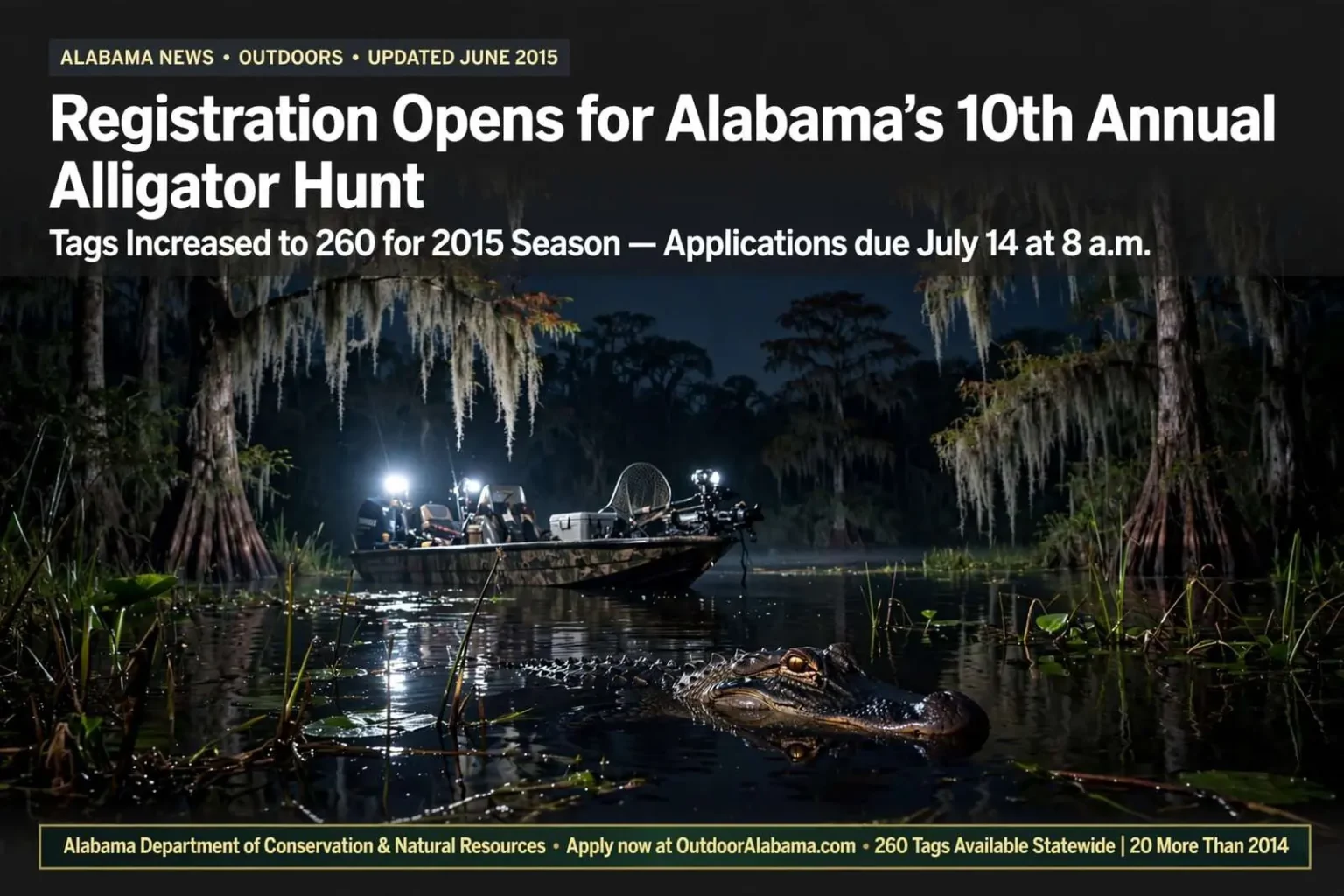
Hunters across South Alabama can now apply for a shot at one of the state’s most coveted outdoor draws: registration is open for Alabama’s 2015 regulated alligator season, the tenth consecutive year the state has held the public hunt. The Alabama Department of Conservation and Natural Resources is overseeing this year’s program, which has grown along with demand.
The number of alligator possession tags has been bumped up from 240 in 2014 to 260 for the 2015 season, giving successful applicants 20 more opportunities statewide than last year. The increase reflects a program that has settled into a fixture of the state’s outdoor calendar — one that draws applications from hunters across the region for a limited handful of tags.
A decade in, the regulated hunt has become one of the most competitive outdoor draws in Alabama. The odds of being selected remain steep, but the tag itself carries no charge beyond the application fee, and successful hunters get the rare opportunity to pursue one of North America’s largest reptiles in the wild waterways of the state’s southern half.
How to Apply
Registration must be completed online no later than 8 a.m. on Tuesday, July 14, through the department’s Outdoor Alabama website. The hunts themselves get underway in mid-August, giving drawn applicants roughly a month to prepare gear, scout access points and line up the boats and equipment a night hunt on Alabama’s rivers requires.
The application fee is $22, and each individual may register one time per zone. Entries are limited to Alabama residents and holders of Alabama lifetime hunting licenses who are at least 16 years old. The per-zone structure means a hunter willing to apply in multiple zones can spread the risk of the lottery across several separate pools, improving the chance of a tag somewhere in the state’s program. Each zone carries its own tag allocation and its own hunting waters, so applicants can weigh travel distance and familiarity when choosing where to enter.
While the alligator tag itself carries no charge, hunters drawn in the lottery — and their assistants — are required to have a valid hunting license in hand during the hunt. The requirement covers everyone on the boat, so drawn applicants need to make sure their entire party is licensed before the hunt dates arrive.
Where the Hunts Happen
For South Alabama outdoorsmen, the summer gator season has become a fixture of the calendar since the state launched its regulated hunt a decade ago, with tagged opportunities concentrated in the river deltas and wetlands of the southern part of the state. The Mobile-Tensaw Delta — the vast maze of rivers, bayous, sloughs and bottomland hardwoods north of Mobile Bay — stands at the heart of Alabama’s alligator country, an ecosystem whose healthy waterways support one of the largest reptile populations in the Southeast.
The delta’s braided channels and abundant prey make it ideal alligator habitat, and its remote stretches see relatively little boat traffic after dark, which is precisely when the hunts are conducted. Beyond the delta, the state’s hunt zones reach into other southern waters where alligator populations sustain limited harvest, with boundaries drawn to match the waters that hold the animals and tag numbers set zone by zone to keep harvest pressure in balance with local populations.
The season’s timing is no accident. August hunts fall in the peak of summer, when alligators are most active and most visible on the water after dark. Hunts are conducted at night, with hunters spotting the animals’ eyeshine from boats before working to get within range — a pursuit that combines scouting skill, marksmanship and boat handling in conditions most hunters rarely face.
A Young but Established Tradition
Alabama’s regulated alligator hunt began as a response to a growing population of a species that had rebounded dramatically since the mid-twentieth century, when unregulated hunting and habitat loss pushed alligators to the brink across the Southeast. Federal and state protections allowed populations to recover over decades, and by the time Alabama launched its public hunt, the state’s southern waterways held an alligator population strong enough to sustain a limited harvest.
Alabama joined other Southeastern states that had already established public alligator programs, adapting the lottery-tag model to its own waters. The design is consistent across the region: a limited number of tags, defined hunt zones, night hunting with specific permitted equipment, and mandatory check-in of harvested animals so biologists can track the size and age structure of the take.
The lottery format serves both goals that conservation agencies balance in such programs: providing public hunting opportunity while keeping the harvest at a level the population can absorb. Limited tags, defined zones and mandatory harvest reporting give biologists a controlled sample of data on the animals being taken, year after year.
Ten years of hunts have also built a body of local knowledge. Outfitters, guides and experienced hunters have developed techniques for the state’s particular waters, and the stories from past seasons — some of them featuring animals well beyond ten feet — circulate through tackle shops, hunting camps and outdoor forums across South Alabama every summer.
What Drawn Hunters Should Know
The gear demands of an alligator hunt set it apart from any other pursuit in Alabama. Successful hunters typically run sturdy boats rigged with lights for spotting at night, heavy tackle for the initial hookup, and the equipment required under the state’s rules for dispatching and retrieving the animal. The department provides successful applicants with the specific regulations and harvest-reporting requirements that govern their tag.
Preparation usually begins well before the hunt date. Scouting the assigned zone, learning the boat ramps and access points, and watching where alligators are holding all improve the odds of a successful night on the water. Hunters unfamiliar with the deltas would do well to spend daylight hours on the water before their hunt dates, learning the maze of waterways they will navigate in the dark.
Safety discipline matters as much as gear. Night hunting from a boat in summer brings heat, insects, and the inherent risks of running unfamiliar water in the dark, and experienced hunters stress the basics: life jackets aboard, navigation lights working, communication gear on hand, and a party that knows who is handling what at every stage of the hunt. The alligators that draw hunters to the water are powerful animals, and the hunts that go smoothly are the ones planned that way.
The Lottery Odds and the Long Game
With 260 tags and a pool of applicants that has grown with each season, the realistic expectation for any individual registration is rejection. That reality has not dulled interest; hunters apply year after year, and the per-zone entry rule lets the most determined applicants build their chances across seasons and zones alike. For many South Alabama hunters, the annual application is simply part of the summer routine — a $22 ticket on a shot at the state’s most distinctive hunt.
The state’s program has expanded carefully since its launch, adjusting tag numbers as managers gained experience with the population and the hunt. The jump from 240 to 260 tags for 2015 continues that measured approach — growth in opportunity without a rapid expansion that could outpace what the resource supports.
What the Season Means for the Region
The alligator season draws hunters, guides and equipment spending into the small communities around Alabama’s southern waterways each August. Towns along the delta and the rivers that feed Mobile Bay see the annual influx as a modest but real boost — boats in the water, gear bought locally, and hunters patronizing the cafes and lodges that serve the region’s outdoors economy.
The hunt has also changed the public’s relationship with an animal that was once seen mainly as a hazard. A decade of regulated harvest, covered each year in outdoor media, has built a picture of the alligator as a managed wildlife resource — something to be pursued responsibly under rules designed to keep the population strong.
The Deadline and Beyond
Applicants who miss this window will have to wait until next summer, when the state is expected to open registration for another season. The July 14 deadline is firm, and the department’s online system is the only route to entry — there is no in-person or mail-in application.
For South Alabama outdoorsmen, the checklist is simple: confirm residency and license status, decide which zones to enter, submit the $22 registration online before 8 a.m. on July 14, and start preparing for the possibility of a mid-August night on one of the wildest waterways in the state. Ten years in, Alabama’s alligator season has proven itself a draw worth the wait — and the 2015 season, with its expanded tags, offers more chances than ever to be part of it.