Rider Dies After 4-Wheeler Runs Stop Sign and Hits Truck on Springhill Avenue
Mobile police say a 4-wheeler ran a stop sign on Springhill Avenue and hit a truck; the rider later died at a hospital.
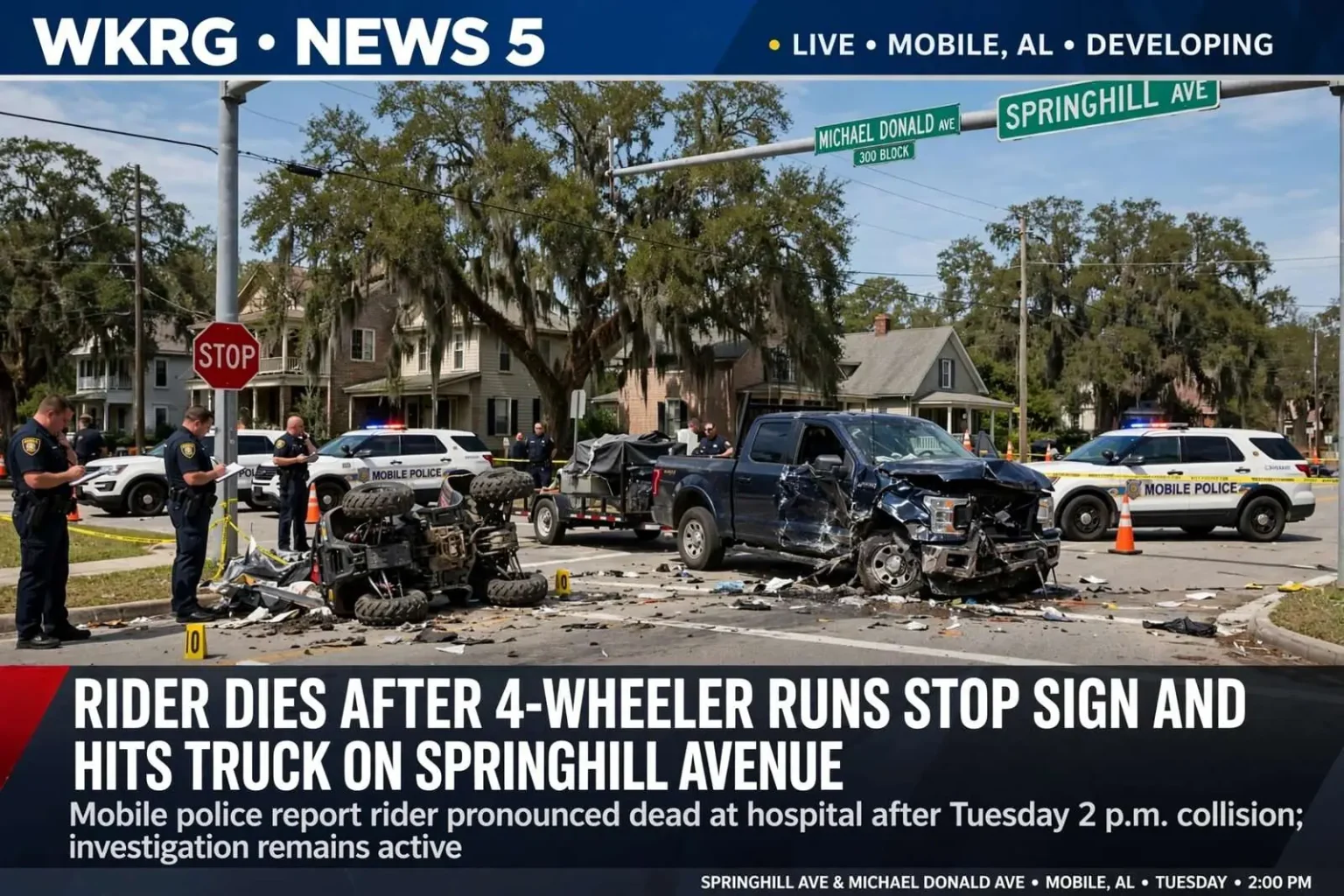
A rider is dead after a crash involving a four-wheeler on Springhill Avenue in Mobile, according to city police. Mobile Police Department officers responded to a traffic accident with possible life-threatening injuries around 2 p.m. Tuesday at the intersection of Springhill Avenue and Michael Donald Avenue. Investigators determined the victim was riding the 4-wheeler when he failed to stop at the stop sign at that intersection, colliding with a truck pulling a trailer. The rider was transported to a hospital, where he was pronounced dead. His identity was not immediately released. The investigation remains active.
The crash joined a painful category of incidents that Mobile and cities across Alabama know well: the four-wheeler on a city street. Four-wheelers — all-terrain vehicles built for trails, fields and off-road use — are not designed for pavement and are not legal to operate on public roads in most circumstances under Alabama law. Yet they appear on city streets with regularity, particularly in neighborhoods where they are common transportation for young riders, and collisions between them and full-sized vehicles too often end in tragedy.
This crash happened at the intersection of Springhill Avenue and Michael Donald Avenue, a crossing in midtown Mobile where a busy east-west thoroughfare meets a residential street. Springhill Avenue carries steady traffic through the heart of the city, connecting neighborhoods from the west side toward downtown, and its intersections see a constant flow of cars, trucks and commercial vehicles throughout the day. At 2 p.m. on a Tuesday, the roadway was in its ordinary working rhythm when the four-wheeler and the truck met.
According to investigators, the rider approached the intersection and failed to stop at the stop sign governing his direction of travel. The four-wheeler pulled into the path of a truck pulling a trailer, and the collision that followed threw the rider into a crash no restraint system could soften. Officers responding to the call found a scene with life-threatening injuries, and the rider was rushed to a hospital, where doctors could not save him. He was pronounced dead at the hospital, and police withheld his name pending notification of family.
The danger of ATVs on city streets
The mismatch between a four-wheeler and a truck towing a trailer is stark. An ATV offers its rider no enclosing frame, no seat belt in most configurations and none of the crash protection that passenger vehicles provide. In a collision with a truck, the rider absorbs the impact directly, and head, chest and abdominal injuries are common outcomes. Safety agencies across the country have long warned that ATVs are built for off-road terrain, where low speeds, soft ground and the vehicle’s wide stance work together to keep the machine stable.
On pavement, everything changes. Hard surfaces offer none of the forgiveness of dirt, the tires designed for trails grip differently on asphalt, and the other vehicles on the road move at speeds that turn any collision into a violent event. Riders on city streets also face hazards off-road vehicles never encounter: intersections, traffic signals, vehicles entering from driveways and drivers who simply do not expect to meet a four-wheeler in a traffic lane.
Alabama law treats ATVs as off-road vehicles, and operating one on a public road is generally prohibited except in narrow circumstances. Law enforcement agencies in Mobile and across the state periodically crack down on street riding, but enforcement is a game of whack-a-mole: four-wheelers are easy to ride through neighborhoods and hard to pursue safely. Police departments have often limited high-speed chases of ATVs precisely because the pursuits themselves endanger the public, leaving education and visibility as the main tools.
The intersection where the crash occurred is marked with a stop sign for the direction the rider was traveling, the standard traffic control at a crossing like that one. Investigators will examine sight lines, speeds and the sequence of movements, but the fundamental fact reported by police — the failure to stop — points to the moment where the outcome was decided. Traffic engineers have long identified failure-to-yield and failure-to-stop crashes at intersections as among the deadliest types, because they occur at closing speeds with little warning to either party.
Michael Donald Avenue and its place in Mobile
Springhill Avenue itself is one of Mobile’s old and busy corridors, running east-west through neighborhoods lined with homes, churches and small businesses. Its width and straightness invite steady traffic, and its intersections with north-south streets are the scene of the ordinary frictions of city driving — and, occasionally, of extraordinary tragedy. Residents along the avenue have grown used to its traffic, but a crash that takes a life on a Tuesday afternoon cuts through that routine completely.
The truck pulling a trailer that struck the four-wheeler could not have stopped the collision once the rider entered its path, by the account investigators gave. Drivers of trucks and other vehicles involved in such crashes face their own ordeal: interviews with investigators, damage to their vehicles and the knowledge that someone died at the bumper of their truck. Police did not identify the truck’s driver or say whether any charges were anticipated, and the active investigation will determine how the case is resolved.
What investigators will do next
Mobile police described the investigation as active, which means the work of reconstructing the crash continues. Investigators will document the final positions of the four-wheeler and the truck, measure skid and scuff evidence on the pavement, examine the vehicles for damage patterns and interview witnesses who saw the moments before impact. In crashes involving a vehicle that ran a stop sign, the physical evidence typically confirms the sequence, but investigators also look for contributing factors: the rider’s speed, visibility at the corner, the condition of the four-wheeler and anything else that shaped the outcome.
The rider’s identity was not immediately released, pending notification of family — the standard practice that gives loved ones time to learn of a death before the public does. Once family is notified, police typically confirm the name, and the full picture of who the rider was becomes part of the record. Until then, the crash is described only in terms of what happened on the pavement.
For police, crashes like this one also generate follow-up work that reaches beyond the scene. Reports go to the district attorney’s office for review. Records of the intersection’s history may be examined. And the department adds the case to the tally of fatal crashes it tracks each year, numbers that shape where the city positions traffic enforcement and safety campaigns.
The broader toll of ATV crashes
Four-wheeler deaths occur across south Alabama every year, on rural roads, county highways and city streets alike. Hospitals in the region treat ATV injuries that range from broken bones to devastating head trauma, and trauma physicians repeatedly note that helmets — rarely worn by street riders — are the difference between walking away and not surviving in many of these crashes. The machines are popular, affordable and useful on private land, which is exactly why they keep turning up on public roads despite the law.
Safety advocates urge parents in particular to treat four-wheelers as the age-restricted machines they are. Youth-sized ATVs carry manufacturer recommendations for minimum ages, and adult-sized machines are not meant for children at all. Beyond age, advocates stress the basics: ride only on appropriate terrain, wear a helmet, never ride under the influence, and never ride on public streets. Each of those rules exists because the alternative has been tested, on streets like Springhill Avenue, with fatal results.
The crash also resonates in a community where four-wheelers are woven into daily life in some neighborhoods. Residents see them running errands, carrying kids to friends’ houses and crossing intersections at all hours. The sight is familiar enough that it no longer draws attention — until an afternoon like this one, when the familiar machine and an ordinary truck meet at a stop sign and a family’s world changes.
The street where the rider died carries a name that Mobile takes seriously. Michael Donald Avenue was renamed to honor Michael Donald, a young Mobile man whose 1981 lynching stands as one of the last in Alabama and whose case ultimately reshaped civil rights law nationwide. The renaming put his memory into the daily geography of the city, on a street that runs through the same midtown neighborhoods where he lived. Crashes that occur at the intersection bring that name into police reports and headlines, a reminder of how the city’s history and its present share the same corners.
Mobile police ask anyone who witnessed the crash or has information about it to come forward, as witness accounts can resolve questions the physical evidence cannot. The department’s traffic investigators will continue the active investigation, and their findings will eventually close the file on the crash itself, though not on the loss behind it.
What remains publicly known is the outline: a Tuesday afternoon around 2 p.m., the intersection of Springhill Avenue and Michael Donald Avenue, a four-wheeler that failed to stop, a truck pulling a trailer, a rider rushed to a hospital and pronounced dead, and an investigation that continues. It is the kind of incident that traffic safety officials describe in statistics and families describe in grief, and Mobile has seen it before.