Rip Current Blamed for Second Gulf Shores Drowning This Season
A 52-year-old visitor drowned in Gulf Shores amid rip current conditions, the second such drowning this season, beach safety officials say.
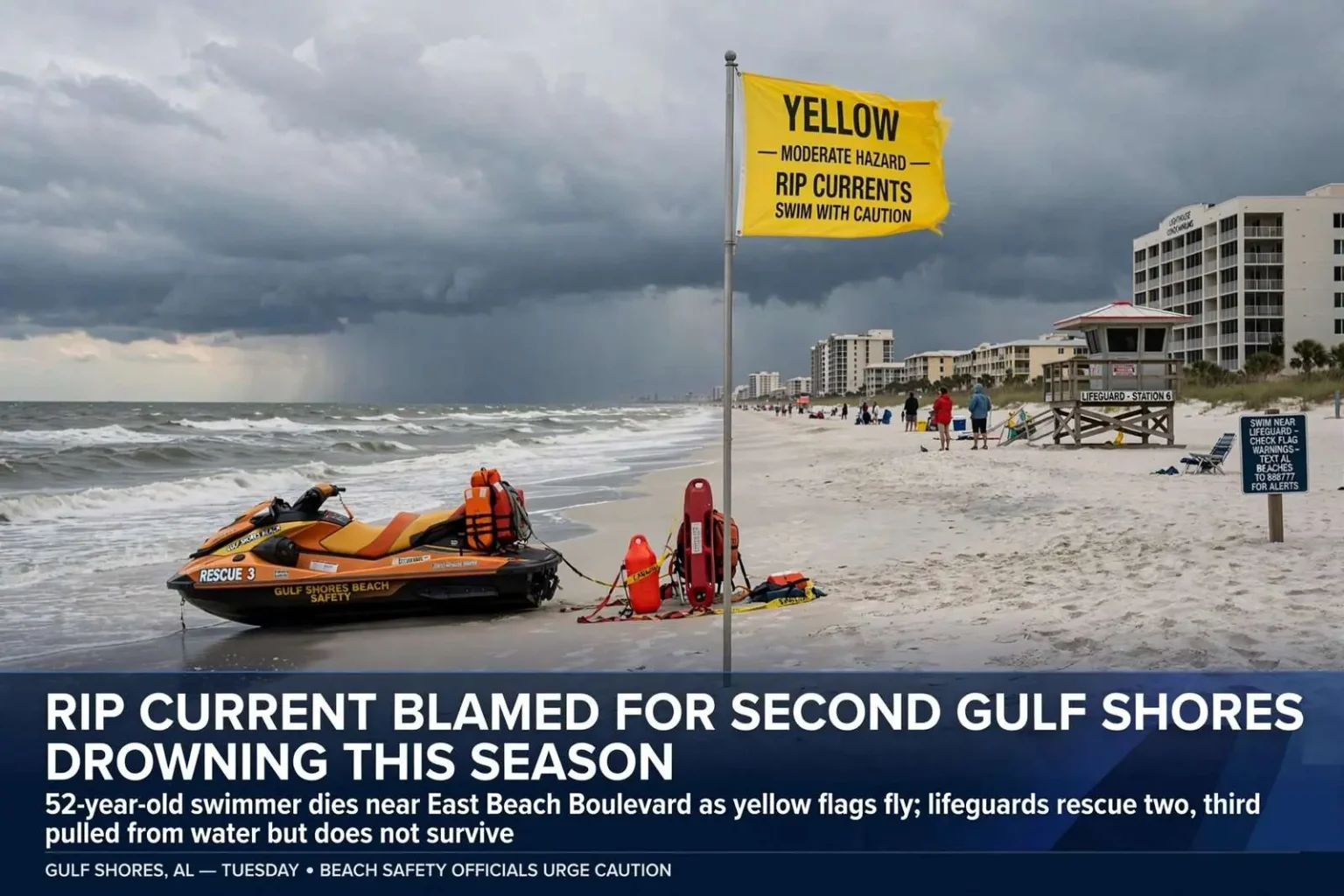
A visiting swimmer died Tuesday after being pulled from the Gulf of Mexico in Gulf Shores, marking the second drowning in the beach town this season, according to city beach safety officials.
The drowning happened just after 5 p.m. near East Beach Boulevard, where Greg Teer was watching from his balcony at the Lighthouse Condominiums when he noticed rescue crews arriving in a hurry. “I could see there was some chaos going on and we saw the first patrol car showing up,” Teer recalled. “And then we saw the jet ski and the swimmer trying to find someone, so I knew that there was somebody that was in trouble in the water.”
Lifeguards responded after receiving reports of three swimmers in distress. Beach safety officers said that by the time crews arrived, two of the swimmers had made it to the beach, but a third person was missing. “Bystanders said there was somebody in the water still, so some lifeguards started assessing the patient on the beach while others went in,” said Joethan Phillips, Beach Safety Chief for the City of Gulf Shores. “Shortly after, the jet ski came in, around two minutes, and they located the other individual in around waist-deep water, brought them in and provided resuscitation.”
The man, described only as 52 years old, was taken to a hospital but did not survive. Two rescued swimmers and one who could not be revived — that is the arithmetic of a rip current rescue, where minutes separate the outcomes and where the responder’s clock starts only when someone realizes a swimmer is gone.
What the flags were saying
Yellow caution flags were flying at the time, and officials say the surf picked up later in the day as storms moved through the area. “It was yellow flags. We had those storms come on and off in the morning,” Phillips said. “Conditions are like they were today and right after that they started to pick up as storms came through. There was a moderate risk of rip currents in effect yesterday, so I think that is what happened.”
Alabama’s Gulf beaches use the standard flag warning system, and the colors carry specific meanings that officials urge every visitor to learn before wading in. Green means calm conditions, yellow signals moderate surf and hazards — swimmers should use extreme caution — red flags mean high hazards with swimming discouraged, and a double red flag closes the water entirely. A yellow-flag day is precisely the kind that catches visitors off guard: the water looks swimmable, the beach is open, but conditions are strong enough to overpower anyone caught in a current.
The timing Phillips described is a familiar pattern on the northern Gulf Coast. Morning storms pass offshore, the afternoon sun draws crowds back to the water, and the storm systems stirring beyond the horizon send pulses of rough surf and stronger longshore currents up the beach. Swimmers who entered the water at midday in benign conditions can find the same stretch of sand producing dangerous currents by late afternoon — which is exactly the window in which Tuesday’s rescue unfolded.
How rip currents catch swimmers
Rip currents are narrow channels of fast-moving water that pull away from the shore, typically forming near breaks in sandbars, around jetties and along dips in the seafloor. They do not drag swimmers under; they carry them out. The danger comes from what happens next — a swimmer who fights the current directly exhausts themselves against water moving faster than they can swim, while the current itself usually dissipates just beyond the breaking waves, where escape is easy for anyone who knows to swim parallel to the beach first.
Safety officials teach the same sequence every season: stay calm, float or tread water rather than fighting the pull, signal for help, and swim sideways across the current toward the breaking waves only once the grip eases. The swimmers who made it back to shore Tuesday likely did so by escaping the current’s channel or reaching the bottom where it weakened; the man who died was located in waist-deep water by a rescue jet ski within roughly two minutes, a reminder of how quickly a search area can be covered when crews respond in force.
A beach town on alert
News of the drowning spread quickly among beachgoers the following day, prompting many visitors to be more cautious as red flags — signaling a high risk of dangerous rip currents — flew up and down the coast. “Oh, I might get my feet in, but I’m not going to get in it. I’m looking for seashells today,” said visitor Terri Janes.
“I’m not going to go way out there like I did a couple days ago, but just up to my knees. Something like that. Just let the water touch me a little bit,” added Richard Dunn, another beachgoer. The shift in behavior — from swimming out to wading in — is exactly what flag changes are designed to produce, and longtime beach workers say it is the surest sign a warning has reached the people it protects.
Gulf Shores and neighboring Orange Beach host millions of visitors a year, many of them inland families whose only experience of open-water swimming comes on this trip. That makes the visitor population the central challenge for beach safety: the people most likely to be in the water are also the people least familiar with Gulf conditions, least likely to know what a rip current looks like from the beach, and least likely to have heard the season’s first warnings.
The risks that remain
Rip currents remain one of the leading causes of drowning deaths along Alabama’s Gulf Coast beaches, particularly after storms pass through and stir up rough surf. The danger is not confined to flagged days or to strong swimmers’ overconfidence; rip currents can overpower capable athletes, and they account for the majority of lifeguard rescues on this coastline in any given year.
Beach safety officials continue to urge visitors to check flag warnings before entering the water and to swim near a lifeguard station whenever possible. The advice is directional as much as behavioral: beaches with lifeguard coverage concentrate rescue capability where the crowds are, cutting the response time that made Tuesday’s rescue of two swimmers possible. Swimming at unguarded stretches — inviting for privacy, treacherous in an emergency — removes the fastest help a swimmer in trouble can get.
Residents and tourists can also sign up for free text alerts on beach conditions through the Beach Safe app by texting “AL BEACHES” to 888777. The alerts push flag changes and hazard warnings directly to the phones of people already on the sand, closing the gap between the flagpole at the public beach and the condo balcony half a mile down the shore.
For a resort town, the season’s second drowning is a somber benchmark, and the days after such a loss tend to bring the kind of vigilance officials wish lasted all summer. The conditions that produced Tuesday’s rescue — storms offshore, a moderate risk upgraded to high, three swimmers in the water — will recur on the Gulf Coast as surely as the season continues. The flags, the jet skis and the text alerts exist for that recurrence, and the difference between a rescue and a recovery, as Tuesday showed, is measured in how quickly the warnings are heeded.
What beach safety looks like in Gulf Shores
Gulf Shores operates one of the more developed beach safety programs on the Alabama coast, with year-round staff, patrolled public beach areas and a chief of beach safety coordinating lifeguards, rescue equipment and condition reporting. The response Phillips described — beach crews triaging patients on the sand while others entered the water, a jet ski locating a missing swimmer within about two minutes — reflects the layered approach the city has built for exactly this kind of emergency.
Visitors sometimes assume the flags at the beach are advisory in the casual sense, but on this coast they are operational. Lifeguard staffing, patrol patterns and rescue readiness are all keyed to the day’s flag color, and the step from yellow to red changes how the beach is managed. Swimmers who watch the flags are effectively watching the safety system adjust around them; swimmers who ignore them are invisible to that adjustment until something goes wrong.
The east end near East Beach Boulevard, where Tuesday’s rescue occurred, is a popular stretch lined with condominiums whose balconies overlook the water. Those balconies play a recurring role in coastal rescues: residents and guests like Teer are often the first to spot trouble, dial 911 and direct crews to the exact patch of water where a head disappeared. In a season of heavy visitation, that informal network of eyes is part of the safety system whether anyone plans it or not.
Advice worth repeating all season
Every drowning on the Alabama coast gets followed by the same guidance, because it is the guidance that works. Check the flags before you choose a spot, not after you have set up your umbrella. Swim where lifeguards can see you. Know that a rip current feels like being carried away from shore, not pulled down, and that the escape is sideways, not straight back. If someone near you is caught, do not swim out after them — throw something that floats, call for help and let trained rescuers make the water entry.
Parents of teenagers should add one more: the calmer-looking water between sandbars is often where the current is strongest, and strong young swimmers are the most likely to test it. Tuesday’s three swimmers were in distress together, which is common — groups enter the water together, get caught together, and separate outcomes come down to position in the current and luck.
The free text alert system extends those warnings beyond the moment visitors first park. Conditions on the Gulf change with the weather by the hour, and a family that arrived under a yellow flag can be on the sand under a red one before lunch. Texting “AL BEACHES” to 888777 puts those changes on the phone in the beach bag, where the decision about the next swim is actually made.
Gulf Shores will post more flags, run more rescues and log more safe swim days than dangerous ones as the season goes on — that is the norm along Alabama’s beaches, where the water is the whole point of the visit. Tuesday’s loss is a reminder of the exception: a moderate-risk day, storms building offshore, and three swimmers for whom the gulf’s pull proved faster than the warnings. The safety system did its job twice that afternoon and fell short once. The numbers for the rest of the season depend on which part of that afternoon visitors remember.