Former State GOP Chairman Quits Party Committees After Backing a Democrat for District Attorney
Roger McConnell, a former Alabama Republican Party chairman from Mobile, resigned from the state and county GOP executive committees in 2004 after co-hosting a fundraiser for Democratic District Attorney John Tyson Jr.
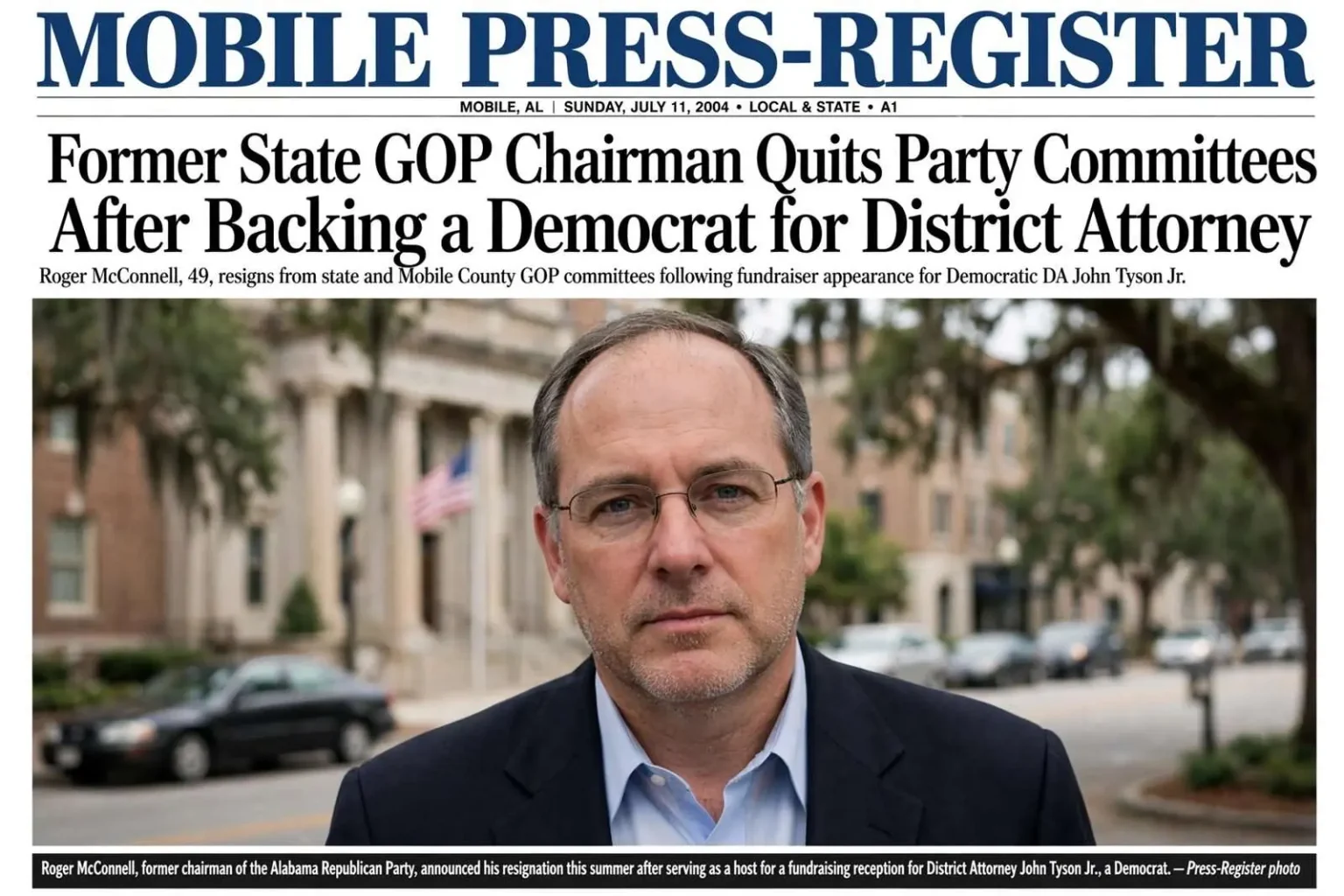
Roger McConnell, the former chairman of the Alabama Republican Party, resigned from both the state and Mobile County GOP executive committees in the summer of 2004 — a move that set Republican circles buzzing and that McConnell himself dismissed as “no big deal.”
The 49-year-old Mobile investment counselor had drawn the ire of some Republicans in June when he appeared as one of roughly 100 hosts of a fundraising reception for Mobile County District Attorney John Tyson Jr., the Democratic incumbent seeking re-election.
The June reception put McConnell’s name on an invitation with a roster of the region’s most prominent political and business figures, and word of it traveled through party circles faster than any formal complaint could. By the time summer arrived, the question circulating among Republicans was not whether McConnell had done it — his name was on the host list — but what, if anything, the party apparatus would do about a former state chairman lending his name to a Democrat’s re-election campaign.
A Bipartisan Guest List
McConnell was hardly alone on that host committee, and the roster was a study in how personal relationships can override party lines in Alabama politics. His co-hosts included Retirement Systems of Alabama chief David Bronner; former Mobile County Sheriff Tom Purvis; former Congressman Jack Edwards; County Commissioner Sam Jones; lobbyist and former Lt. Gov. Steve Windom; former Democratic Party chairman Jack Miller; businessman Oliver H. Delchamps Jr.; and Riley Boykin Smith, who had headed the Conservation Department under Gov. Don Siegelman.
The list crossed party lines in both directions. Edwards was a Republican who had held the region’s congressional seat for two decades; Windom was a Republican former lieutenant governor; Jones and Smith were Democrats; Bronner, who ran the state pension system, famously contributed to candidates of both parties. Tyson, a Democrat who had served as district attorney since the 1980s, cultivated exactly this kind of crossover support, and his fundraising rosters routinely included Republicans who knew him from his years as a prosecutor, a judge and a fixture in the local legal community.
Tyson was set to face Republican nominee Walter Honeycutt in the November general election.
A Rule With an Exception
Bylaws governing the Mobile County Republican Executive Committee prohibited members from supporting non-Republican candidates over Republican nominees — except, notably, “by personal vote.” That carve-out draws a line between what a committee member may do privately in the voting booth and what he may do publicly with his name on an invitation.
According to GOP officials, no formal complaint about McConnell’s role in the Tyson campaign was ever filed. He resigned before the question was forced.
Honeycutt, for his part, expressed disappointment that “at least one conservative Republican is supporting a very liberal Democrat.”
The two candidates were scheduled to address the Mobile County Law Enforcement Association at the MCLEA lodge on Riviere du Chien Road that Monday evening, one of the traditional joint appearances of a Mobile County district attorney’s race, where the endorsement of the law enforcement community carries its own weight.
The distinction the bylaws drew — between the private ballot and the public invitation — reflected an old accommodation in Alabama politics. Party organizations have always had to coexist with a political culture in which friendships, professional ties and family history frequently outweigh party labels, particularly in county offices like district attorney and sheriff where a candidate’s reputation is built across decades of courtroom work.
Who McConnell Was
McConnell’s departure carried more weight than a routine resignation because of the role he had played in building the modern Alabama Republican Party. As state chairman, he personally traveled to all 67 Alabama counties in a grassroots effort to construct the party from the county courthouses upward.
That was a deliberate reversal of strategy. Previous Republican gains in Alabama had come from the top down — statewide and federal offices flipping first, with local offices following slowly if at all. McConnell argued that the party’s long-term viability depended on establishing a base at the county level, where sheriffs, probate judges, commissioners and district attorneys actually run local government.
The strategy he championed would, in time, largely be vindicated. Alabama’s counties that had never elected a Republican courthouse official began doing so through the 1990s and 2000s, and by the following decade GOP dominance extended through county offices across most of the state. The irony of 2004 was that a party leader who had preached county-level loyalty found himself on the receiving end of the same discipline he had spent years building.
He had also been, arguably, Gov. Bob Riley’s chief antagonist within the party the previous year, when Riley — a Republican — campaigned for a sweeping tax reform and revenue increase. The measure was crushed in a statewide referendum in September 2003, and McConnell was among the conservatives who helped bury it.
The referendum, remembered as Amendment One, remains one of the most lopsided losses for a sitting governor in modern Alabama history, and the conservatives who organized against it — anti-tax groups, county party activists and figures like McConnell — emerged from the fight with a defined identity inside the party. That history colored the reaction to his resignation: some Republicans read it as the exit of a man already at odds with the party’s leadership, while others saw a genuine loss of institutional knowledge and fundraising ability.
In announcing his resignation, McConnell said his philosophy of lean, efficient and less expensive government had not changed. He intimated that he could pursue that goal more effectively without official party ties — a statement that read, to some, less like a retreat than a repositioning.
The Larger Point
The episode illustrated a tension that has run through Alabama’s political realignment for decades. Party organizations demand loyalty to nominees. But in a state where a district attorney’s race turns on reputation, courtroom record and personal relationships built over thirty years, plenty of voters — and plenty of party officials — will cross the line without hesitation.
District attorney is a peculiar office in that respect. Unlike governor or senator, the job is defined less by ideology than by administration: deciding which cases to charge, managing assistants, working with every police agency in the county and answering for convictions and mistakes alike. Voters in Mobile County had returned Tyson, a Democrat, to office repeatedly in an era when the county was otherwise drifting Republican, because the office’s work was seen as separate from the party contest. Candidates like Honeycutt faced the problem every Republican DA challenger of that era faced — arguing that a competent incumbent should be replaced because of his ballot label.
McConnell chose to resolve the conflict by removing himself from the party apparatus rather than by removing his name from the invitation. In doing so, he made explicit what the bylaws had tried to keep implicit.
The resignation also set a practical precedent for the county committee. A member can support whomever he likes in the booth, the bylaws say, but a member’s name on a Democratic fundraiser is a public act with consequences — and the consequence here was resignation rather than expulsion, without a vote, a hearing or a recorded complaint. The quiet end to the episode was itself characteristic: Alabama party politics of the period preferred accommodation to confrontation, especially when the member in question had built much of the organization doing the judging.
Whatever McConnell’s own accounting, the summer of 2004 offered a case study in the limits of party loyalty in Alabama — where a former state chairman can help bury a Republican governor’s tax plan one year and host a Democratic district attorney’s fundraiser the next, and where the party’s own rules leave just enough room for both.
The timing of the resignation also intersected with a consequential election season. The 2004 cycle brought a presidential contest, a U.S. Senate race and a full slate of county offices to the November ballot, and the Mobile County Republican Executive Committee was preparing its general election operation — sample ballots, headquarters staffing, fundraising calls — when the summer’s episode played out. Party committee members are the foot soldiers of those operations, and McConnell’s exit, whatever it said about principle, removed one more experienced hand from the fall’s work.
The episode also said something about the era’s partisan arithmetic in Mobile County. Republicans had come to dominate most federal and statewide races in the county, but county-level offices remained a mixed landscape where Democratic incumbents like Tyson persisted on personal support. Party leaders on both sides understood that the realignment was still incomplete — which is precisely why a former party chairman’s name on the wrong invitation mattered, and precisely why the bylaws’ “personal vote” exception existed at all. Everyone involved knew how much was at stake in converting county offices, and everyone also knew that the people doing the converting had Democratic friends.