A Favor, Not an Endorsement: Sen. Rusty Glover Explains a Check to a County Commission Challenger
State Sen. Rusty Glover's $250 contribution to a Republican challenging an incumbent county commissioner needed explaining. He said it was simply reciprocity, and that he stays out of GOP primaries.
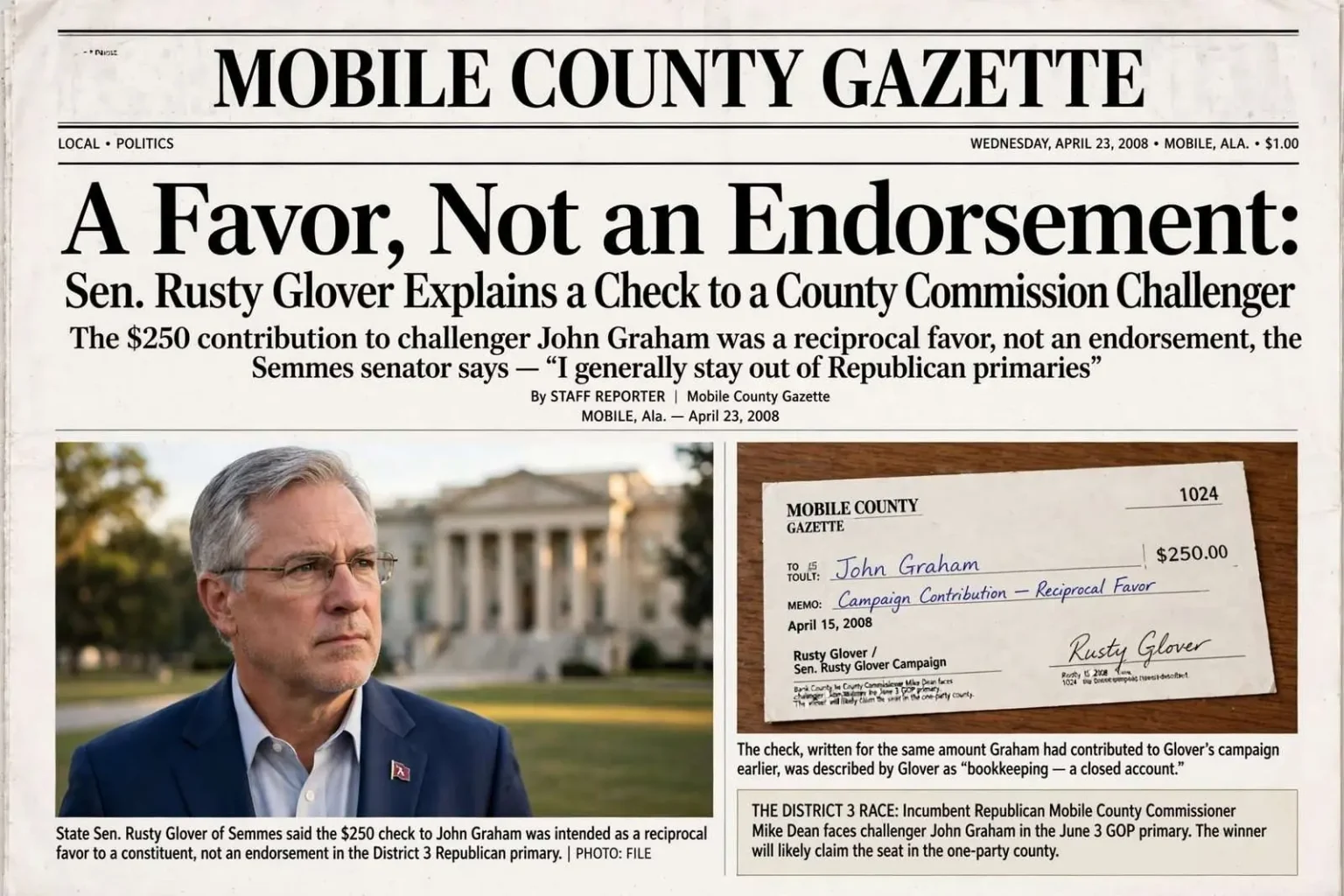
In the small world of Mobile County Republican politics, a 250-dollar check can require a paragraph of explanation. In April 2008, state Sen. Rusty Glover of Semmes supplied one. Glover had contributed 250 dollars to John Graham, the Republican challenging incumbent Republican Mobile County Commissioner Mike Dean. Dean and Graham were headed for the June 3 primary in District 3, and the sitting senator’s money showing up on the challenger’s side of the ledger was the kind of thing that gets noticed.
It gets noticed precisely because primaries are where political money is supposed to have opinions. A contribution to the opposing party tells everyone what they already know; a contribution to an incumbent’s challenger tells the incumbent something he did not. In a one-party county, where the Republican primary functionally decided who held the office, that small check was the local equivalent of a newspaper editorial.
Reciprocity, not preference
Glover’s explanation was that the check should be read as a favor to a constituent rather than an endorsement of a candidate. Graham had contributed 250 dollars to Glover’s own state senate campaign. Glover was reciprocating because, in his words, “it was the right thing to do.” He added a principle that many officeholders profess and fewer observe: “I generally stay out of Republican primaries.”
The matching amount was the tell. A true endorsement comes in a number chosen for its message; a returned favor comes in the same number the friend gave, timed to the same season. By writing the check in precisely the size of the original, Glover converted an act that would otherwise read as disloyalty to Dean into bookkeeping — a closed account between two campaigns, nothing more.
The reasoning is not hard to follow. An intraparty primary forces an officeholder to choose between people he will have to work with afterward, whichever one wins. The safest course is to give to anyone who gave to you, at the same amount, and to say plainly that the money means nothing more than that. Whether a challenger’s campaign would decline to interpret it more favorably is another question, and one the senator could not control.
For a senator whose district included the western part of Mobile County, the calculation had a practical edge as well. Semmes sits inside the sprawling District 3 commissioner territory, meaning whichever man won the primary would be Glover’s county-level partner on roads, drainage and the west Mobile County growth corridor. Choosing between them, in public, was a bet with no upside for the senator; recusing himself, in writing, cost him nothing with either camp.
The District 3 contest
The Mobile County Commission is a three-member body, which makes each seat consequential in a way that a large council seat is not. Two commissioners constitute a majority. Control of the county’s budget, its roads, its industrial recruitment and its considerable discretionary spending turns on very small numbers of votes, cast by very few people.
An incumbent Republican facing a Republican challenger in a June primary, in a county where the GOP nomination was increasingly the decisive contest, was therefore a race worth watching, whatever the senator from Semmes intended by his contribution. The county commission’s portfolio — the highway program, the port-adjacent industrial development, the water and sewer extensions that shaped where the suburbs could grow — made the nomination a genuine prize, not a ceremonial line on a ballot.
District 3 itself covered some of the county’s fastest-changing territory, stretching from Semmes and the fast-growing northwest toward the deeper western reaches of the county. Roads and schools were the constant subjects, and the commissioner who controlled a share of the county’s road money was, in practical terms, one of the most powerful local officials his constituents had.
The Republican women prepare a forum
Voters wanting to size up the field had an opportunity later that month. The Azalea City Republican Women scheduled a forum of local and statewide candidates in the June 3 GOP primary as the program for their regular monthly meeting, set for Tuesday, April 29 at 6 p.m. at the American Cafe, 3662-A Airport Blvd. Visitors and prospective members were welcome. The club listed Jeanette Greene at 675-4094 and Shirley Short at 344-1394 as contacts for more information.
The setting — a restaurant meeting room on Airport Boulevard, early on a weeknight — was the native habitat of Alabama primary politics. Candidates in a June contest do not buy television; they go where the reliably engaged are, and in Mobile County in 2008 the Republican women’s clubs were among the most reliably engaged audiences in the county.
Groups like the Azalea City Republican Women played an outsized role in a primary season of this kind. Turnout in a June primary is low, the electorate is dominated by the reliably engaged, and an evening in a restaurant meeting room in front of forty or fifty committed party members could matter more to a county commission candidate than a much larger expenditure on advertising. The clubs were also a network: the members who filled one room filled the others, forwarded the emails, hosted the coffees and remembered, in September, who had shown up in the spring.
For a challenger like Graham, the forum was the whole campaign in miniature. He needed the activists in that room to conclude that the incumbent could be beaten and that he was the one to do it — a judgment they would carry into their churches, workplaces and subdivision associations through the spring. For Dean, it was an hour of defending a record he had spent years building, before the exact audience most likely to have already formed an opinion.
Small money, small rooms
What the episode illustrates is how local politics actually works, at a scale that rarely makes headlines. A challenger gives a state senator 250 dollars. The senator gives it back, in effect, when the challenger runs. A club of party activists rents a room at a cafe on Airport Boulevard and invites the field to come explain themselves. Somewhere in that circuit, a county commission nomination is decided.
Glover, a history teacher by profession, went on to serve in the Alabama Senate for years and later ran for lieutenant governor. His careful little explanation of a 250-dollar check is, in its way, a complete education in the etiquette of one-party politics: give to your friends, stay out of the family fights, and if you must do both at once, say so out loud before somebody else does.
There is a broader lesson in the arithmetic as well. The county’s campaigns were financed in increments — two hundred fifty dollars here, a room rental there — and decided by margins measured in dozens of votes per precinct. In that economy, the difference between a candidate who attends the forums and one who skips them, or between a senator who explains his check and one who lets others explain it, is often worth more than the money itself. Mobile County’s June primaries had become the real elections, and April’s small rooms were where they were actually fought.
The statewide portion of the forum’s program broadened the evening’s stakes. June 3, 2008 put a full slate of statewide Republican primaries on the ballot, from the Public Service Commission to the state’s judicial races, and the clubs that hosted candidate nights in the spring functioned as the de facto debate schedule for all of them. A county commission candidate sharing a program with statewide hopefuls got a bigger room, a longer program and an audience primed to hear from everyone on the card.
The timing also mattered. Late April sat at the point of the primary calendar when campaigns either had money or did not, when the direct mail had either been designed or postponed, and when a candidate’s spring schedule told observers how seriously the campaign would run through June. The clubs’ calendars, published in advance with phone numbers for the club officers, were the public record of who was going where — and any campaign not on those calendars was, by definition, running a different kind of race.
For the officeholders watching, the spring club circuit carried its own message. The activists who filled those rooms were the volunteers every subsequent campaign would need, the poll workers every election would require and the voters every runoff would turn on. An officeholder who minded his relationships with them — as Glover was minding his relationships with everyone, by declining to pick sides — was protecting an asset that no single election would exhaust.
The episode between Glover, Graham and Dean dissolved into the county’s routine after that spring, as such episodes do. Dean carried the establishment’s advantages into June, Graham carried the challenger’s case into the small rooms, and the senator’s returned favor stayed exactly what he said it was — a closed account, explained out loud, in the vernacular of one-party Mobile County politics.