Sally Ripped Up Docks and Sank Boats at Orange Beach’s Sanroc Cay Marina
Hurricane Sally tore apart docks and sank boats at Sanroc Cay Marina in Orange Beach, where crews began clearing debris from the basin days after the storm.
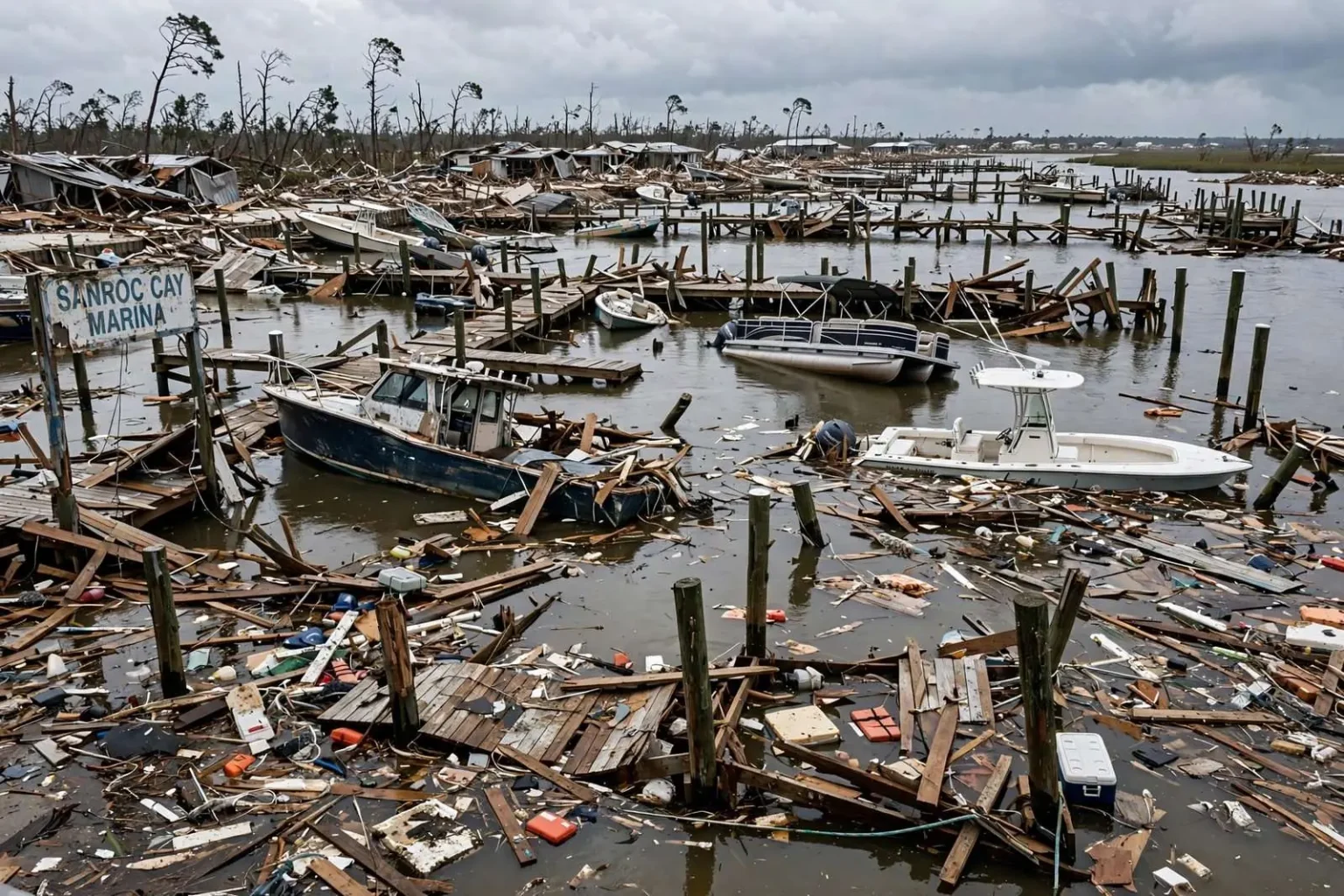
Hurricane Sally battered waterfront property across Baldwin County when it came ashore in September 2020, and Sanroc Cay Marina in Orange Beach was among the hardest-hit spots on the north side of the island. Video taken after the storm showed docks torn apart, vessels sunk at their slips and debris scattered through the basin. Pilings that held walkways in place were snapped or pulled loose as the surge rose and fell, leaving walkways twisted off their supports and floating in pieces across the water.
Sally was a slow-moving storm, and that slowness was what made it so destructive along the Alabama coast. Rather than sweeping through in a few hours, the hurricane sat and spun as it approached and after landfall near Gulf Shores, driving wind and water into the same communities over and over. For a low-lying barrier island community like Orange Beach, hours of persistent onshore wind meant the surge had time to stack up in the back bays, bayous and marina basins that shelter boats along the northern shores of Ono Island and the surrounding waterways.
A slow storm that pushed the water ashore
Storm surge behaves differently in a marina basin than it does on an open beach. At the shoreline, waves crash and recede, but inside a confined harbor the water has nowhere to go. As the surge rose at Sanroc Cay, it lifted docks and boats off their normal positions, and as it fell, anything not properly secured dropped onto pilings, cleats and the boats around it. Fixed walkways designed to flex with normal tides were no match for water levels that rose and fell well outside anything the structures were built to handle.
The damage was not unique to one harbor. From Mobile Bay east to Perdido Bay, Sally tore at nearly every piece of waterfront infrastructure in Baldwin County. Boathouses were ripped from their moorings on Fish River and Weeks Bay, piers along Mobile Bay’s eastern shore were splintered, and in Orange Beach and Gulf Shores entire marina districts spent days underwater. Emergency crews spent the first days after the storm focused on life safety, search and rescue, and clearing roads, which meant waterfront property owners often waited before they could even reach their docks to assess what was left.
What the video from the basin showed
The footage out of Sanroc Cay told the story in blunt visual terms. Docks that had formed neat rows of walkways were reduced to floating sections pinned against one another. Vessels sat partially submerged at slips where their mooring lines had failed or where the dock structure itself had given way beneath them. Debris of every kind, from broken decking to personal items washed out of boat storage areas, was scattered across the surface of the basin and piled along the seawalls.
Pilings are the backbone of any marina, and at Sanroc Cay many of them snapped outright or were pulled completely loose from the bottom. When a piling fails, the walkway it supports loses its anchor, and one failure tends to cascade into the next as freed sections of dock drift and ram into neighboring structures. That chain reaction is a large part of why a single hurricane can turn a functioning marina into a field of floating wreckage in a matter of hours, even when the boats themselves were tied off correctly.
The marina’s place in Orange Beach boating life
Sanroc Cay serves a community where boating is not a hobby so much as a way of life. Orange Beach sits at the heart of one of the busiest recreational boating regions on the Gulf Coast, with residents running vessels out of Perdido Pass into the Gulf, through the Intracoastal Waterway, and into the back bays and bayous that thread through the island. A marina on the north side of the island offers protected access to those waters, and for many slip holders it is the year-round home port for fishing boats, cruisers and pontoon boats alike.
When a facility like that goes down, the impact reaches well past the dock itself. Slip holders lose access to their vessels at the exact moment many of them need boats to check on their own waterfront homes. Charter operators and fishing guides who work out of the harbor lose their workplace. The marina basin becomes both the damage site and the logistical center of the recovery, which is why the days immediately after the storm matter so much for what comes next.
Crews on the ground by Tuesday
Cleanup was underway in the marina area by Tuesday, as crews hauled out broken decking and other debris so salvage operators could reach the boats that went down during the storm. That sequencing matters. Sunken vessels cannot be raised until the wreckage around them is cleared, and floating debris makes it dangerous to bring in the barges, cranes and dive teams that do the actual recovery work. Getting the basin clean enough to work in is therefore the first stage of every post-hurricane marina recovery, and it often takes longer than the salvage itself.
Raising a sunken boat is slow, specialized work. Salvage crews typically use lift bags, cranes and divers to refloat vessels one at a time, and every boat presents its own problems depending on where it settled, what it is resting on and whether its fuel tanks have held. Along the Gulf Coast after Sally, salvage operators worked basin by basin across Orange Beach, Gulf Shores and Pensacola, and the demand for their services far outstripped the number of qualified crews available in the immediate aftermath.
There are environmental stakes as well. Every sunken or damaged vessel carries fuel, oil and batteries, and a marina basin full of compromised boats is a potential pollution source right in the middle of a residential and tourist area. Part of the early cleanup involves containing sheens and carefully draining tanks before boats are lifted, which adds time but protects the waterways that the local economy depends on.
The same story along Cotton Bayou, Terry Cove and the Intracoastal
Marinas along Cotton Bayou, Terry Cove and the Intracoastal Waterway reported similar damage after Sally, with sunken and displaced boats complicating cleanup for weeks. Those waterways form the core of Orange Beach’s boating network, and all of them sit low and exposed to the same wind-driven water that hammered the north side of the island. A displaced boat is its own hazard: a vessel that breaks free drifts until it strikes something, and in a crowded harbor a single loose boat can damage a dozen others before anyone can get to it.
The weeks-long cleanup timeline is a familiar pattern for anyone who has watched a major hurricane hit the northern Gulf Coast. After previous storms, derelict vessel removal programs in Alabama and Florida stretched on for months, with state agencies, insurance companies and private owners sorting out who was responsible for each wreck. Boats with identifiable owners and valid insurance generally get raised and repaired or scrapped quickly; abandoned vessels can sit as hazards until a government program steps in, and every one of them is an obstruction for the other traffic trying to use the waterway.
Why commercial dock rebuilds take so long
Recovery at commercial marinas is often slow, because damaged docks have to be surveyed and permitted before they can be rebuilt. That requirement surprises many people, but it exists for good reasons. A marina is a regulated commercial structure sitting in public waters, and before reconstruction can begin, engineers have to determine what failed, whether the remaining pilings and utilities are sound, and what the rebuilt facility must look like under current codes and environmental rules.
Permitting for work in navigable waters involves multiple agencies, and a hurricane does not pause those requirements. In the weeks and months after Sally, marina owners across Baldwin County were simultaneously dealing with insurance adjusters, structural engineers and permit applications while also trying to keep whatever part of their operation still functioned running. Materials were another bottleneck: lumber, pilings, concrete and marine hardware were in heavy demand all along the coast at the same time, and construction crews were scarce for anyone without an existing contractor relationship.
For marina operators, the math of that delay is painful. Every month a basin is out of service is a month of slip revenue lost, and many slip holders who cannot wait simply move their boats to facilities that escaped the storm or further inland. Some never come back, which means a badly damaged marina is not automatically restored to its old business even after the docks are rebuilt. Operators who communicate clearly with their slip holders tend to keep more of their customer base through the rebuild.
What recovery looks like for boat owners
For the people whose vessels went down at Sanroc Cay, recovery runs through insurance as much as through salvage. A boat owner filing a claim after a hurricane needs documentation of the vessel’s condition, photographs of the damage, and a survey establishing its value, and in the weeks after Sally, marine surveyors along the Gulf Coast were booked solid as owners from Mobile Bay to Pensacola Bay worked through the same process. Policies differ on what they cover for salvage and haul-out costs, and those expenses can be substantial when a boat has to be lifted from a crowded, debris-filled basin.
Once a boat is raised, the decisions begin. A vessel that was underwater takes on water in the engine, electrical systems and interior, and the cost of full restoration can approach the value of the boat itself. Some owners repair, some accept a total loss settlement, and some end up selling damaged hulls to buyers willing to rebuild them over years. In every case the timeline is measured in months, not weeks, and that reality shapes the pace at which a marina’s slips refill after a storm like Sally.
Lessons for the next storm
Every hurricane along the Gulf Coast renews the conversation about storm preparation for boaters, and Sally was no exception. The boaters who fared best were generally the ones who moved their vessels well in advance, either to hurricane-rated storage or to protected anchorages well upriver or inland, where surge from the open bays cannot reach. Double and triple lines, extra fenders and removal of canvas and electronics all help, but the most reliable protection is simply not being in the surge zone when the water starts to rise.
Marina operators learned their own lessons. Modern dock design increasingly emphasizes taller pilings, more flexible walkway attachments and utility systems that can be quickly shut down and disconnected, all aimed at letting a facility ride out a surge rather than fighting it. After Sally, several marinas along the Alabama coast rebuilt with those principles in mind, and the rebuilt docks at damaged facilities are generally engineered to handle water levels well above what the original structures were designed for.
A long road back for the harbor
The images from Sanroc Cay captured a moment, but they were not the end of the story. Marinas in the region have rebuilt from hurricanes before, and the ones that survived Sally’s worst damage reopened in stages, first clearing the basin, then salvaging vessels, then rebuilding docks in phases so that at least part of the facility could serve boaters while construction continued. Recovery at this scale is measured in seasons, and the boating community that uses the harbor generally pitches in along the way, from helping neighbors haul gear to simply keeping business flowing through the rebuild.
For Orange Beach, the storm was a reminder of how tightly the city’s identity and economy are tied to its waterfront. The restaurants, charter fleets, boat dealers and marinas that line the back bays all depend on infrastructure that a single hurricane can tear apart in an afternoon. Sally’s damage to Sanroc Cay and marinas across Cotton Bayou, Terry Cove and the Intracoastal Waterway showed both the vulnerability of that network and the determination of the people who work on the water, and the slow, methodical cleanup that began that Tuesday was the first step in putting it all back together.