Saraland Planned New High School After 2007 School-System Split
Saraland school leaders outlined a new high school campus and transition plans in 2007 as the city prepared to separate from the Mobile County school system.
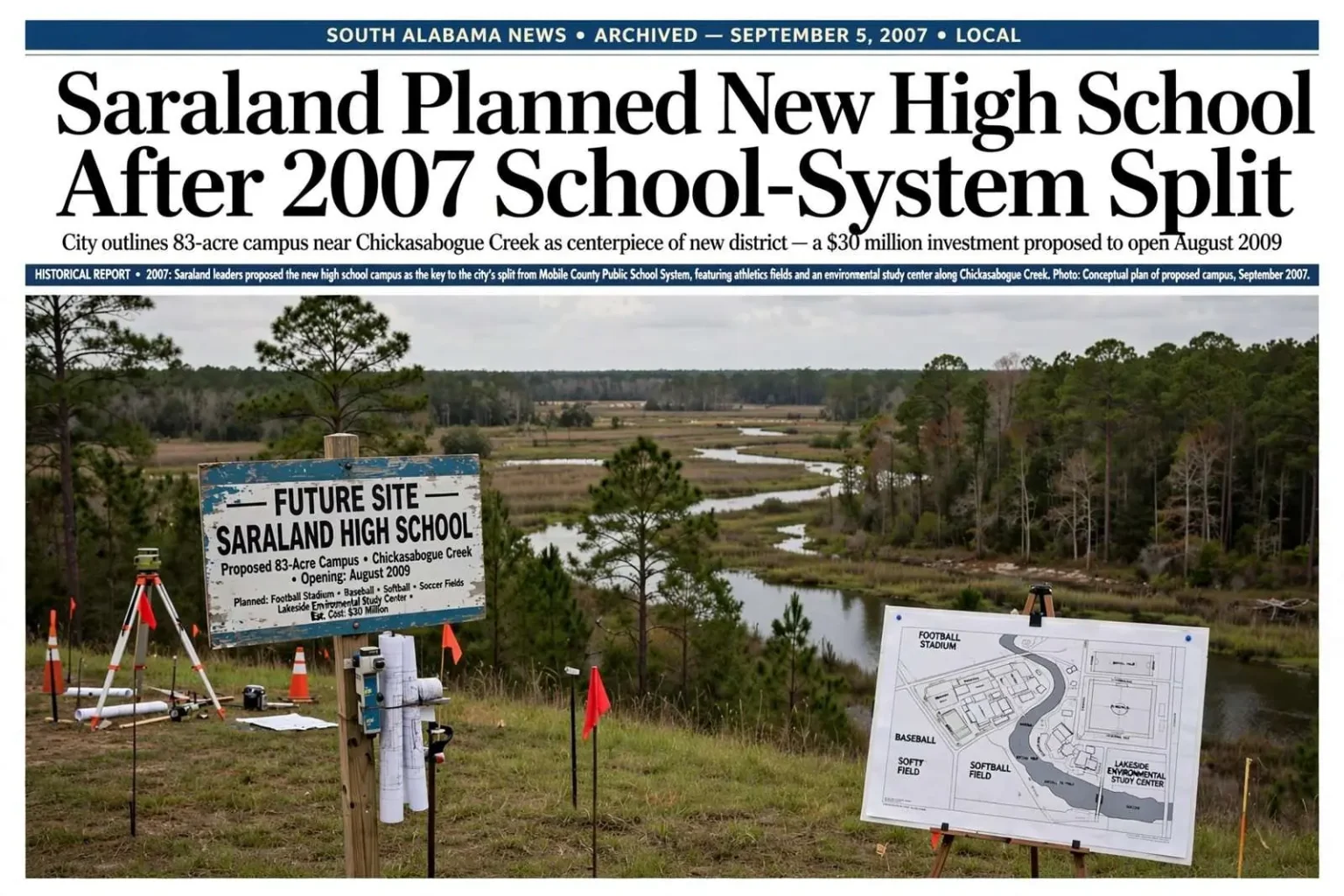
Historical report preserved from an archived 2007 local news story.
Saraland school leaders outlined plans for a new high school campus in 2007 as the city prepared to operate independently from the Mobile County school system — the boldest piece of the new district’s founding blueprint, and a promise of what the split was meant to deliver for the city’s students.
The proposed 83-acre site near Chickasabogue Creek was to include a football stadium, baseball, softball and soccer fields, and a lakeside environmental study center, a campus plan that went well beyond classrooms to picture athletics, outdoor education and community life on one piece of ground. The projected cost was just under $30 million, a figure that made the new school the centerpiece investment of the city’s breakaway school system.
Board member Bill Silver said leaders believed the city had not received adequate funding for construction and maintenance under the existing system. The split was scheduled to take effect the following fall, while the new high school was expected to open in August 2009. This article records plans reported in 2007 and is not a statement of current Saraland school facilities or policy.
Why Saraland split
Saraland’s departure from the Mobile County Public School System was the culmination of years of frustration in the city, a fast-growing suburb along U.S. 43 and Interstate 65 just north of Mobile. The state’s framework for municipal school separation — governed by Alabama law that requires a city to approve a split, hold a referendum and work out property transfers with the existing county board — made such breaks rare in Mobile County, where no city had left the county system in modern times. Saraland’s leaders argued that tax dollars raised in the city should be spent on the city’s own schools, and that a smaller, locally governed district could move faster and spend smarter.
Board member Bill Silver’s comment about inadequate funding for construction and maintenance captured the core grievance. Under the county system, Saraland’s schools aged while the city’s population grew, and local leaders pointed to overcrowded classrooms and deferred maintenance as evidence that the county’s capital priorities lay elsewhere. The split, in that framing, was not a rejection of public education but a bid for local control of it.
The timing mattered as well. Alabama had seen a wave of municipal school splits in the Birmingham area in earlier years, and Saraland’s move made it the first in Mobile County — a precedent that would be watched closely by neighboring communities in the years that followed, and one that reshaped public education across the county’s northern corridor once other cities pursued the same path.
The campus plan
The 83-acre site near Chickasabogue Creek reflected the ambitions of a new district building from scratch. The plan’s athletics component — a football stadium plus dedicated baseball, softball and soccer fields — would give a growing city’s teams facilities that the aging county-era campuses could not match, and would turn Friday nights in Saraland into the community gathering point that Texas-style high school football stadiums have long provided across the South.
The proposed lakeside environmental study center was the most distinctive piece. Sitting near Chickasabogue Creek — the waterway that threads through the area and feeds the Chickasabogue Park preserve downstream — the center imagined the school taking direct advantage of its setting: outdoor classrooms, wetland study and hands-on science along the water. The idea signaled the new board’s intent to build a curriculum identity, not merely new buildings, and to tie the school’s programs to the natural landscape of north Mobile County.
The just-under-$30-million projection made the campus one of the largest single investments the young city had ever contemplated, and paying for it became the defining test of the new district. City school systems in Alabama typically fund construction through a mix of local property and sales tax revenue, bonds issued against that revenue, and state capital funds distributed through the Alabama Department of Education’s formulas. A new district’s first years are the hardest: it inherits facilities of uncertain condition, assumes responsibility for debts and transportation, and must build administrative capacity while proving to voters that the split was worth it.
What the new district inherited
When the split took effect the following fall, Saraland assumed operation of the schools that had served the city under the county system, and the transfer of properties, employees and students between the two boards was negotiated under state oversight. The new district took on the schools it had — and set about replacing what they lacked, with the high school as the priority. High schools are the most expensive and most visible facilities a district operates: they require the widest range of classrooms, labs and athletic infrastructure, and they are where a community judges its schools at graduations, ballgames and band competitions.
The projected August 2009 opening of the new high school gave the city a two-year runway from the 2007 announcement — design, site work, bidding and construction compressed into the shortest realistic timeline. New-district construction of that pace required the board to sequence decisions carefully, from choosing architects to finalizing attendance zones, and every step was followed closely by a community that had voted for the split precisely to see its money become buildings and programs.
Chickasabogue and the setting
The site near Chickasabogue Creek placed the planned campus in one of the most scenic corners of the Saraland area. The creek runs through a landscape of pine and hardwood lowlands toward Mobile Bay, and the nearby Chickasabogue Park — a Mobile County recreation area of more than a thousand acres — has long offered the region hiking trails, campsites and water access. A school campus on adjoining ground, with a lakeside study center looking out over the same watershed, would have tied the city’s schools into that natural corridor in a way few Alabama districts attempt.
For the city’s families, the new high school plan represented the whole argument for the split in miniature: local dollars, local decisions and a campus designed for Saraland’s own students. The 2007 report captured the district at its founding moment — full of plans, budgets and promises — and this article preserves it as history: the campus as proposed, the cost as projected, and the timeline as reported, with no statement about what the facilities or policies became in the years since.
What the record shows is a city betting on itself: 83 acres by a creek, a stadium and ballfields for its teams, a lake for its science classes, and a school system of its own to run them. That was the plan Saraland’s leaders described in 2007, just under $30 million and two school years away from the opening they promised for August 2009.
Financing a brand-new district
Building the campus required the new board to assemble a financial structure from nothing. Newly formed city systems in Alabama inherit a share of local school tax revenue as the split takes effect, but construction projects of this scale almost always require borrowing — bonds retired over decades from the district’s future revenue — plus whatever state capital-outlay money the new district can capture. The board’s decisions in those first years about debt, taxes and construction priorities would shape the district’s budget for a generation.
Silver’s point about funding under the county system framed the argument for taking on that debt: if the city’s tax base had been supporting construction and maintenance that never arrived, then local control meant not just running the existing schools but finally building what the city’s students needed. The new high school was the proof case. Its cost, its timeline and ultimately its quality would be the measure by which Saraland judged the decision to split.
The planning also required the district to project enrollment growth. Saraland was one of the fastest-growing cities in Mobile County in the 2000s, its population fed by families moving north from Mobile along the Interstate 65 corridor, and a high school sized for the city’s existing students would be undersized within a decade if growth continued. Campus plans of that era typically built expansion capacity into the design — core facilities sized for future wings — and the 83-acre site offered room for the district to grow into.
The precedent for Mobile County
Saraland’s split was watched across Mobile County, where other municipalities had debated for years whether to follow the same path. The legal machinery — the local law, the referendum, the negotiations over property and personnel, the state Board of Education’s approval — was untested in the county, and Saraland’s experience would map the route for any city that followed. A successful break, crowned by a new high school, would make the argument for independence far stronger in neighboring communities than any policy paper could.
County officials, for their part, had to manage the loss of students, facilities and revenue while maintaining services for the rest of the system — a transition that touched everything from bus routes to teachers’ assignments. The negotiations between the two boards determined which buildings transferred, how employees moved and what the county retained, and the terms reached in Saraland’s split became the reference point for every subsequent separation in the county.
For the families of Saraland, though, the 2007 report was closer to home: a site by a creek, a stadium for Friday nights, fields for the spring sports, a lake for science class, and an opening date on the calendar. The board’s plan promised that the city’s students would walk into a campus built for them, and it committed the young district to the hardest two years of its existence to get there. The archived report preserves that founding promise as it was made — in plans and projections, before the first brick was laid.