Saraland Water and Sewer Board Awarded $25,000 ADECA Grant for LED Lighting Upgrades
The Saraland Water and Sewer Board has received a $25,000 ADECA grant to fund LED lighting upgrades at its wastewater treatment facility and lift stations.
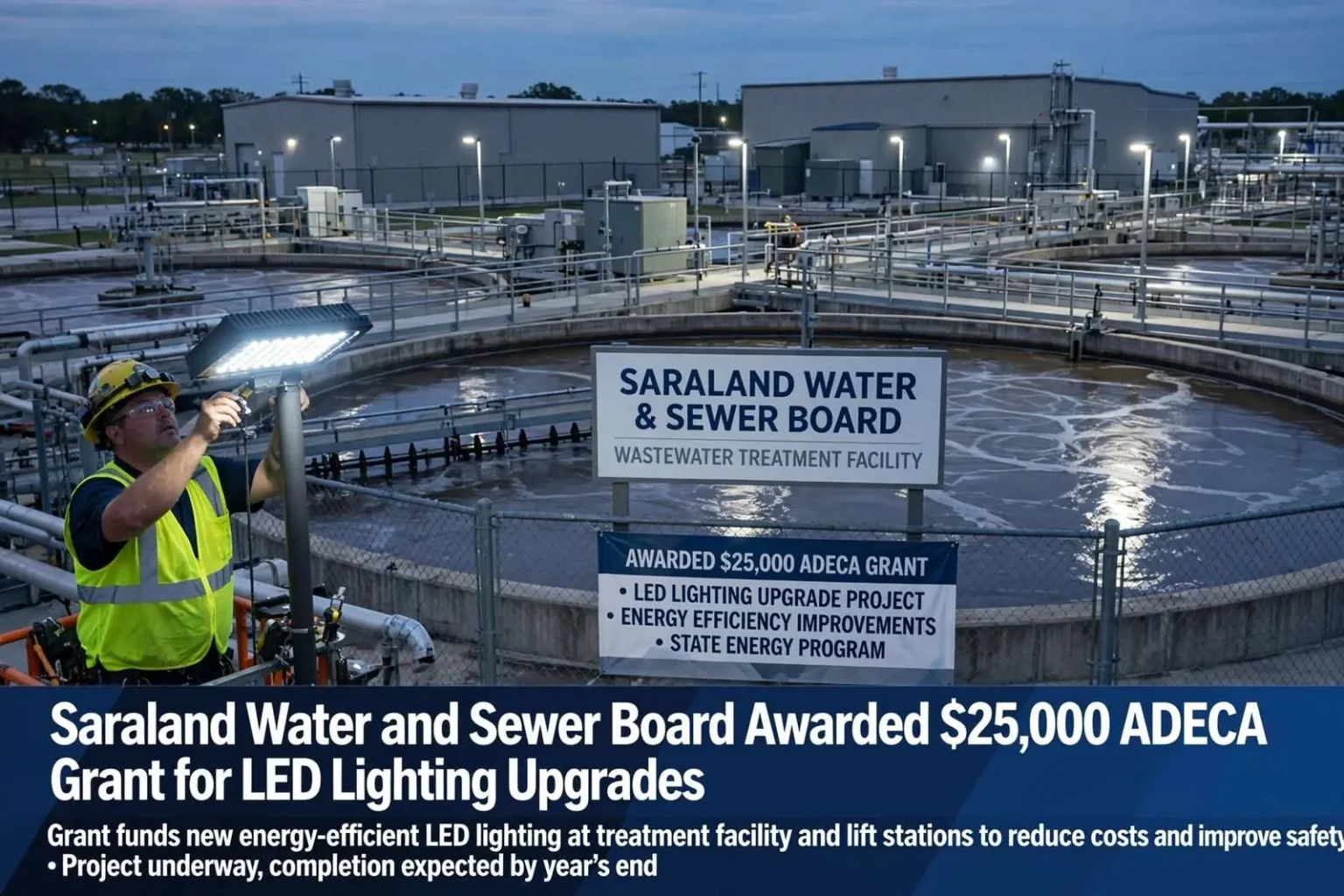
The Saraland Water and Sewer Board has been awarded a $25,000 State Energy Program Grant through the Alabama Department of Economic and Community Affairs (ADECA), funding that will go toward installing energy-efficient LED lighting at the Saraland Wastewater Treatment Facility and its supporting lift stations. The award positions the north Mobile County utility to modernize its facilities with technology that lowers both operating costs and energy consumption across its system.
Funding Energy-Efficient Upgrades
The grant is part of ADECA’s ongoing statewide effort to promote energy efficiency and sustainability, and it will allow the Saraland Water and Sewer System team to replace outdated lighting systems at the treatment facility and lift stations with modern LED technology. The State Energy Program, which ADECA administers with federal support, channels funding to Alabama municipalities, school systems and public utilities for projects that reduce energy use in public facilities, with applications evaluated on expected savings and community benefit.
According to the utility, the upgrade is expected to deliver several benefits for the system and the community it serves. LED lights consume up to 75% less energy than traditional lighting, meaning the switch is expected to lead to substantial reductions in electricity usage and costs for the utility. For a wastewater treatment operation that runs lighting, pumps and aeration equipment around the clock, every reduction in baseline electrical demand compounds month after month across the utility’s budget.
LEDs also have a longer operational life than conventional bulbs, which should reduce future maintenance and replacement expenses. At a treatment facility, lighting fixtures are often mounted above tanks, channels and process equipment where replacing a bulb requires coordination, lifting equipment and crew time. Fixtures that operate for years without service translate directly into fewer maintenance hours and lower long-term costs — a practical advantage that utilities weigh alongside the energy savings.
Why Lighting Matters at a Treatment Plant
Beyond the cost savings, the utility says the brighter, more reliable lighting will improve safety and visibility for workers at the wastewater treatment facility and lift stations, supporting more efficient day-to-day operations. Treatment plant staff work around open tanks, wet surfaces, machinery and below-grade structures where poor lighting is a genuine safety hazard. Better illumination makes inspections, maintenance and emergency response safer and faster, and lift stations — which sit in neighborhoods throughout the service area and often operate in the dark — benefit from lighting that keeps crews visible to the public and to passing traffic.
Lift stations are the unglamorous backbone of any sewer system. They collect wastewater from low-lying neighborhoods and pump it uphill toward the treatment plant, and they must operate continuously, in all weather, to keep service reliable. Saraland’s system relies on a network of these stations spread across the city, and upgrading lighting at each site improves both the working conditions for crews who service them at night and the security of equipment that is critical to the system’s operation.
The project is also expected to support broader environmental goals by reducing the facility’s carbon footprint. Lower electricity consumption means reduced demand on the regional power grid, and for a utility whose core mission is protecting the environment by treating wastewater, the lighting upgrade aligns the facility’s own operations with the environmental purpose it serves.
A Step Toward Sustainability
“We are thrilled to receive this grant from ADECA,” said Jim Davis, Chairman of the Saraland Water and Sewer Board. “This funding will help us enhance the efficiency and sustainability of our operations, benefiting both our community and the environment. We are committed to implementing energy-saving measures and this project is a significant step towards achieving these goals.”
Davis’ comments reflect a broader shift among Alabama’s municipal utilities, which have increasingly pursued state and federal funding to modernize infrastructure while containing the rates their customers pay. For a water and sewer board, every dollar saved on electricity is a dollar available for pipes, pumps and treatment capacity — investments that directly affect service quality in a growing city.
The Saraland Water and Sewer Board said it is grateful to ADECA for its continued support of energy efficiency initiatives across Alabama. ADECA, headquartered in Montgomery, administers a range of programs that fund everything from energy projects to community development and law enforcement support, and its energy office works with local governments and utilities to identify upgrades that pay for themselves through avoided energy costs.
Saraland and Its Utility
Saraland sits in the northern tier of Mobile County along Interstate 65, one of the fastest-growing parts of the county as development pushes outward from Mobile. The Saraland Water and Sewer Board serves customers in and around the city, operating the wastewater treatment facility and lift stations that will benefit from the upgraded lighting. Growth along the Interstate 65 corridor has steadily increased demand on the system, making operating efficiency a rising priority for the board’s long-term planning.
Utilities in the Mobile County region have taken varied approaches to modernization in recent years, with LED conversions, automated metering and pump efficiency projects appearing on capital lists across the area. Saraland’s grant-backed lighting project fits that pattern — a modest-dollar upgrade with compounding returns, applied to facilities that operate every hour of every day.
Installation of the new LED lighting is slated to begin in the coming months, with the utility expecting the project to be completed by the end of the year. Work will be scheduled around the treatment facility’s operations and the lift stations’ service demands, with crews replacing fixtures a section at a time to avoid interrupting treatment processes or maintenance schedules.
What the Upgrade Means for Customers
For Saraland’s utility customers, the LED conversion is unlikely to bring visible changes — the work will happen inside the treatment facility and at lift stations scattered around the city — but its effects will show up in the system’s finances. Reduced electricity bills ease the pressure on rates, extend the life of the operating budget and free capital for infrastructure improvements that would otherwise compete for the same funds. Utility officials note that energy projects of this kind essentially pay for themselves over the life of the fixtures, making grant-supported upgrades among the most cost-effective investments available to a public system.
The grant also strengthens Saraland’s position for future funding applications. ADECA and other funding agencies track the performance of completed projects, and utilities that demonstrate successful implementation of energy upgrades build the track record that supports larger awards down the road. For a growing city, that cycle — grant, upgrade, documented savings, next application — has become a standard strategy for stretching infrastructure dollars.
The $25,000 award covers a focused project rather than a system overhaul, and the board’s leadership has framed it as one step in a longer commitment to energy-saving measures across the utility’s operations. As the fixtures go in over the coming months, the utility expects to begin realizing the savings that motivated the application, with the full benefit reflected in operating results once the conversion is complete by year’s end.
From the treatment plant floor to the lift stations serving neighborhoods across the city, the new lighting will mark a small but meaningful modernization of a system most residents never see — and a demonstration that in Saraland, sustainability and sound utility management are being pursued in the same project, one fixture at a time.
Inside the Wastewater Operation
A wastewater treatment facility is one of the most energy-intensive operations a municipality runs. Beyond the lighting that the grant will replace, the plant operates pumps, blowers, aerators, screens and disinfection equipment around the clock, treating every gallon that flows from homes and businesses in the service area. The process must run continuously to meet environmental permit requirements, which is why utilities scrutinize every source of electrical demand — and why an upgrade as straightforward as lighting can produce measurable savings when multiplied by 24 hours of operation, every day of the year.
The treatment process itself moves through stages: solids are screened and settled, organic material is broken down by biological treatment, and the water is disinfected before it is released. Each stage depends on equipment working in sequence, and plant operators monitor the system continuously. Well-lit work areas at every stage make those rounds safer and more effective, particularly during night shifts and storm events when crews are responding to elevated flows.
Lift stations extend that operational challenge across the city. Because gravity alone cannot move wastewater across uneven terrain, stations at low points in the system pump flows up toward the treatment plant, and a failure at any station can back up service to surrounding homes. Crews respond to alarms at these stations at all hours, making the brighter, more reliable lighting at each site a safety improvement for the workers as much as a maintenance savings for the system.
ADECA and the State Energy Program
The State Energy Program that funded the Saraland project operates under ADECA’s Energy Division, which administers federal energy funding for Alabama and works with local governments, school districts, state agencies and public utilities. Grant applications typically document the current energy use of a facility, the savings a proposed upgrade would produce and the payback period, allowing the agency to direct limited funds toward projects with clear, measurable returns.
Across Alabama, State Energy Program awards have funded lighting conversions, HVAC replacements, building controls and renewable energy pilots in communities large and small. For small utilities and municipalities, the program’s value lies in its practicality — projects that are too small to attract major financing but large enough to matter to an operating budget find support through the program, and the savings accrue locally for years after the work is done.
Saraland’s award places its Water and Sewer Board among the Alabama utilities that have taken advantage of that opportunity, and the board has indicated it will continue to evaluate its facilities for further efficiency improvements. As the LED project moves from application to installation in the coming months, the utility will be watching the same numbers that won the grant — energy use, maintenance hours and operating costs — as the measure of a project that turns a $25,000 award into a lasting reduction in the cost of running the system Saraland depends on every day.