Satsuma’s Homecoming-Week Curfew Splits Opinion Among Students and Parents
Satsuma's mayor signed a homecoming-week curfew keeping high schoolers indoors past midnight; students call it strange, parents call it fair.
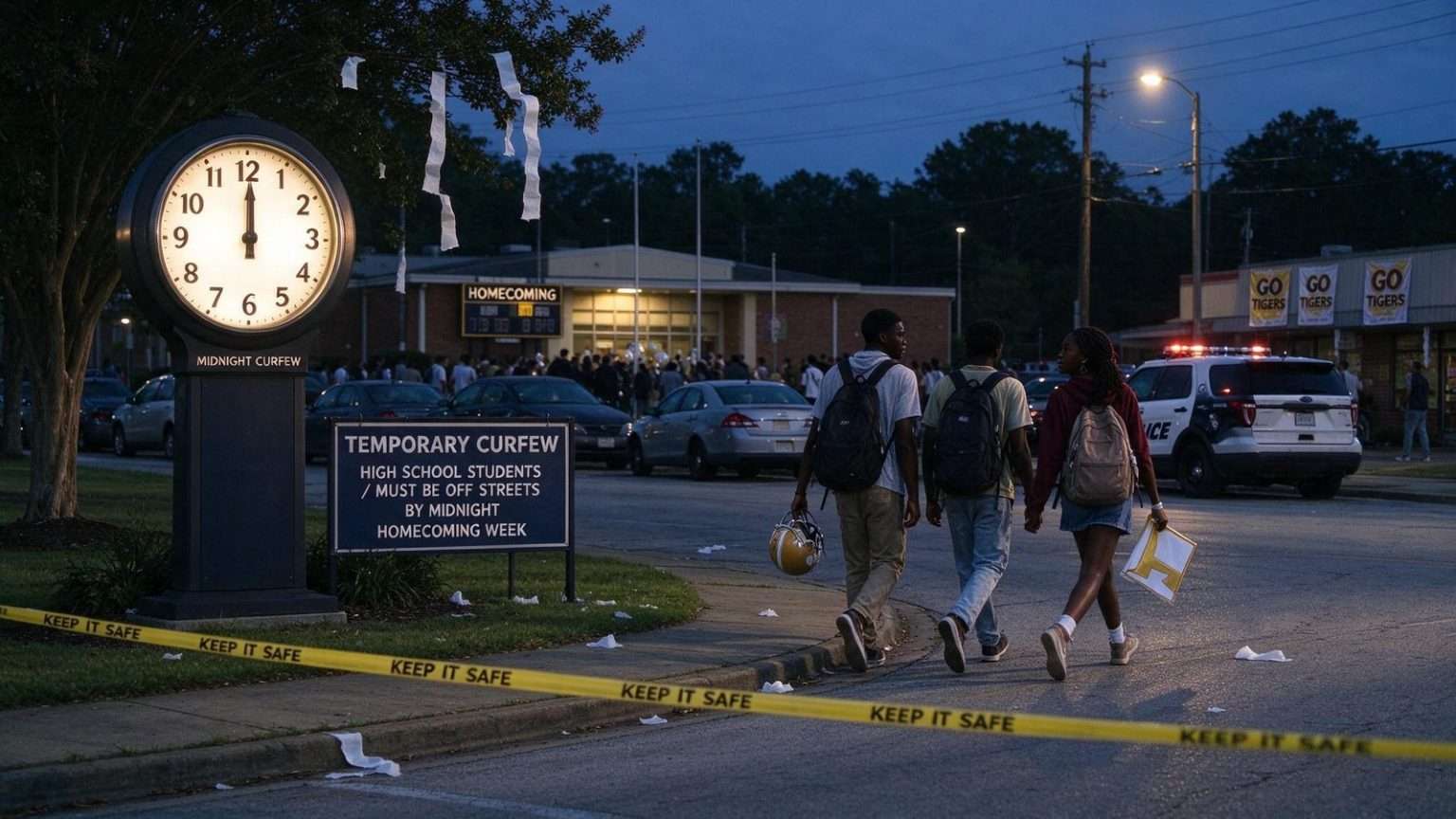
SATSUMA, Ala. — High school students in Satsuma had to be off the streets by midnight during homecoming week, under a temporary curfew ordinance signed by Mayor Mark Barlow. The measure, requested by Satsuma City Schools, bars high school students from being out past midnight for the duration of homecoming week, a window that includes the game itself, the weekend celebrations around it and the traditions that follow.
Barlow said the goal is simple: keep students safe on school nights. “We just like to prevent major incidents from happening,” he said. The ordinance gave police clear authority to move along any high school student found on the streets after midnight during the designated period, and it applied citywide — no exceptions for specific neighborhoods or events.
Satsuma, a small city in Mobile County north of Prichard and Saraland, operates its own school system, one of the smallest independent districts in the county. Homecoming in a city that size is a whole-town affair: alumni return, businesses post good-luck signs, and the game draws a substantial share of the population to the high school campus. That intimacy is part of what makes the traditions — and the debate over them — so visible.
Students push back, parents shrug
Not everyone is sold. Satsuma High student Jarrett Brown called the rule strange, saying students should be able to enjoy homecoming festivities with their parents later into the night. He suspects the city’s real motive was limiting the tradition of rolling — toilet-papering yards and trees after the big game, a generations-old ritual across Southern high school towns that leaves papered landscapes in its wake each morning.
Rolling occupies a peculiar place in homecoming culture. Officially discouraged by school administrations because of the litter and the occasional property damage, it is unofficially tolerated — and sometimes celebrated — in communities where it has gone on for decades. Students plan it, parents photograph it, and municipal crews or the students themselves clean up after. A curfew aimed at the after-midnight hours lands directly on that ritual, which is why Brown and other students saw the ordinance through that lens.
Parent Scott Wood sees it differently. He said midnight gives kids plenty of time to carry out their traditions while still getting home at a reasonable hour. “There’s really no need for them to be out after 12 at night,” Wood said. For parents like Wood, the ordinance read not as a ban on fun but as a boundary line drawn where the celebration ends and the risk begins.
Not a new rule
Barlow noted the ordinance actually dates to 2019, before he took office, and said no students violated it this year. The temporary curfew expired at 6 a.m. Sunday, Sept. 18, once homecoming week wrapped up, making it a self-extinguishing law that requires no formal repeal — a design that lets the city use it for special occasions without keeping a standing juvenile curfew on the books.
The 2019 origin places the ordinance among a wave of school-night safety measures adopted in small Alabama cities in recent years. Municipal governments hold broad authority to regulate juvenile conduct during nighttime hours, and courts have generally upheld curfews that include legitimate-activity exceptions and clear duration limits. Satsuma’s version, applying only to homecoming week each year, sits at the narrow end of that spectrum.
For the city’s police, the practical effect is modest but real. A midnight curfew during one week of the year gives officers an unambiguous tool for handling the small hours after the game and the parties that follow — the hours when, in communities across the region, vandalism, noise complaints and the occasional fender-bender cluster together.
Why a city the size of Satsuma leans on temporary ordinances
Satsuma’s approach reflects the constraints of small-city governance. With a compact police force and a part-time municipal infrastructure, the city cannot staff a large special-event operation for homecoming week the way bigger municipalities can. A temporary curfew is inexpensive, requires no equipment, and communicates expectations clearly to families before the week begins.
The request coming from Satsuma City Schools is also notable. School systems and municipal governments operate under separate elected boards and councils, and when a district asks a city for a safety measure, it effectively transfers the enforcement problem to a body with the legal tools to act. The school board sets the academic calendar and the game itself; the city sets the rules for the streets afterward.
The fact that no students violated the curfew this year, by Barlow’s account, suggests the measure functioned as much as a signal as a sanction. In small communities, an announced rule shapes behavior as much as its enforcement does — families know the expectation, and students plan around it. The alternative, in cities without such ordinances, is often an unspoken tolerance of after-midnight gatherings that can drift into trouble.
The rolling debate, after midnight
The tradition Brown defended is under quiet pressure across the South. Municipalities increasingly treat post-game rolling as a nuisance or a liability issue — wet toilet paper on streets and trees, clogged storm drains, occasional egging and property damage mixed in with the harmless kind. Some cities have responded with organized alternatives: school-sponsored post-game parties, designated rolling events on campus, or community clean-up efforts that turn the tradition into a service project.
In Satsuma, no formal alternative to rolling has been put in place, and the curfew stops short of banning it outright — students have until midnight to carry out their rituals, as Wood pointed out. The debate then becomes about where the line falls: early enough to prevent the large late-night convoys of cars that trail rolling crews, but late enough to preserve the tradition the community clearly values.
Students’ complaints have a procedural echo, too. Curfews of any kind put the burden on young people to prove their business on the street, and even a well-intentioned one can feel arbitrary to the teenagers it governs. Brown’s objection — that students should be able to enjoy festivities with their parents later into the night — points to the family-oriented character of homecoming in a town the size of Satsuma, where the line between supervised celebration and unsupervised gathering is not always obvious from a patrol car.
Homecoming week in a small Alabama city
Homecoming week itself follows a rhythm recognizable in any Alabama school town: themed dress-up days at school, a Friday night game with alumni introductions at halftime, a weekend dance, and the after-hours traditions that vary from town to town. In Satsuma, where the school system serves as the community’s focal point, the week concentrates the city’s social calendar into seven days.
The temporary curfew is the city’s most visible contribution to that week, and its expiration at 6 a.m. Sunday, Sept. 18 returned the streets to their ordinary rules. Nothing in the ordinance carries forward until the next homecoming — a design that both preserves the tool and limits its reach, exactly as its 2019 authors intended.
Whether the city continues the practice under Barlow and future councils will likely depend on the same calculus that shaped this year’s result: a week with no violations, no major incidents and no formal complaints rising to the council dais is, from a mayor’s perspective, a measure working exactly as designed.
What the ordinance actually says in practice
Temporary curfews like Satsuma’s are written to be enforceable but narrow. They identify a specific age group — high school students, in this case — a specific time window, and a specific duration, and they typically leave enforcement to the discretion of officers on patrol. Students found out after midnight during homecoming week could expect a ride home and a conversation with parents rather than a formal charge in most first instances, though the ordinance provides the legal backing if a situation escalates.
The midnight hour is a common dividing line in municipal curfews nationwide. It is late enough to accommodate school events, part-time work shifts and family gatherings, and early enough to cover the hours when unsupervised gatherings historically produce most calls for service. Wood’s observation — that midnight gives kids plenty of time for their traditions — reflects that balance from a parent’s side of the equation.
Exemptions are standard in such ordinances even when unstated in public discussion: students accompanied by a parent or guardian, students traveling directly home from work or a school event, and emergencies all fall outside the practical scope of enforcement. What the ordinance does is remove ambiguity, giving both teenagers and their parents a bright line for planning the week.
The mayor’s framing
Barlow’s public comments kept the rationale deliberately modest: preventing major incidents rather than promising to end any particular tradition. That framing matters in a small city, where an ordinance that reads as anti-tradition can poison community goodwill while one framed around safety — and validated by a violation-free week — draws little lasting resistance.
His acknowledgment that the measure predates his administration also served a purpose. By noting the ordinance’s 2019 origin, Barlow positioned the curfew as settled city practice rather than a new initiative of his own, insulating the decision from becoming a referendum on his leadership during his first homecoming weeks in office.
The city’s decision to let the ordinance expire on schedule rather than extend it reinforced that positioning. A curfew that quietly lapses at 6 a.m. Sunday, Sept. 18 makes no headlines and sets no precedent for expansion, leaving the city with the same tool available next year and no standing restriction on its young residents.
Looking toward next year
The conversation in Satsuma will likely repeat each fall, as it does in small towns across the state: students will object to the curfew, parents will mostly shrug, and the city will renew a measure that costs nothing and, by the mayor’s account, works. The rolling tradition at the center of student complaints will continue within whatever window each year’s ordinance allows.
What the Satsuma episode illustrates more broadly is how small Alabama cities govern culture. lacking the staff and budget for elaborate event management, they legislate narrowly — a curfew for one week, a temporary sign ordinance for a parade, a special-event permit for a festival — and rely on community norms to do the rest. In Satsuma, the norms held: no violations, no major incidents, and a homecoming week that ended with the streets quiet by midnight.
For the students of Satsuma High, the lesson of the week may be the most durable takeaway of all: in a city this size, traditions survive only where the community agrees on their limits, and the after-midnight hours are, for now, outside those limits.