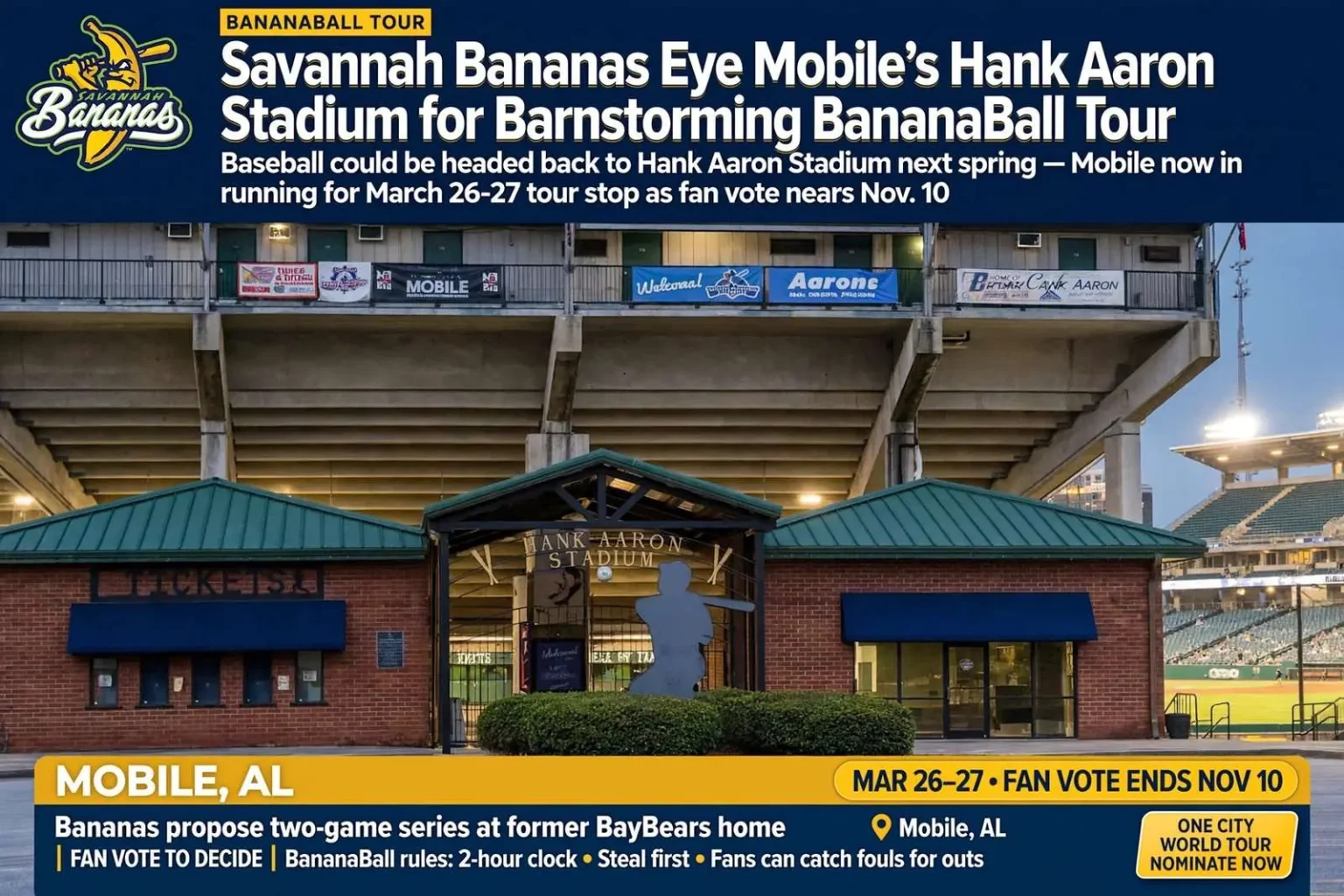
Baseball could be headed back to Hank Aaron Stadium next spring, with the wildly popular Savannah Bananas floating Mobile as a possible stop on their barnstorming tour. The possibility has energized a ballpark that has sat mostly silent since minor league baseball left the Port City — a chance to fill the seats of a stadium that bears the name of Mobile’s most famous son with a brand of baseball that has become one of the sport’s biggest draws.
Team owner and president Jesse Cole has been in discussions with Mobile officials about bringing the exhibition squad to the Port City for games on March 26 and 27, according to plans circulated by the organization. Cole, the showman in the yellow tuxedo who built the Bananas from a small collegiate summer team into a national phenomenon, has made a career of asking where else his traveling circus of sold-out crowds might play — and Mobile’s ballpark, with its history and its hungry fan base, fits the profile of the kind of city the tour visits.
A Different Kind of Baseball
The Savannah, Georgia-based club, which normally competes in the collegiate wood bat Coastal Plain League, would field a roster of independent players who have been scouted, tried out and signed specifically for the spring series. They would face another free-agent team known as the Party Animals, the Bananas’ permanent sparring partner on the tour — a full-time rival assembled for the same purpose, so that every stop on the schedule features two rosters built entirely for the show.
Games would be played under “BananaBall,” a modified ruleset designed for pace and spectacle: no bunting, no walks, batters allowed to steal first base, fans able to record outs by catching foul balls, and a two-hour time limit on every game. Every rule aims at the same targets — dead time and the slow erosion of attention. No bunting means no sacrifice outs; no walks means every plate appearance ends with a ball in play; the fan-catch rule turns the stands into part of the field; and the two-hour clock guarantees that even families with young children know exactly how long they are committing to an evening.
The result is a product that looks like baseball but behaves like nothing else in sports: players dancing between innings, walk-up performances, choreographed routines and constant interaction with the crowd. The Bananas have filled major league stadiums with this formula, and their games regularly draw television audiences and viral clips that most minor league clubs could never dream of generating.
The roster construction is part of the spectacle. Because every player is signed specifically for BananaBall, the Bananas and the Party Animals recruit athletes who fit the show — players with flair, stamina for a long touring season and the versatility to play multiple positions. Auditions draw hundreds of hopefuls, and those who make the cut sign on for something closer to a traveling production than a traditional season: weeks on a bus, two games a weekend in a different city, and a nightly obligation to entertain a crowd that expects the unexpected.
The schedule is grueling, but the payoff is a following that most minor league franchises spend decades chasing. The Bananas’ fan base stretches far beyond Savannah, built on viral video clips, a documentary streaming series and word of mouth from families who describe the games as the most fun they have had at a ballpark in years. When the tour announces a stop, host cities treat it like a festival weekend rather than a ballgame.
Fans Get a Vote
Mobile’s inclusion is not guaranteed. The Bananas are asking fans to help decide which city and stadium makes the cut for the team’s “One City World Tour,” with nominations submitted through the team’s website. Organizers plan to narrow the field to five finalists before announcing a single winning city on November 10. The fan-vote format is pure Bananas — a decision about where to play turned into a campaign that cities rally around, with social media armies, local businesses and even city governments lobbying for their town to win.
For Mobile, the pitch writes itself. The city has one of the deepest baseball pedigrees in America: Hank Aaron grew up here, and the stadium that bears his name was built on the city’s westside as a modern minor league showplace. A BananaBall stop would put that history in front of a national audience — and give the Bananas’ travelling show a stadium whose name alone carries more baseball weight than most big-league parks.
Hank Aaron Stadium, the former longtime home of the Mobile BayBears along the city’s westside, has sat largely without regular baseball since the minor league club’s departure, making it a natural candidate for a showcase event of this kind. The BayBears, who played a decade and a half on the banks of this ballpark as the Angels’ and Diamondbacks’ Double-A affiliate, departed after the 2019 season when the franchise relocated north to Madison to become the Rocket City Trash Pandas, leaving Mobile as one of the largest cities in America without affiliated minor league baseball.
The vacancy has been felt ever since. The stadium hosted some independent and special events in the years that followed, but nothing has filled the steady rhythm of a summer schedule — the nightly crowds, the concessions stands, the youth leagues and the season-ticket holders who made the ballpark part of the city’s routine. A two-game BananaBall visit would not restore that rhythm on its own, but it would prove the ballpark can still draw a crowd, and it would give Mobile baseball fans a reason to believe bigger events could follow.
The ballpark itself remains one of the nicer facilities in the region — a former Southern League home with a seating bowl sized for several thousand fans, a grass berm beyond the outfield fence and the kind of intimate sightlines that suit BananaBall’s up-close style perfectly. The Bananas’ production team can turn a stadium like this into their canvas overnight: overhead cameras, on-field hosts, between-inning acts and the constant soundtrack that follows the show wherever it goes.
What It Would Mean for Mobile
The economic case is easy to sketch. A sold-out BananaBall night brings thousands of visitors into the city for an evening — filling hotels, restaurants and the businesses around the airport and westside corridors. Two nights of that, in late March when the city’s tourism calendar is otherwise quiet between Mardi Gras and the spring festival season, is a welcome shot in the arm. The exposure may matter even more than the gate: the Bananas’ games are broadcast and clipped to audiences in the millions, and every broadcast mention of Hank Aaron Stadium is free advertising for a city that built the place to be seen.
The timing also fits Mobile’s broader push to reactivate its signature venues. City officials have spent years working to keep the stadium economically viable without a minor league tenant — hosting college games, community events and concerts where possible — and a BananaBall date would be the highest-profile tenant the ballpark has landed since the BayBears loaded the trucks for Madison. Cole’s team has shown a talent for choosing exactly these kinds of venues: ballparks with stories to tell and communities eager to tell them.
For fans, the practical checklist is simple. Nominations go through the team’s website, the finalists drop to five, and the winning city is announced November 10 — which means Mobile’s chances rest less on the negotiations than on the volume of local voices making the case. If the Port City pulls it out, tickets to the Bananas are famously hard to get anywhere else; the tour’s stops routinely sell out in minutes, with waiting lists in the tens of thousands.
Whether the Bananas arrive in March or the tour goes elsewhere, the bid itself has already done something: it has reminded the region that Hank Aaron Stadium is sitting there, in good repair, waiting for baseball. Mobile gave the sport Hammerin’ Hank, Satchel Paige, Billy Williams, Willie McCovey and Ozzie Smith — a claim no other city its size can make. The least the sport owes the city is a couple of nights under the lights, played the Bananas’ way, with the whole town invited.
The Bananas, for their part, have made a habit of choosing ballparks where the story matters as much as the game. Every stop on their tours is framed as a celebration of the host city — its history, its people and its love of the sport — and Mobile’s résumé in that department is unmatched: five members of the Baseball Hall of Fame call the city home by birth or upbringing, and the stadium on the westside was named for the greatest of them. If the fan vote lands Mobile among the finalists, the campaign will be about more than two dates in March — it will be a city with unmatched baseball roots making its case to host the sport’s most joyful traveling show.