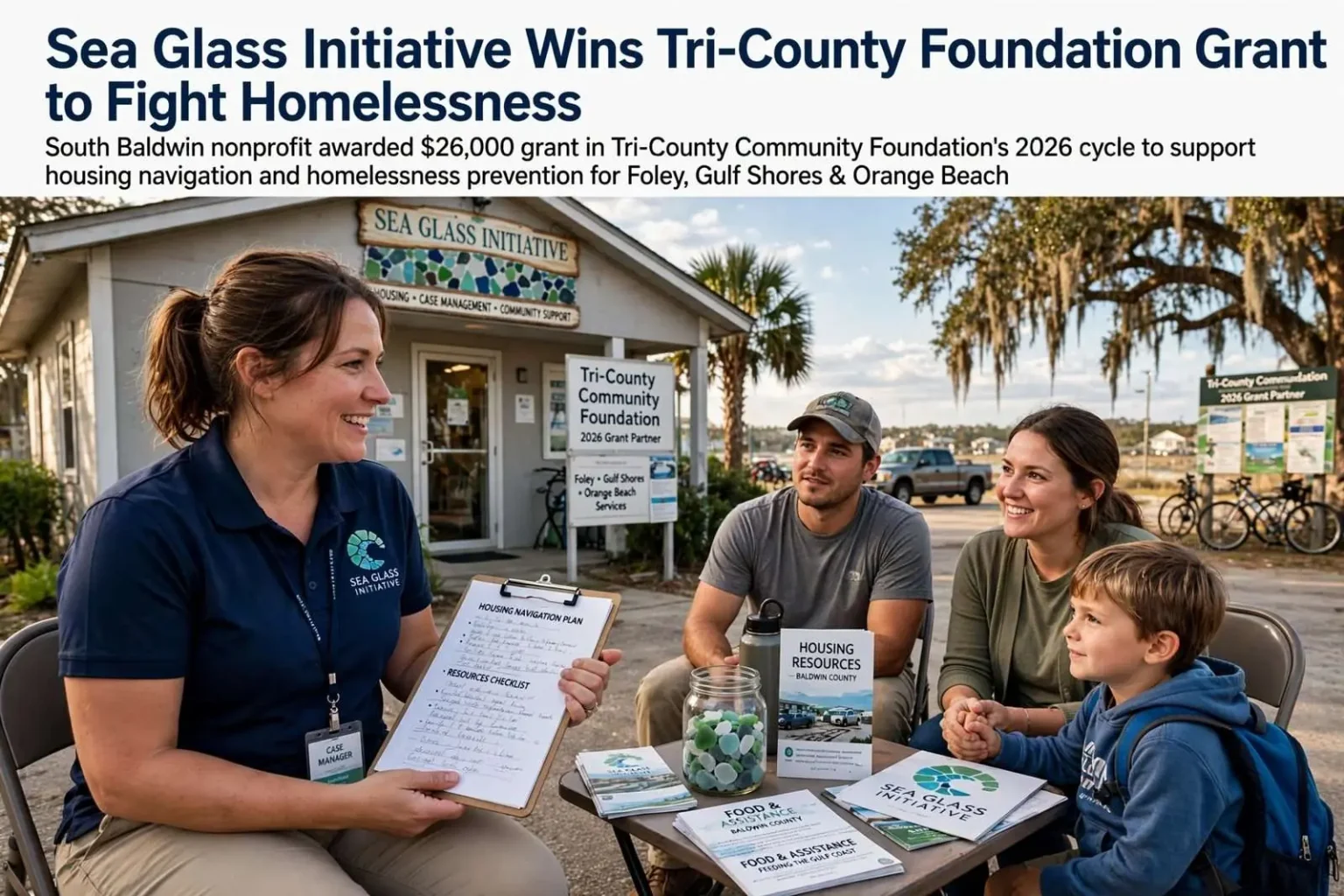
A South Baldwin County nonprofit working to prevent and end homelessness is among seven organizations chosen to receive funding in the Tri-County Community Foundation’s 2026 competitive grant cycle. The Sea Glass Initiative was selected as one of the grant recipients as part of a combined $26,000 distributed among seven nonprofit organizations dedicated to improving quality of life across Foley, Gulf Shores, and Orange Beach. The award places the organization alongside a group of food security, child advocacy, health, and relief organizations serving Alabama’s lower Baldwin County coastline.
The funding arrives at a significant moment for South Baldwin County, where rapid growth and a housing market shaped by tourism have made it harder for working families to secure stable, affordable places to live. Service-industry workers who staff the region’s restaurants, hotels, and attractions often face long commutes or crowded housing because seasonal demand pushes rents beyond what year-round wages can comfortably cover. Nonprofits that focus on housing insecurity say the need for coordinated assistance has grown alongside the population, making steady local funding sources more important than ever.
How the Tri-County Community Foundation Works
The Tri-County Community Foundation is an affiliate of The Community Foundation of South Alabama, a Mobile-based philanthropic organization that manages charitable funds and grantmaking across the southwest Alabama region. The affiliate structure allows donors in smaller communities to support local causes while drawing on the parent foundation’s investment management, grant administration, and philanthropic expertise. The guiding principle is simple: charitable dollars raised in a community should be invested back into that same community, with decisions made by people who know it firsthand.
The foundation relies on a local advisory committee made up of Foley, Gulf Shores, and Orange Beach residents to identify community priorities and direct charitable investments where they are needed most. That structure gives the competitive grant cycle a distinctly local character, since the people evaluating applications live in the same communities as the organizations seeking support. Advisory committees of this kind are a standard feature of the community foundation model, and they are intended to ensure that grant decisions reflect firsthand knowledge of local needs rather than a distant reading of written proposals.
Community foundations occupy a distinctive place in the American philanthropic landscape. Unlike private foundations that typically fund a narrow set of causes chosen by a founding family, community foundations pool contributions from many donors and distribute them broadly across local needs, from education and health to housing and the arts. In fast-growing regions such as Baldwin County, that flexibility matters, because the most pressing needs can shift quickly as new residents arrive and the economy changes.
The 2026 competitive grant cycle distributed a combined $26,000 among seven nonprofit organizations serving the Foley, Gulf Shores, and Orange Beach area. Along with the Sea Glass Initiative, the foundation’s 2026 grant recipients include CARE House, Inc.; Dream Center of Baldwin County; Sight Savers America; Feeding the Gulf Coast; Southern Relief; and the YMCA of South Alabama.
The list illustrates how many different forms community need can take in a coastal county. Food banks and hunger-relief groups address the most immediate household pressures, while child advocacy organizations work with families navigating the court system after allegations of abuse. Health-focused nonprofits provide vision care and similar services to residents who might otherwise go without them, and relief organizations stand ready to respond when storms disrupt life along the Gulf Coast. Housing-focused groups such as the Sea Glass Initiative sit at the center of that web, because housing instability tends to intensify nearly every other hardship a family faces.
Grant awards of this size rarely fund an entire program on their own, but they serve an important secondary purpose. A competitive award from a community foundation signals that a local panel of residents has vetted an organization and judged its work effective, which can help the recipient attract larger gifts from individuals, businesses, and other funders. For a relatively young nonprofit, that validation can be as valuable as the money itself.
About the Sea Glass Initiative
The Sea Glass Initiative is dedicated to uniting the community through compassion to end and prevent homelessness. The organization connects individuals and families facing housing insecurity to essential resources, personalized case management, and housing navigation services. Its name reflects the belief at the heart of its mission, guided by the idea that broken situations can be transformed into renewed hope, the way weathered fragments of glass tossed by the Gulf are smoothed into something treasured.
In practice, that mission translates into direct, practical assistance. Case management pairs a household with a consistent advocate who helps identify the root causes of its housing crisis, whether job loss, medical bills, a family breakup, or the simple arithmetic of rents rising faster than wages. Housing navigation services help clients search for available units, understand lease requirements, and apply for assistance programs, while connections to essential resources link families to food, transportation, childcare, and medical care that keep a housing placement stable once it is achieved.
The organization works to remove barriers and provide every individual with equal access to a stable home. That framing matters in a region where homelessness is often hidden rather than visible: instead of large urban encampments, housing insecurity in South Baldwin County is more likely to look like families doubling up with relatives, workers sleeping in cars near the jobs that sustain them, or residents one unexpected expense away from losing an apartment.
Homelessness in Baldwin County and on the Gulf Coast
Homelessness in coastal Alabama looks different from the images many residents carry in their minds. Because the region lacks large-scale urban shelters and encampments, people without housing tend to move between motel rooms, vehicles, and the homes of relatives or acquaintances, a pattern housing advocates describe as hidden homelessness. The invisibility of that need is one reason it can persist in prosperous communities, where rising skylines and record tourism figures can mask households quietly struggling a few miles from the beach.
Baldwin County has ranked among the fastest-growing counties in Alabama for years, and that growth has reshaped its housing market. New subdivisions and apartment complexes rise along the Highway 98 and Foley corridors, but a large share of the area’s housing stock is oriented toward second homes, vacation rentals, and seasonal occupancy, which thins the supply available to year-round residents. When a community’s rental market caters to visitors willing to pay premium nightly rates, workers earning local wages find fewer doors open to them, and even employed residents can drift into housing instability after a single disruption.
Service organizations across the Gulf Coast respond to that reality through a coordinated network rather than a single program. Federal housing assistance, regional food banks, faith-based ministries, and community foundations each address part of the problem, and case managers try to weave those threads into a plan for each household. That is precisely the role the Sea Glass Initiative describes for itself: not simply handing out aid, but guiding people through a fragmented system until they reach a stable front door of their own.
The cost of unaddressed homelessness falls on the whole community, which is one argument for preventive work. Households that lose housing often cycle through emergency rooms, jails, and school disruptions that cost far more than stable housing would have. Children who change schools repeatedly fall behind their classmates, and parents juggling housing crises struggle to hold the jobs that could restore their footing. Prevention-focused nonprofits argue that every household stabilized before it reaches the street saves the community money and preserves a family’s future at the same time.
What the Grant Means for South Baldwin County
For the Sea Glass Initiative, the grant provides both resources and standing. The funding supports the organization’s core work of connecting residents to resources, case management, and housing navigation, and the competitive selection process itself testifies that a committee of local residents judged the organization’s approach worthy of investment. In a funding environment where national grants are scarce and competitive, locally rooted dollars often determine whether a small nonprofit can keep its staff focused on clients rather than on fundraising.
For Foley, Gulf Shores, and Orange Beach, the broader lesson of the 2026 cycle is that philanthropy structured around local decision-making can respond to needs as they emerge. The seven funded organizations span homelessness, child advocacy, food security, vision care, relief work, and youth development, and together they touch many of the pressure points created by the region’s growth. Residents who want to support that work have avenues beyond waiting for the next grant cycle, since community foundations accept contributions of many sizes and the funded nonprofits themselves rely on volunteers and donors year-round.
The Sea Glass Initiative’s guiding belief that broken situations can be transformed into renewed hope is more than a slogan for a coastal community; it is a description of the work that lies ahead. As Baldwin County continues to add residents, the organizations funded in this grant cycle will be tested by demand that shows no sign of easing. Awards like this one, modest in dollar terms but significant in their local grounding, help ensure that the people evaluating the region’s needs and the people meeting them are neighbors.
The Tri-County Community Foundation’s 2026 grant recipients, including the Sea Glass Initiative, CARE House, Inc., Dream Center of Baldwin County, Sight Savers America, Feeding the Gulf Coast, Southern Relief, and the YMCA of South Alabama, will carry their work forward in the months ahead, each addressing a different strand of quality of life across Foley, Gulf Shores, and Orange Beach. For residents of South Baldwin County, the combined $26,000 in funding represents a practical investment in the safety net beneath their community, and for the families the Sea Glass Initiative serves, it represents help arriving before a housing struggle becomes a housing crisis.