Search continues for Grand Bay teenager reported missing since March
ALEA and Mobile County deputies are searching for 16-year-old Ashton Powell of Grand Bay, last seen leaving home March 16. Tips: (251) 574-8633.
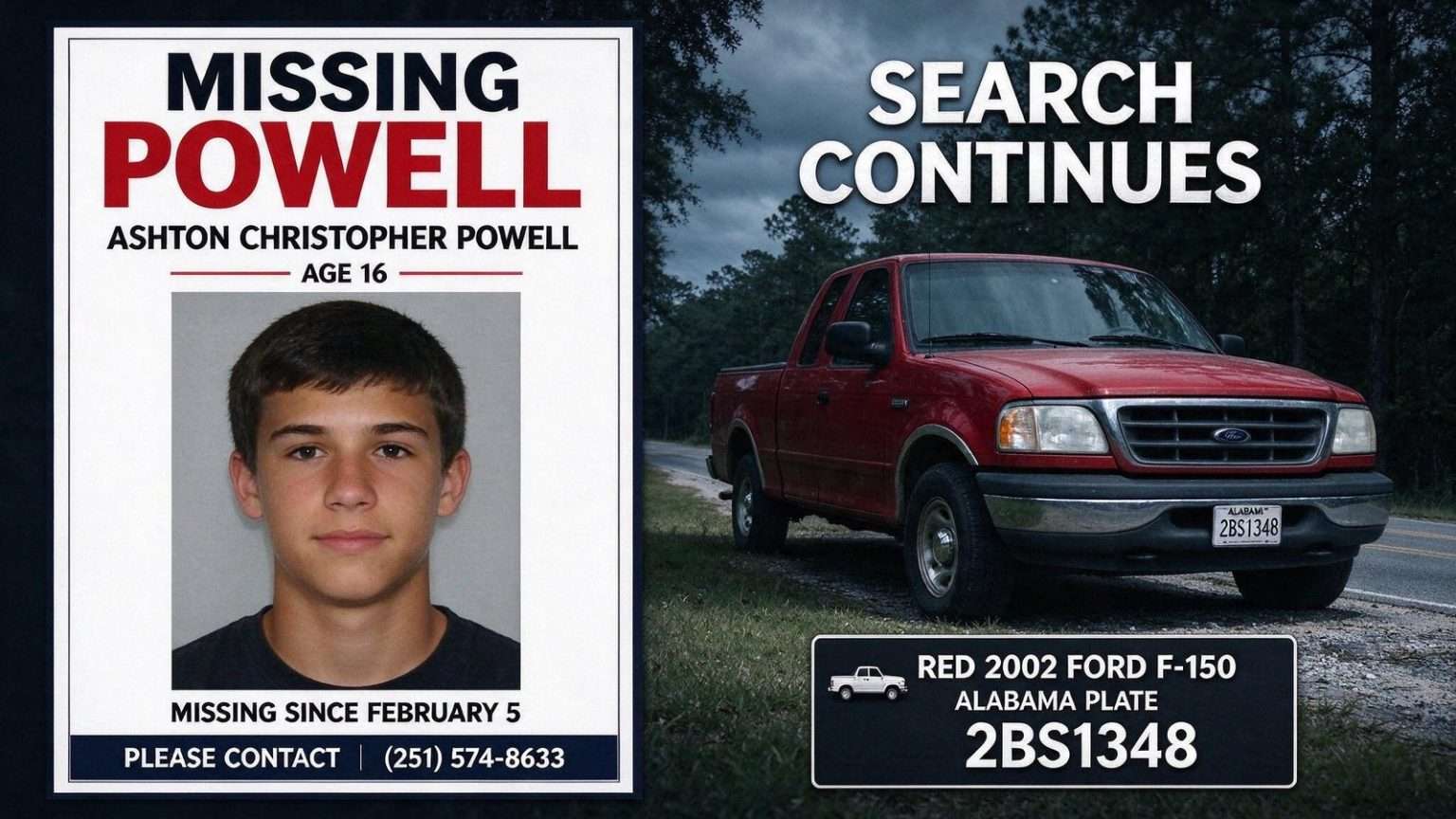
MOBILE COUNTY, Ala. — Authorities are asking for the public’s help in locating a 16-year-old from the Grand Bay community who was reported missing earlier this spring. The Alabama Law Enforcement Agency issued a Missing Child Alert for Ashton Christopher Powell, who was first reported missing on February 5 after leaving his home around 8:00 p.m.
At the time of the initial alert, Powell was last seen driving a red 2002 Ford F-150 bearing Alabama license plate 2BS1348. Deputies with the Mobile County Sheriff’s Office have been assisting in the effort to find the teenager, and ALEA later issued an updated alert in March after Powell was still unaccounted for. Investigators said at that time that his direction of travel remained unknown — a detail that matters, because without a direction, the search area in practical terms covers a wide swath of south Alabama, the Mississippi Gulf Coast and beyond.
How Missing Child Alerts work in Alabama
Missing Child Alerts in Alabama are coordinated through ALEA and distributed to news outlets and the public to quickly spread identifying details about a missing juvenile. The alerts are a step below the state’s AMBER Alert program, which is reserved for cases with evidence a child has been abducted and is in imminent danger. A Missing Child Alert, by contrast, is the standard mechanism for spreading the word when a juvenile is missing and authorities cannot confirm what happened — which describes most missing-teen cases, including runaways, which make up the majority of missing-child reports nationally.
What the alert does is put the case in front of the public quickly: the child’s name, age, photo when available, the vehicle involved and the plate number, all pushed through media, highway signage partners and law enforcement networks. That distribution matters most in the early days of a case, when sightings are freshest, but it continues to work as the case ages, because someone who sees the vehicle or the teenager months later still has a number to call.
The distinction between alert types also explains why the public may see fewer electronic billboard activations for a Missing Child Alert than for an AMBER Alert, even though the underlying investigation is just as active. Deputies follow leads, check sightings, contact known associates and coordinate with other agencies regardless of which alert category a case falls under.
The search in Grand Bay and beyond
Grand Bay is an unincorporated community in southern Mobile County near the Mississippi state line, a rural stretch of the county where homes sit along tree-lined roads, agriculture mixes with residential property and the nearest municipal services are a drive away. The community sits along Highway 90 and near Interstate 10, both of which run east-west toward the Mississippi line, meaning that from Grand Bay, a vehicle can be well into Mississippi, or headed toward Mobile, within minutes.
That geography shapes the search. The Mobile County Sheriff’s Office, which has primary responsibility for unincorporated Mobile County, covers a jurisdiction that spans more than 1,200 square miles, one of the largest county territories in the state, and it has leaned on deputies, investigators and cooperation with ALEA, neighboring agencies and Mississippi authorities to chase leads as they come in.
The red Ford F-150 remains the anchor detail of the case. A 2002 model truck is a common sight in rural south Alabama, but the specific vehicle — red, with Alabama plate 2BS1348 — is distinctive enough that anyone who has seen it, parked anywhere from Grand Bay to the coast to across the state line, can give investigators a location to check.
What investigators do on a months-long case
Missing juvenile investigations do not stop when the initial alert cycle ends. Deputies and investigators continue working the case through follow-up interviews, records checks, surveillance of known locations and coordination with other agencies, and the updated alert ALEA issued in March reflects that ongoing effort — a deliberate re-push of the case into public view when early leads had not produced the teen’s location.
Investigators in missing-teen cases look at a predictable set of threads: the teenager’s phone and social media activity, friends and relatives who may have information, any financial transactions, and sightings reported by the public. Each tip gets run down, and even tips that seem to lead nowhere help narrow the map by ruling out locations and timeframes.
Time is the complicating factor. In the first hours and days, sightings are fresh and cameras along likely routes hold useful footage; as weeks pass, the search depends more on someone recognizing the face or the truck. That is why families and investigators keep asking the public to stay alert long after the initial news cycle moves on.
What families and the community can do
For families of missing teenagers, advocates recommend keeping the child’s photo circulating, maintaining contact with the investigating agency, and using the national resources that remain available regardless of how long a case has been open — including the National Center for Missing and Exploited Children, which assists on missing-child cases and keeps case photos in its searchable database. Posters in the community, shares on local social media groups and continued mentions in local news all keep the case visible to the people most likely to recognize him: neighbors, hunters, anglers and drivers who travel the same roads every day.
Residents of Grand Bay and surrounding communities can help in specific ways. Anyone who lived along the teen’s likely routes can check doorbell and security cameras for the dates in question and note anything unusual. Landowners with property along Highway 90, I-10 frontage roads and the rural roads of southern Mobile County can walk and check outbuildings and remote corners of their property. And anyone who recalls seeing a red early-2000s Ford F-150 in an unusual place — abandoned, parked for days, or driven by someone who did not seem to belong to it — should report it.
How to help
Anyone with information about Powell’s whereabouts is urged to contact the Mobile County Sheriff’s Office at (251) 574-8633. Tips can be anonymous, and investigators stress that no detail is too small — a partial plate, a glimpse of the truck, an overheard comment. In long-running missing-person cases, the single tip that resolves the case has often come from someone who hesitated to call because they did not think what they saw mattered.
The wider picture: missing youth in south Alabama
Missing-teen cases are among the most common — and most stressful — calls law enforcement handles. Thousands of juveniles are reported missing in Alabama each year, and the overwhelming majority are located, but the cases that stretch on for months carry a distinct weight for the communities involved. Grand Bay is a close-knit area where families have roots going back generations, and a missing teenager there is not an abstract news item; he is somebody’s son, classmate and neighbor.
The alert system exists precisely for those communities. Alabama’s Missing Child Alert framework, administered by ALEA’s State Bureau of Investigation, connects local agencies to statewide distribution channels that a small rural community could never mount on its own, and it keeps the case in the public record until it is resolved. The Mobile County Sheriff’s Office routinely publicizes its missing-person cases on its own channels as well, pairing the statewide alert with direct appeals to local residents.
The Sheriff’s Office has also emphasized over the years that its investigators remain assigned to missing-person cases until they are closed, whatever the calendar says. Cases are not shelved when leads slow down; they are reviewed and re-worked as new information arrives.
If you think you have seen something
The guidance for the public in a case like this one is simple. If you believe you have seen Powell or the red 2002 Ford F-150 with Alabama plate 2BS1348, do not approach or follow the vehicle — note the location, time and direction of travel, and call the Mobile County Sheriff’s Office at (251) 574-8633 as soon as possible. If you believe you are seeing him right now, call 911.
Details that seem trivial — a truck seen at a convenience store, a young man walking along a rural road, a plate number that looked close to the one in the alert — are exactly the kind of information investigators need. In cases across the country, reunions have started with a call like that, made weeks or months after hope had started to fade.
For now, the alert remains active, the truck remains the key identifier, and the Sheriff’s Office continues to ask for the public’s eyes. Sixteen-year-olds belong home, in school, with their families — and in Grand Bay, a community that has watched this search since February, everyone is waiting for the call that says he has been found.