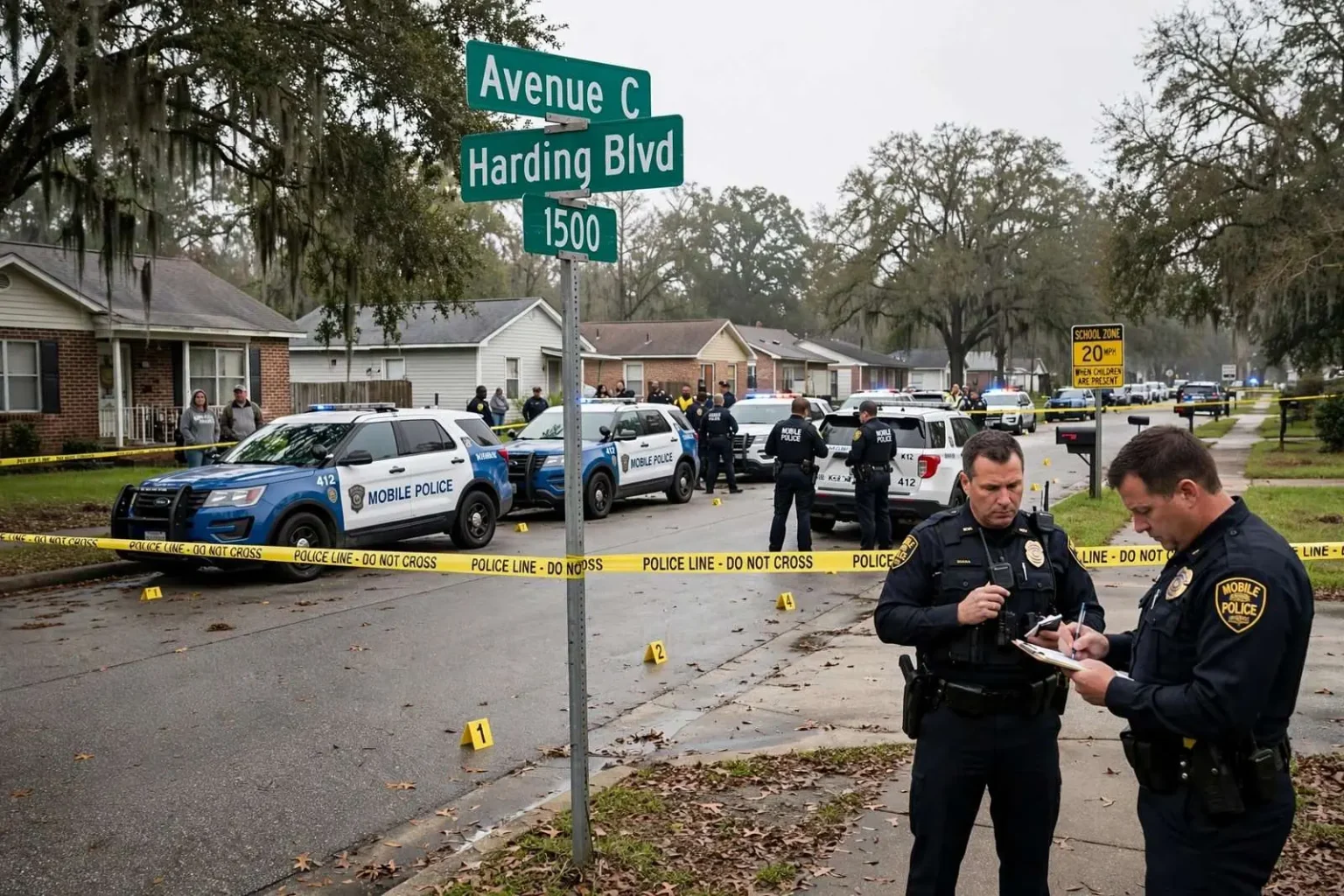
Mobile police are investigating a second fatal shooting that occurred less than 12 hours after an unrelated shooting left a woman dead and two other people injured on Elm Circle overnight. The second shooting happened near the intersection of Avenue C and Harding Boulevard, just off Old Shell Road, before 9 a.m. Thursday, leaving one man dead and another injured. The back-to-back killings put the city’s homicide investigators to work on two separate cases within a single day, straining resources and rattling neighborhoods on different sides of the city.
The morning shooting broke the routine of a residential area near Old Shell Road, a corridor lined with homes, schools and businesses that commuters travel daily. Officers converged on the intersection after reports of gunfire, finding one man dead and another wounded. The injured man’s condition was not immediately detailed, and authorities had not released the identities of either victim as investigators began canvassing the neighborhood for witnesses.
“We heard some gunshots so we just came to check it out,” resident Eric Santos said. “I knew something had happened because we don’t usually hear this around this time in the morning.” His account captured what made the shooting so unsettling for the surrounding blocks: gunfire at an hour when the streets are normally filled with school traffic, joggers and people heading to work, rather than violence.
Neighbors describe a troubled stretch
Neighbors said the area has seen ongoing problems, and the shooting has left some residents feeling less safe. “There’s just a lot of people sneaking into the houses. We’ve called police many times. Down on Fairway, there’s an abandoned house that a lot of drug addicts, a lot of people prostitute themselves. And we’ve called many times because, you know, we got kids,” resident April Santos said. Her remarks pointed to the frustration many residents feel in neighborhoods where repeated calls to police about abandoned properties and street activity have not produced lasting relief.
Complaints about vacant houses are among the most common quality-of-life issues reported in Mobile neighborhoods, and residents say such properties can attract the kind of activity that escalates. A single neglected structure can become a block’s most persistent problem, drawing loitering, break-ins and drug activity that spill into the surrounding streets. For families living nearby, the concern is less about any single incident than about the steady erosion of the sense that children can play outside safely.
The Thursday morning shooting tested that patience directly. Residents who had already been calling police about suspicious activity in the area now had a homicide at the neighborhood’s edge, and the questions they posed to investigators were the same ones voiced in yards and driveways all morning: who was shooting, at whom, and whether the people responsible were still nearby.
Two cases, one day
Police said the two shootings are not related, and investigations into both remain ongoing. The Elm Circle shooting overnight had left a woman dead and two other people injured, and the daylight violence near Old Shell Road followed within half a day. Investigators treat each case on its own evidence, but the combined effect of two fatal shootings in so short a span registers across the city, prompting renewed attention to Mobile’s persistent gun violence and the resources devoted to solving it.
For the police department, back-to-back homicides mean dividing detective squads, crime scene technicians and patrol support between two active scenes and two sets of witnesses. The first hours are critical in both investigations, when memories are fresh and surveillance footage has not yet been overwritten. Families of the victims in both cases began the same grim wait for answers, while the neighborhoods involved began adjusting to the attention that follows a killing.
The Avenue C and Harding Boulevard area sits in a part of the city where residential streets branch off busy Old Shell Road, a route that carries traffic between midtown and west Mobile. The mix of longtime residents, rental properties and commercial strips along the corridor gives the neighborhood both stability and turnover, and the people who live there describe a place they are invested in despite its troubles, which is precisely why the complaints about neglected properties and recurring calls for police service continue.
What investigators will be working to establish
In both the Elm Circle and Avenue C cases, detectives face the same foundational tasks: identifying the shooters, establishing motive and determining whether the victims were targeted. Homicide investigators typically begin with the victims’ last known movements, interviews with anyone present or nearby, and whatever cameras in the area captured. The 9 a.m. timing of the second shooting means plenty of potential witnesses were awake and moving when it happened, which investigators count as an advantage, since morning violence in a residential area is rarely unseen.
The department has not said whether either case has produced a suspect description, and officials generally hold back details that could compromise their work. What is clear is that the cases are officially separate, a distinction that matters both for the investigation and for the neighborhoods, since residents near one scene want to know whether the danger was specific or part of something broader. Police have answered that question to the extent they can: the shootings are not related.
The woman killed on Elm Circle and the man killed near Avenue C and Harding were among the victims in a city that has long wrestled with shooting violence, and each case leaves behind injured survivors as well as the deceased. The two people wounded on Elm Circle overnight and the man injured Thursday morning all faced recoveries whose outcomes had not been detailed publicly, and their statements to detectives could prove decisive in both investigations.
The neighborhood’s ongoing calls for help
The residents’ descriptions of abandoned houses and repeated police calls point to a persistent challenge for cities like Mobile: properties that fall into neglect can anchor a block’s decline long before any violent incident occurs. Cities address the problem through code enforcement, condemnation and demolition programs, but the process moves slowly, and residents living next to a problem house measure time differently than the city’s docket does. Each unsecured structure represents an open question about who is coming and going at all hours.
Community policing advocates argue that the trust built between officers and residents in the everyday calls, the suspicious-person reports and the nuisance complaints, becomes decisive when a serious crime occurs. The neighbors who spoke about this shooting did so on the record, an act that carries risk in any neighborhood, and their willingness reflects both frustration and engagement. Detectives working the case will be counting on that same willingness from everyone who saw something Thursday morning.
The larger pattern, two fatal shootings in less than half a day on opposite sides of Mobile, is the kind of stretch that prompts city leaders to revisit violence prevention efforts, from youth programs to focused enforcement in areas with repeated calls for service. Those conversations recur in Mobile as they do in comparable cities, and the people most affected are the residents of the streets where the violence lands. For the families mourning on Elm Circle and near Avenue C, the policy debate is abstract; what they need is an arrest, and that depends on the investigations now underway.
Anyone with information about either shooting is urged to contact Mobile police. As with any active homicide case, even small details, a vehicle, a direction of travel, a voice heard in the night, can provide the lead that breaks the case open.
How a morning shooting changes a neighborhood’s sense of safety
Daylight violence carries a different weight than the overnight kind. A shooting before 9 a.m. occurs while children are walking to school stops, while commuters idle at the same intersection, and while neighbors water lawns and walk dogs. The randomness of being awake when gunfire erupts strips away the psychological distance that night violence sometimes preserves, and residents in the blocks around Avenue C and Harding Boulevard spent Thursday morning reassessing a place they thought they knew.
School officials and parents in areas near shooting scenes routinely wrestle with how much to tell children and how to answer the questions that follow. Traffic disruptions from the police perimeter added practical complications to the morning, as buses and drop-off routes detoured around the investigation. By afternoon, when the tape came down and the street reopened, the evidence of what happened had been collected, but the neighborhood’s questions remained entirely open.
The injured man’s recovery is one of the details that will matter to both his family and the investigation. Survivors of shootings can sometimes provide the most valuable testimony available, and their cooperation often determines whether a case can be charged. Hospitals treat gunshot victims as patients first, but detectives follow closely, and the account the survivor eventually gives may shape the entire direction of the case.
The resources behind two homicide investigations
Handling two homicides in twelve hours requires the Mobile Police Department to spread its specialized personnel across two scenes, two victim autopsies and two parallel canvasses. Crime scene units must photograph and process both locations, evidence technicians must log and analyze what is collected, and detectives must interview witnesses who may only be available once. The department’s homicide clearance record depends on this early surge of work, which is why simultaneous cases stretch capacity so noticeably.
The overnight Elm Circle case came with three victims to account for, one deceased and two wounded, multiplying the interviews and the notifications involved. The morning case on the west side added a second scene hours later. Patrol officers, who typically secure scenes and take initial reports, bore the double load first, followed by the investigative units who carry the cases forward. For the families involved, the pace of those first two days largely determines how quickly they learn anything about what happened to their loved ones.
City officials watch stretches like this closely, both for what they signal about crime trends and for the public response they generate. Two unrelated killings in half a day is statistically possible in any city of Mobile’s size, but the coincidence shapes perception, and perception shapes the pressure on police to show progress. Departments typically respond by emphasizing tip lines and, where appropriate, increasing visible patrols in the affected neighborhoods in the days that follow.
For now, both investigations continue, and police have committed to releasing additional information as it develops. Residents with knowledge of either the Elm Circle shooting or the Avenue C and Harding Boulevard shooting can contact the Mobile Police Department, and as detectives in both cases made clear in similar investigations before, the community’s phone calls are what turn a scene into a solved case.