
‘Secret Sister’ Gift Exchange Spreading on Facebook: Fun Holiday Tradition or Felony?
The viral Secret Sister gift exchange is a pyramid scheme that could carry felony racketeering risk. What Gulf Coast users should know.
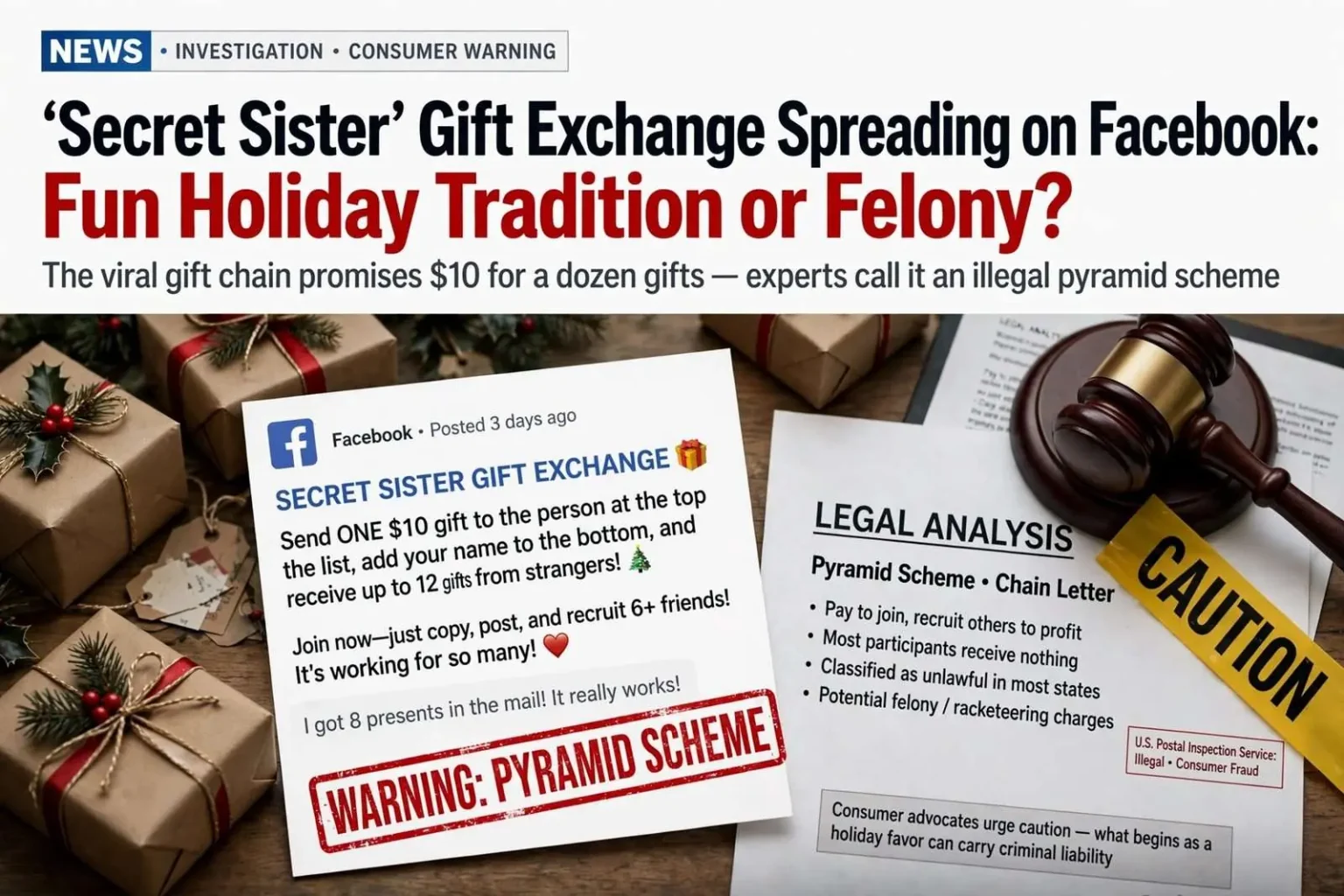
It promises something for nothing: send one gift, receive up to a dozen in return. But the “Secret Sister” gift exchange circulating on Facebook feeds every holiday season has a legal dark side — attorneys say participating could amount to a felony. The posts surface each year as the holidays approach, decorated with images of wrapped presents and testimonials from people who claim the exchange changed their Christmas, and each year consumer advocates and lawyers push back against the same basic warning.
The scheme’s endurance is part of what concerns experts. Versions of the Secret Sister exchange have circulated on social media for years, disappearing for a season and then returning with new enthusiasm as fresh users encounter it for the first time. The pitch is essentially unchanged: a chain letter dressed up as a festive tradition, complete with instructions that look harmless at first glance.
How the Exchange Works
The viral posts invite women to join a gift-exchange chain: buy a $10 gift for the “secret sister” at the top of the list, add your name, and supposedly receive piles of presents from strangers down the line. The instructions typically direct participants to copy the post, send one gift to the person listed, and then move their own name into the rotation, recruiting six or more friends to keep the chain moving.
On paper, the math looks enticing. One $10 gift in, and — if every participant follows through and recruits their own circle — hundreds of gifts could theoretically arrive at your door. That promise of multiplication is the engine of the entire structure, and it is also the reason the scheme collapses mathematically no matter how enthusiastically it spreads.
Some participants swear by it. “I got this ring, when I saw it, I was shocked,” said one woman who stands by Secret Sister as harmless holiday fun. Success stories like hers spread faster than any warning, because they arrive with photographs, excitement, and the implicit endorsement of a friend or family member — precisely the trust the scheme relies on to keep moving.
Why It’s a Pyramid Scheme
Attorneys and consumer experts see it differently. The structure — pay in, recruit others below you, profit only from those who join after you — fits the definition of a pyramid scheme, which is illegal in most states. The name on the gift tag does not change the legal analysis, and neither does the holiday packaging; a chain that pays earlier participants with money from later ones is a pyramid whether it sells vitamins, candles, or wrapped presents.
Because each round of recruits must keep growing to pay off the last, the vast majority of participants end up with nothing while the people at the top collect the gifts. The arithmetic is unforgiving: a chain that requires each person to recruit several more quickly demands more participants than exist, which is why most chains stall and why the people at the bottom — nearly always the majority — send their gift and receive nothing in return.
“She’s probably just at the top of the pyramid scheme, and the ones on the bottom are getting scrooged,” one lawyer explained of lucky participants. “It’s considered racketeering and you could face up to a year in jail.” The warning is aimed squarely at the people the posts seem designed to attract: well-meaning participants who see the exchange as harmless fun and have no idea the structure they are joining carries legal exposure.
Chain Letters and the Law
The legal problem with Secret Sister exchanges long predates Facebook. Chain letters that promise returns to participants who recruit others have been prosecuted in the United States since the early twentieth century, and the United States Postal Inspection Service has long treated mail-based versions as illegal lottery schemes. The social media era did not create a new legal category — it simply moved the old chain letter onto feeds where it spreads faster and reaches people the original authors never could.
Attorneys point out that the law looks at the structure rather than the intent. A participant who genuinely believed she was joining a festive gift swap is still, technically, joining a pyramid: sending money or goods into a chain where her expected return depends entirely on people joining beneath her. Prosecutors rarely target small-scale participants, but the exposure is real, which is why legal experts describe the exchange not as a gray area but as a straightforward violation.
The racketeering characterization that lawyers attach to these schemes surprises most participants, who assume anything this openly shared must be permitted. In practice, the ease of sharing is part of the danger: a post forwarded through six friend groups has recruited dozens of people into an illegal structure within hours, and each new participant moves the scheme further from its originators and closer to its inevitable collapse.
The Privacy Cost Nobody Mentions
Beyond legal exposure, sharing the post typically means handing your name, address and personal details to strangers. The mechanics of the exchange require every participant to send their home address up a chain of people they have never met, whose identities cannot be verified and who may be participating from anywhere.
Consumer advocates note that information often does not stay within the chain. Address lists collected through gift exchanges have circulated into marketing databases and worse, and participants — frequently women exchanging details of their homes and family routines — have no way of knowing where their information ends up. In an era when personal data is itself a commodity, that is a cost the cheerful posts never disclose.
There is also the disappointment factor. For every triumphant photograph of a gifted ring, there are many more silent stories: gifts sent, nothing received, and a vague sense of embarrassment that keeps people from warning others. The scheme’s social framing makes the loss harder to talk about, because admitting you were taken in feels worse than absorbing the ten dollars quietly.
Skipping the Chain This Season
Consumer advocates’ advice this season: skip the chain, and if you want to exchange gifts, do it with people you actually know. A gift exchange organized among coworkers, church groups, or family — where everyone knows the participants and no recruiting is involved — captures the fun of a surprise present without the pyramid structure or the legal questions.
Anyone who spots a Secret Sister post can also help slow its spread by declining to share it and, where appropriate, reporting it to the platform. Facebook’s own policies prohibit pyramid schemes, which makes the exchanges a violation of the site’s rules as well as state law — a fact many participants never consider when they click share.
The season’s most durable holiday scam, in other words, arrives wrapped in the most innocent-looking paper. The message from the people who study these schemes is consistent: the gifts come from strangers for a reason, and the people at the bottom of the list are the ones paying for the ones at the top.
Why the Scheme Survives
Every year brings the same cycle: the posts appear, the warnings follow, and the exchange returns the next season anyway. The reason is structural. Secret Sister spreads through the one channel that carries built-in trust — the personal friend list — and it clothes itself in the season’s warmest imagery. A pitch about “blessing” other women and receiving gifts in return sounds generous, not predatory, which is exactly why rational warnings struggle to outrun emotional appeals.
The holiday timing matters too. December is the season when people most want small acts of generosity to be real, and when budgets are tightest, so the fantasy of multiplying one modest gift into a pile of presents hits at the moment people are most receptive to it. Experts who track consumer fraud note that seasonal schemes follow this pattern across the board: they attach themselves to whatever people are already feeling, and hope and generosity are December’s dominant emotions.
There is also the quiet social pressure of the share button. When a friend, sister, or coworker posts the invitation, declining can feel like a small rebuke, and participating feels like joining a game rather than entering a transaction. That framing — fun, festive, low stakes — is the scheme’s most effective disguise, and it works on intelligent, careful people precisely because it never looks like a transaction at all.
A Pattern to Recognize Anywhere
The Secret Sister exchange is worth understanding even for people who never intend to touch it, because its structure appears in countless other forms. Mystery boxes, “sisterhood” chains, bless-these-children posts, and pay-it-forward gift games all share the same skeleton: a small payment from each new participant, distributed to earlier ones, with recruitment doing the heavy lifting. Learning to recognize the skeleton is the best defense, because the decorations change every season while the math never does.
The reliable test is simple. If your potential return depends on people joining after you — rather than on a product, a service, or an exchange between known parties — you are looking at a pyramid structure, whatever the post calls it. No amount of festive language changes that arithmetic, and no success story at the top of the chain predicts the experience of the people beneath it.
For households across the Gulf Coast and beyond, the takeaway this holiday season is modest and practical. Enjoy gift exchanges with people you know, skip the chains that arrive from strangers, and treat any offer of something for almost nothing — especially one that arrives requiring you to recruit — as the warning sign it is. The most valuable present most participants will ever get from a Secret Sister exchange is the lesson not to join one.


