Historical report preserved from an archived 2008 local news story.
SEMMES, Ala. — In 2008, residents of the Semmes community west of Mobile were engaged in a debate that would shape the area’s future for years: whether the fast-growing community should incorporate as its own city, with its own government, its own services and its own control over the tax dollars its residents paid.
The discussion, recorded in archived local news reports from the time, weighed whether a new municipality could improve local services and give residents more say over how revenue raised in Semmes was spent. It was a question that had circulated in the community for years, and it split neighbors into two camps with very different pictures of what cityhood would mean.
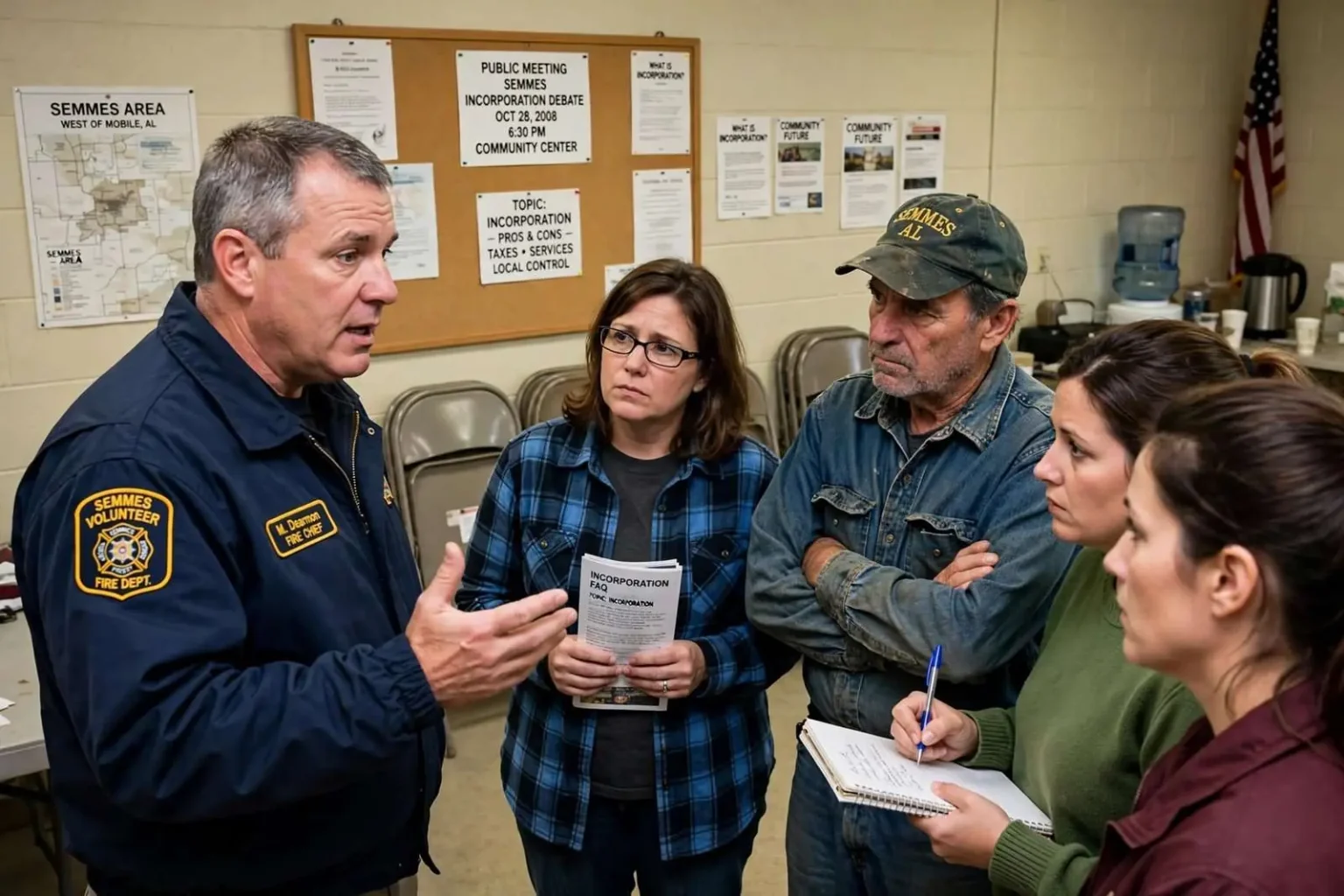
Supporters of incorporation pointed first to emergency services. At the time, fire protection arrangements in the community were a source of frustration, and supporters noted that Mobile Fire Department units could be dispatched past the Semmes Volunteer Fire Department to calls inside the community — meaning that, in some emergency scenarios, help from farther away would pass the neighborhood’s own fire station on its way to a Semmes address.
Fire Chief Mickey Dearmon said the situation troubled local residents, according to the archived report. For a community that had grown rapidly while still unincorporated, the question of who responds — and how quickly — was not an abstraction but a daily concern for families and business owners alike.
A Community Outgrowing Its Status
Semmes in 2008 was one of the fastest-growing areas of Mobile County, a former agricultural community known for its nurseries and its nursery heritage that had transformed within a generation into a suburban expanse of subdivisions, schools and storefronts along Moffett Road and the corridors feeding into it. Thousands of new residents had arrived, but the community itself had no city hall, no municipal police force and no local government of its own; it was governed as unincorporated Mobile County territory.
That status carried consequences residents felt directly. Zoning and development decisions were made by the Mobile County Commission rather than by any local body. Planning input from the community was limited. And the revenue generated by Semmes’ rapid commercial growth — its retail, its restaurants, its service businesses — flowed to the county and state, leaving some residents to argue that the money raised in the community should be reinvested there.
Incorporation supporters argued that growth and locally controlled tax revenue could make a real difference: a city government could prioritize road improvements, fund its own police department, negotiate its own fire service arrangements and direct commercial development according to local preferences rather than countywide ones.
The Skeptics’ Case
Opponents and skeptics raised practical objections. Some residents questioned whether the community could financially support a city government, asking where the money would come from to staff a police department, run a city hall and pay for the services a municipality is expected to provide. Small Alabama cities operate on thin budgets, and a government’s early years are often the leanest.
Others worried about taxes. Incorporation would give a new city authority to levy its own municipal taxes, and residents who had moved to Semmes in part for its unincorporated, lower-tax character were wary of adding a layer of government that would cost them money each year. There were also questions about what boundaries the new city would take in, and whether the more rural areas on the community’s edges wanted to be included at all.
The volunteer fire department itself stood at the center of the emergency-services debate. Semmes’ fire protection had historically been built around its volunteer department and its tradition of community self-reliance, and any move toward cityhood would force a reckoning over how fire service would be funded and staffed — whether the volunteer tradition could be preserved, supplemented or replaced in a municipal structure.
The Debate’s Long Arc
The 2008 debate recorded in the archived report was not the end of the question but part of a longer arc in the community’s history. Semmes residents continued to press the issue in the years that followed, and the community eventually voted to incorporate, becoming the city of Semmes in 2011 — a step that transformed the town’s governance and gave it the municipal structure that residents had been weighing in 2008.
Historical reports like this one preserve the arguments as they stood at the time, when the outcome was still uncertain and both sides were making their case to neighbors at public meetings, in civic groups and door to door. Reading them now, the debate of 2008 captures a community at a turning point: growing fast, divided over the price of self-governance, and uncertain whether a city government would serve the people better than the county system it knew.
The arguments raised then — about fire response, about police protection, about who controls tax revenue and who decides how land is used — are the standing questions of municipal incorporation anywhere on the Gulf Coast, and Semmes’ experience became a reference point for other unincorporated communities in Mobile County weighing the same step.
What the Record Shows
The archived 2008 report preserves specific details of the moment: the supporters’ concern about Mobile fire units being dispatched past the Semmes Volunteer Fire Department, Chief Dearmon’s acknowledgment that the arrangement troubled local residents, the skepticism about whether the community could afford a city government, and the incorporations’ argument that growth plus locally controlled revenue could change the community’s trajectory.
This article records that 2008 debate and the circumstances surrounding it. It is not a statement of Semmes’ current governmental structure or services, which have evolved substantially since the community’s incorporation. Residents seeking information about the city’s present-day services, fire protection or municipal operations should consult the city of Semmes directly.
For local historians and longtime residents, however, the record of the 2008 debate remains a valuable window into the community’s past — the moment when Semmes, still unincorporated and still deciding, argued its way toward becoming a city.
How Incorporation Debates Work in Alabama
The question Semmes was asking in 2008 is governed by Alabama’s municipal incorporation law, which lays out the boundaries, petition signatures and census thresholds a community must meet before a referendum can even reach the ballot. The process is deliberately demanding: a proposed city has to show it has the population and the taxable base to stand on its own, and the county commission and the courts are part of reviewing whether a new municipality’s boundaries make sense.
Communities across the state have taken different paths through that process. Some voted incorporation down and remained unincorporated for decades; others, like Semmes, pushed through to cityhood after years of debate. The arguments in every case tend to rhyme — control over zoning and tax revenue on one side, the cost and complexity of a new government on the other — and local history shapes which argument wins.
In west Mobile County, the growth that fed the 2008 debate was part of a larger wave spreading along the Mississippi line and down the corridors toward Mobile. School construction, subdivisions and commercial strips had remade the landscape within living memory, and residents who remembered a rural crossroads community watched the change with mixed feelings — pride in the growth, and worry that decisions about it were being made elsewhere.
What the Record Shows
19|
The archived 2008 report preserves specific details of the moment: the supporters’ concern about Mobile fire units being dispatched past the Semmes Volunteer Fire Department, Chief Dearmon’s acknowledgment that the arrangement troubled local residents, the skepticism about whether the community could afford a city government, and the incorporations’ argument that growth plus locally controlled revenue could change the community’s trajectory.
20|
Preserving the Record
Archived news reports like the one this article preserves serve a purpose that goes beyond nostalgia. They document what residents actually said and feared at the time, in their own terms, rather than the smoothed-over versions that circulate after the fact. For a community that changed as quickly as Semmes did, that record is one of the few ways to understand how the present arrangement of the town came to be.
This article records that 2008 debate and the circumstances surrounding it. It is not a statement of Semmes’ current governmental structure or services, which have evolved substantially since the community’s incorporation. Residents seeking information about the city’s present-day services, fire protection or municipal operations should consult the city of Semmes directly.
21|
For local historians and longtime residents, however, the record of the 2008 debate remains a valuable window into the community’s past — the moment when Semmes, still unincorporated and still deciding, argued its way toward becoming a city.
22|