Semmes Police Investigate Criminal Mischief Incident at Magnolia Community Center
The Semmes Police Department is investigating a criminal mischief incident at the Magnolia Community Center that occurred Monday evening, and officers are asking the public for information about those involved.
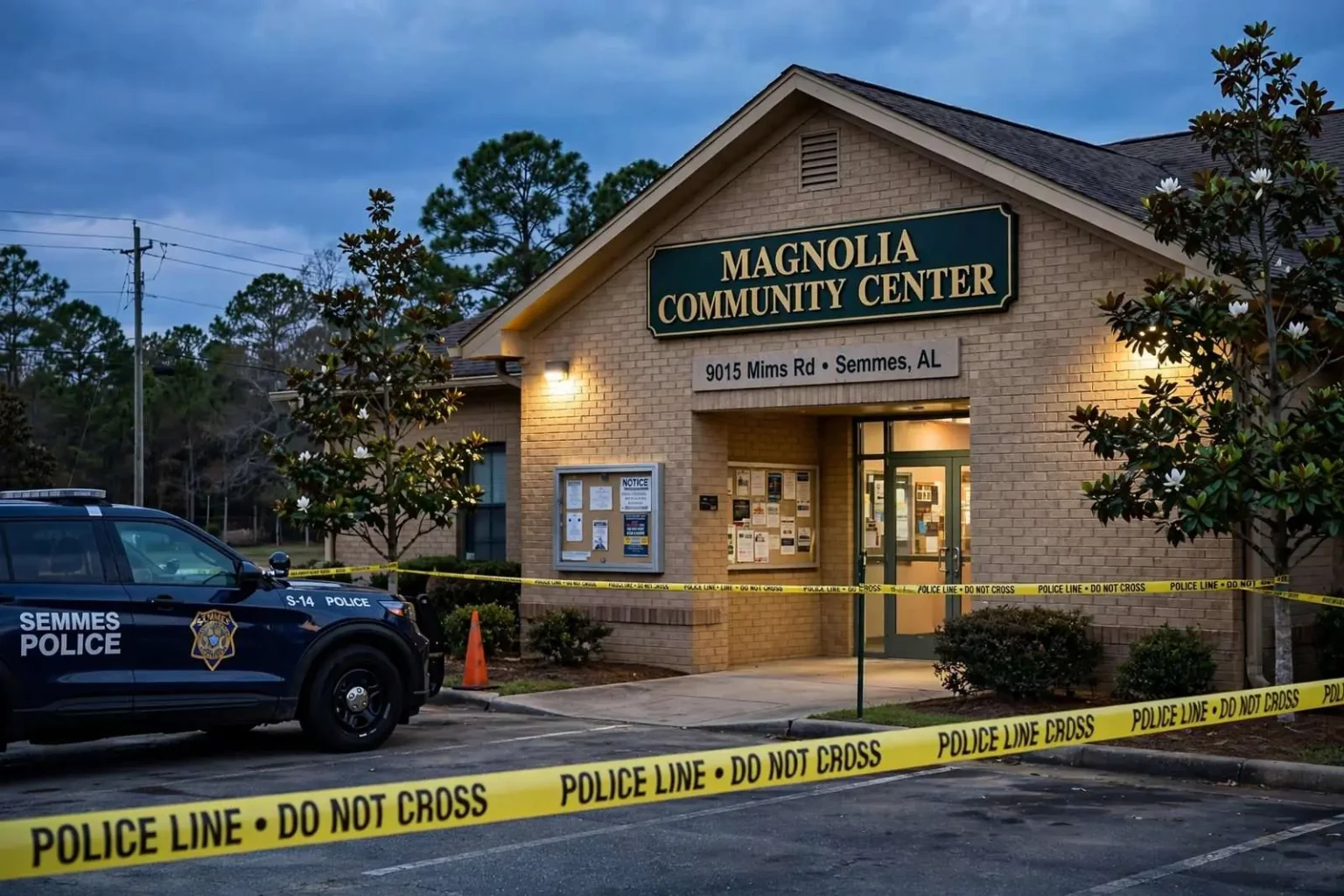
SEMMES, Ala. — The Semmes Police Department is investigating a criminal mischief incident that took place at the Magnolia Community Center earlier this week. According to a post on the department’s Facebook page, the incident occurred around 8 p.m. on Monday, Aug. 3, at the community center.
Images released by police show four people at the scene, though officials said more individuals may have been involved. Police have not disclosed specifics about what the individuals are accused of doing.
Officials are asking anyone with information about the incident or the people involved to contact the Semmes Police Department at 251-459-6061. The investigation remains active, and no further details have been released at this time.
Context and Background
Semmes is a community in western Mobile County that has grown from a rural crossroads into a populated suburban area on the outskirts of the Mobile metropolitan region.
Local police departments in Alabama are responsible for enforcing state law and municipal ordinance within their city limits, and they routinely investigate property crimes, traffic offenses, and quality-of-life complaints that make up the bulk of day-to-day police work in a community.
When a police investigation produces evidence of a crime, the department typically refers the matter to the appropriate prosecutor, and the findings may lead to charges, an arrest warrant, or a referral to a county or district attorney for presentation to a grand jury.
Criminal investigations in Alabama generally begin with a report to a police department or sheriff’s office, after which detectives gather statements, physical evidence, and records that may be used to identify a suspect and to support charges if the evidence points to one.
Many local investigations are conducted jointly with state or federal partners when the conduct crosses city or county lines, involves controlled substances shipped through the mail, or touches on matters that fall under federal jurisdiction.
The communities of southwest Alabama are bound together by a shared Gulf Coast setting, common institutions such as county fairs and high school athletics, and the daily interconnections of work, family, and commerce that link the cities and towns of the region.
Local news outlets serve an important role in these communities by reporting on the meetings, incidents, and decisions that shape daily life and by keeping residents informed about the agencies and officials who serve them.
Storms are a fact of life on the northern Gulf. Hurricane season runs from June through November, and the low-lying coastal counties have developed a culture of preparedness, from evacuation routes inland to the building codes and levee discussions that follow each major event.
The communities of the region are small by national standards but tightly connected. A decision made at a county commission meeting in Bay Minette or a sentencing in a Mobile courtroom can ripple across the neighboring cities and unincorporated areas that make up the broader metro and rural fabric of southwest Alabama.
Education and athletics are woven into the identity of the region’s towns. Friday-night football, the rivalries between neighboring high schools, and the pride that small communities take in their teams are a recurring thread in the local conversation from summer practices through late-fall playoffs.
Public safety on the coast is a shared enterprise. Municipal police departments, county sheriffs’ offices, state troopers, and federal agencies each have a role, and they routinely work together on cases that cross the lines between a city, a county, and federal jurisdiction.
The Alabama Gulf Coast sits at a crossroads of the Southeast. Interstate 10 runs east-west just above the bay, Interstate 65 runs north from Mobile toward Montgomery and Birmingham, and U.S. highways tie the beach communities to the inland counties and to the Florida Panhandle just across the line.
Demographic growth has reshaped Baldwin County in particular, as new residents and retirees have moved to the eastern shore and the beaches, straining roads, schools, and services and prompting continual debate over how fast and in what form the county should develop.
Local journalism in southwest Alabama carries a civic weight that goes beyond the headlines. By documenting arrests, verdicts, budgets, and storms, the region’s news outlets provide a public record that residents, officials, and researchers rely on to understand what is happening in their communities.
The wetlands and waterways around Mobile Bay are not only scenic; they buffer the coast from storm surge, filter the water that flows to the Gulf, and support the fisheries that underpin both the commercial and recreational life of the Alabama shore.
Behind many south-Alabama stories is a simple truth: the region is a collection of close-knit places where the same families, agencies, and institutions show up again and again, and where a single incident can connect a small town to a federal courthouse in Mobile or to a beach packed with out-of-state visitors.
Southwest Alabama, the part of the state that touches the Gulf of Mexico, is a region defined by water: the Mobile River and its delta, Mobile Bay, and the open Gulf beyond. The cities and towns of Mobile and Baldwin counties, together with the rural counties that lie inland from the coast, share an economy and a way of life shaped by that geography.
The stretch of Alabama along the Gulf is unlike the rest of the state. Where northern Alabama is anchored by the Tennessee Valley and central Alabama by the Black Belt and the state capital, the southern tier looks outward to the water, to shipping lanes, to beaches, and to the weather systems that form in the warm Gulf each summer and fall.
For residents of Mobile and Baldwin counties, local news is intensely practical. Court dockets, sheriff’s reports, city-council votes, school-board meetings, and the daily cadence of highway and beach traffic are the matters that affect households directly, and community outlets exist to keep neighbors informed about exactly those things.
The history of the Alabama Gulf Coast runs from the French and Spanish colonial era through the cotton and timber economy of the 19th century to the port, shipbuilding, and tourism economy of today. That layered past is visible in the region’s architecture, its place names, and the annual traditions that still draw crowds.
Tourism is a cornerstone of the coastal economy. The white-sand beaches of Gulf Shores and Orange Beach, the charter-fishing fleets of the bays and the pass, and the festivals and events that fill the calendar from spring into fall together support thousands of jobs and a large share of the region’s tax base.
The Port of Mobile gives the region an industrial counterweight to tourism. As one of the Gulf’s leading seaports, it handles container, bulk, and breakbulk cargo and is tied to the steel, chemical, and shipbuilding activity that has anchored Mobile’s economy for generations.
The mayor-council form of government is common among Alabama’s cities, with an elected mayor serving as the chief executive and a council voting on ordinances, budgets, and appointments that guide the community’s direction.
The timber industry has long been a backbone of south Alabama’s inland economy, with pine forests across the region supplying pulp, paper, and lumber mills that have employed generations of residents in places far from the beach.
Commercial seafood, from oysters and shrimp to finfish, has sustained communities like Bayou La Batre and the bayside towns for generations, linking the Alabama coast to markets across the Southeast and beyond.
Shipbuilding and repair are a signature of the Mobile area, where yards have built vessels for the Navy, for commercial operators, and for the offshore energy industry, tying the region’s fortunes to national defense and global trade.
The Alabama screen-based and film incentives, along with the state’s varied landscapes, have occasionally drawn productions to the Gulf Coast, adding a small but visible layer to the region’s economic mix.
Higher education in the region includes the University of South Alabama in Mobile, a public university that anchors health-care and research activity and serves students from across the coastal counties and the state.
Community colleges and technical schools across south Alabama provide workforce training in fields from welding and nursing to information technology, and they are a key pipeline for the region’s hospitals, shipyards, and factories.
The Alabama Department of Transportation maintains the coastal highways and bridges, and its projects, from bridge repairs to new interchanges, are a recurring subject of public interest because of how directly they affect daily travel.
Mobile Bay itself is a large, shallow estuary where fresh water from the Mobile-Tensaw delta meets the saltier water of the Gulf, creating the productive nursery grounds that support the coast’s fisheries and birdlife.
The barrier islands of the Alabama coast, including Dauphin Island and the Auburn University-managed research areas, protect the mainland from the open Gulf and are studied by scientists for what they reveal about coastal change.
Local chambers of commerce in Gulf Shores, Orange Beach, Fairhope, and Mobile promote the region to visitors and businesses, and their economic reports are a routine measure of how the coastal economy is performing season to season.
Property and casualty insurance on the Alabama coast is shaped by hurricane risk, and the affordability and availability of coverage is a perennial concern for homeowners and a recurring topic in state and local policy discussions.
Volunteer fire departments and rescue squads play an outsized role in the more rural parts of Mobile and Baldwin counties, where paid staff is thin and neighbors answer the call to protect one another’s homes and livelihoods.
The court clerks, district attorneys, and public defenders who work the circuit courts of the coastal counties are the quiet infrastructure of the justice system, handling the filings, appearances, and schedules that keep cases moving.