Semmes Community Mourned Teen Killed in 2007 Crash
Semmes residents mourned after a 16-year-old pedestrian died following a December 2007 crash on McCrary Road, according to WKRG.
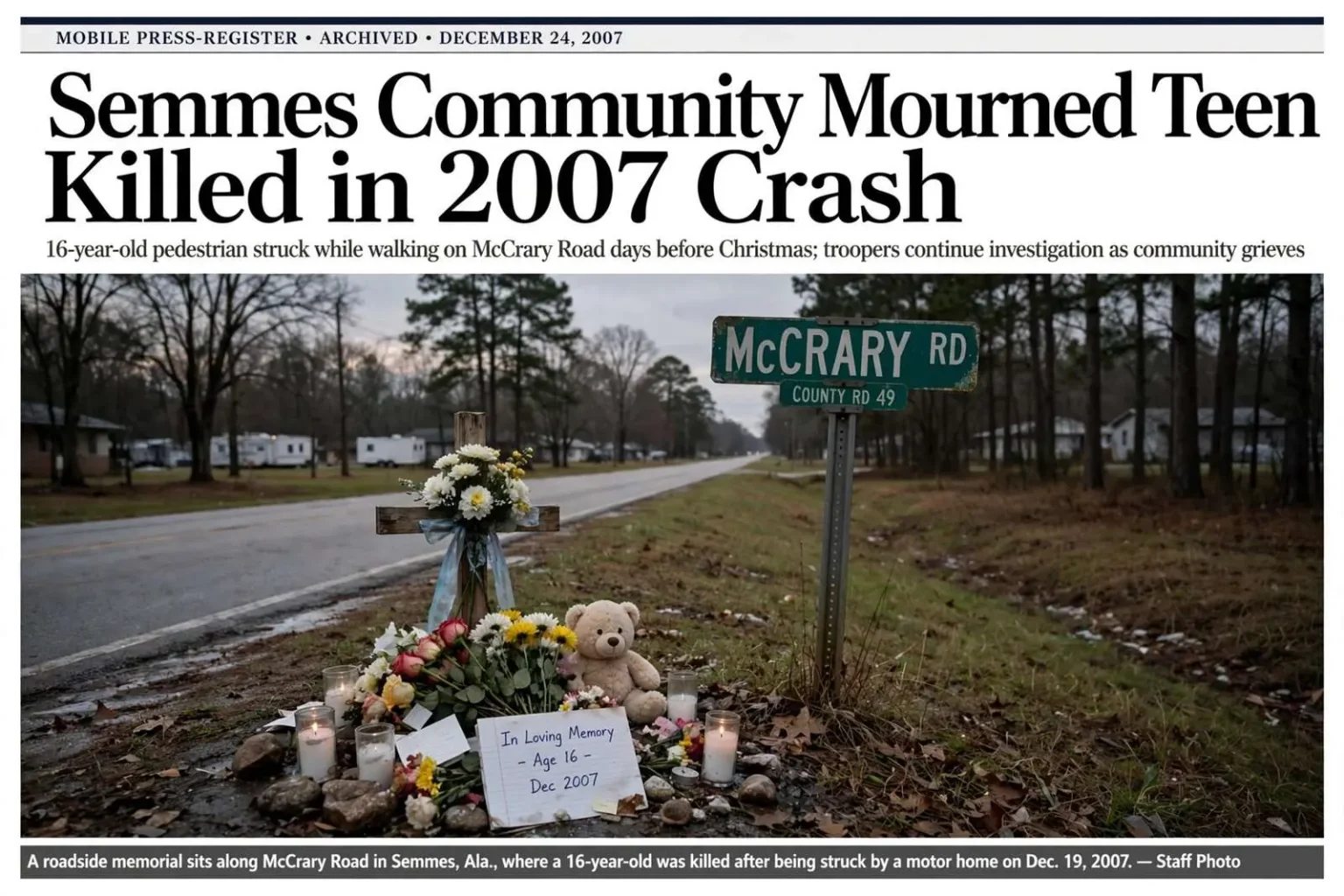
Originally reported December 24, 2007. Semmes residents mourned after a 16-year-old pedestrian died following a crash on McCrary Road in December 2007, according to an archived local news report. The death of a teenager on a road that families in the community traveled daily stunned the small western Mobile County city, where residents described the days after the crash as a time of grief and disbelief.
The teen was walking with a friend when he was struck by a motor home. He was taken to USA Medical Center, the regional trauma hospital in Mobile, and later died from his injuries. The friend who had been walking alongside him escaped injury but was in shock in the aftermath, the report said, a detail that captured how sudden the crash was for the two teenagers who had set out together on an ordinary walk.
State troopers had not filed charges at the time of the archived report, and the account noted that they were examining whether alcohol may have been involved in the crash. That open question — unanswered in the days before Christmas 2007 — was among the details investigators weighed as they reconstructed what happened on McCrary Road, a road that threads through the residential and rural landscape west of Mobile.
The crash on McCrary Road
McCrary Road runs through Semmes, a community that in 2007 was still a small town on the western edge of the Mobile metropolitan area, years away from the incorporation it would later pursue. Roads like McCrary carry a mix of local car traffic, school buses and through traffic, and their shoulders and stretches without sidewalks have long been a point of concern for pedestrian safety in unincorporated and newly incorporated parts of Mobile County.
Pedestrians struck by vehicles face some of the gravest odds of any crash type, and a motor home presents particular dangers: a large, heavy vehicle with a high front profile and long stopping distances. A pedestrian struck at roadway speed has little protection, which is why even prompt emergency response — in this case, transport to USA Medical Center — could not save the teenager’s life.
The presence of a second teenager, walking beside the victim, made the crash harder for the community to absorb. Witnesses in the immediate aftermath are often the closest observers of what happened, but a friend in shock is also among the most traumatized, and investigators must balance the urgency of gathering an account with the reality of what the witness had just experienced. The report recorded no injuries for the friend beyond that emotional toll.
How the investigation proceeded
At the time of the archived report, troopers had filed no charges, and the possibility that alcohol may have been involved remained an open line of inquiry rather than a finding. Investigations of pedestrian fatalities typically examine the driver’s condition and actions, the pedestrian’s position on or near the roadway, lighting conditions at the time of day, and sight lines along the road, before any decision about charges is made.
Mobile County’s district attorney reviews fatal crash investigations before charges are brought, and in cases where impairment is suspected, toxicology results and reconstruction work shape the eventual decision. The archived account, written days after the crash, correctly declined to state any outcome — it notes only the question under examination. This historical account avoids graphic detail and reflects the early investigation; it does not state later charges or court outcomes.
That restraint was deliberate. Early crash reports often contain provisional details that later investigations refine or overturn, and the archived record preserves only what troopers said at the time: a 16-year-old struck while walking with a friend, transported to USA Medical Center, later dead, no charges filed, and a question about alcohol under examination.
A community’s grief
The timing compounded the loss. The crash came days before Christmas, in a season when Semmes — a community anchored by its churches, schools and long agricultural traditions, including the nurseries that made the area famous for azaleas — was preparing for holidays built around children and family gatherings. Grief support and community mourning typically follow such deaths through school counselors and congregations, as classmates of a 16-year-old return to school with an empty desk among them.
Semmes in 2007 was part of the Mobile County school zone it remains today, and teenagers there lived along roads where walking meant sharing the pavement edge with traffic. The loss of one of their own on McCrary Road was the kind of event that stays in a community’s memory — recalled years later by classmates and neighbors who remember where they were when word spread.
The archived report stands as the historical record of those days: a 16-year-old walking with a friend on McCrary Road in December 2007, struck by a motor home, taken to USA Medical Center, and gone. His friend survived, shaken but unhurt. Troopers examined whether alcohol played a role and filed no charges at the time of the report, and the community of Semmes mourned a teenager whose walk ended in a crash that no one who lived through it forgot.
Pedestrian safety in west Mobile County
The crash fit a pattern that safety officials in Mobile County have wrestled with for decades: pedestrians using roads that were designed for cars. In communities like Semmes, residential streets feed into collector roads such as McCrary, where walkers, joggers and students share narrow or nonexistent shoulders with through traffic. National pedestrian safety guidance consistently identifies these conditions — higher traffic speeds, no separated walkway, low lighting in winter evenings — as factors in fatal strikes.
December adds its own hazards. Days are shortest late in the month, meaning afternoon walks can unfold in dimming light, and drivers visibility drops just as pedestrians in dark winter clothing become hardest to see. Safety campaigns across Alabama have long urged both sides of that equation — drivers to slow and scan in residential corridors, walkers to face traffic, wear bright or reflective clothing and avoid roads without shoulders when alternatives exist.
In the years since 2007, west Mobile County’s population growth has intensified exactly these pressures. Subdivisions replaced nurseries and fields along many corridors, adding both walkers and cars, while the roads themselves remained largely as they were. Local governments have periodically added sidewalks, lighting and crossing improvements where funding and right-of-way allowed, and crashes like the one on McCrary Road are part of the record that justifies those projects.
USA Medical Center and the region’s trauma system
The hospital that received the teenager, USA Medical Center, anchors the trauma system for a large region of the central Gulf Coast. Patients with the most serious injuries from crashes across Mobile County and beyond are routed there, where surgical teams, blood banks and specialists stand ready around the clock. For families in communities like Semmes, that capability — roughly twenty miles away — represents the difference between local emergency care and the highest level of treatment available in the region.
Even the best trauma care operates within limits set at the moment of impact. Pedestrian strikes involving large vehicles cause injuries that cannot always be survived regardless of response time, which is why prevention, not treatment, remains the only reliable lever against fatalities of this kind. The archived report’s brief clinical detail — taken to USA Medical Center, later died — compresses what would have been hours of emergency effort into a single line.
Emergency medical crews from the Semmes area responded to the scene, as they do to calls along McCrary Road and the surrounding corridors, and the transport into Mobile followed the standard pathway for critical patients in the county’s western communities. The friend who walked beside the victim did not require that transport, escaping the crash physically unharmed but carrying what witnesses to such events carry afterward.
Remembering a life cut short
What remains from the December 2007 report is the outline of a loss: a 16-year-old from a close-knit community, walking with a friend on a road both knew, struck by a motor home before either could react. The report does not record his name or photograph, only his age and the circumstances, and that spareness is itself a function of how such stories were written — protecting a grieving family while the investigation was still open.
The community’s mourning, noted in the archived account, followed the patterns familiar to small towns across south Alabama. Vigils, memorial funds, and quiet gestures at the crash site typically mark the weeks after a teenager’s death, and schools bring in counselors for the classmates who knew the victim best. McCrary Road still runs through Semmes today, carrying the same mix of traffic it did in 2007, and the memory of that December belongs to the neighbors who lived it.
This historical account preserves the original report’s facts without speculation: a December 2007 crash on McCrary Road in Semmes, a 16-year-old pedestrian struck while walking with a friend, transport to USA Medical Center, a later death, a friend in shock but unhurt, no charges filed at the time, and an open question about alcohol that troopers were still examining as the community grieved.