Semmes traffic stop leads to meth trafficking charges, $45K in cash seized, police say
Semmes police say a traffic stop on Moffett Road led to meth trafficking charges and the seizure of drugs and more than $45,000 in cash.
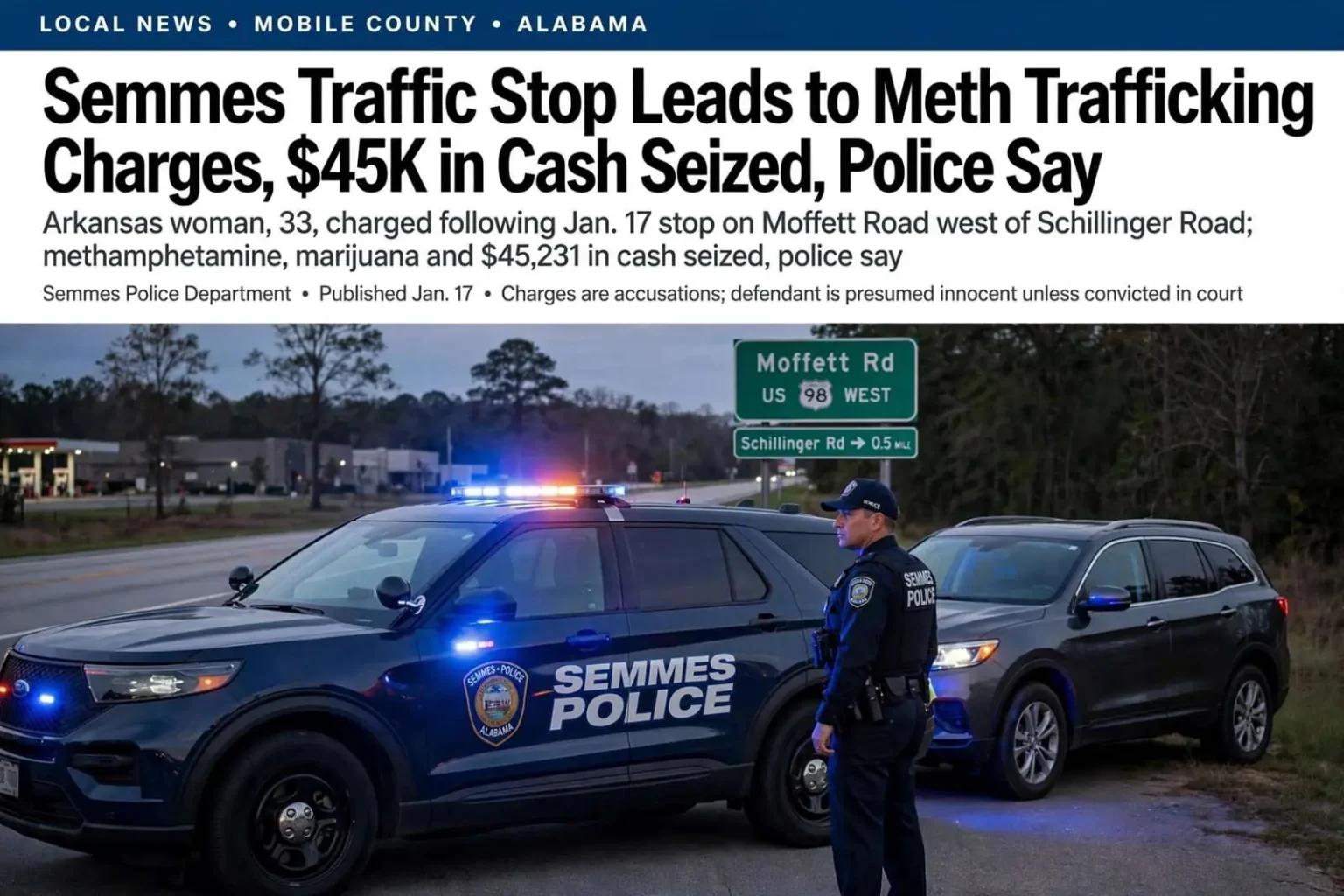
A traffic stop in Semmes led to drug trafficking charges for an Arkansas woman after officers found methamphetamine, marijuana and thousands of dollars in cash in her vehicle, according to the Semmes Police Department.
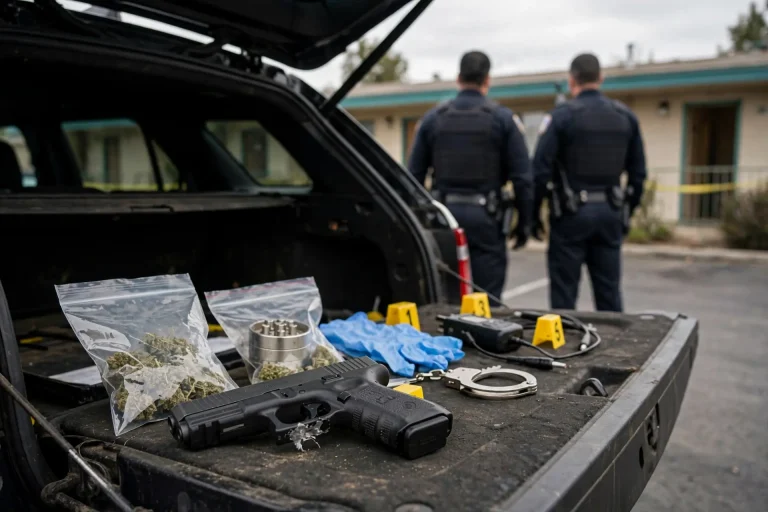
Police said Kayla Renee Lott-Minix, 33, of Arkansas was pulled over on Moffett Road just west of Schillinger Road on Jan. 17 for a traffic violation. According to the department, officers noticed a strong smell of marijuana coming from the vehicle and searched it. The search turned up what police described as methamphetamine, marijuana and roughly $45,000 in cash.
Lott-Minix was charged with trafficking methamphetamines, first-degree possession of marijuana and possession of drug paraphernalia. Police estimated the street value of the suspected methamphetamine at $10,470 and the marijuana at $1,272, alongside $45,231 in cash seized during the stop. Charges are accusations, and a defendant is presumed innocent unless convicted in court.
Where the stop happened
Moffett Road, also known as U.S. Highway 98, is one of the main east-west corridors through Semmes in western Mobile County. The stretch just west of Schillinger Road sits near the boundary between the city’s commercial core and its more rural western reaches, an area where two-lane and four-lane segments meet and where traffic enforcement is a routine part of the police department’s daily patrol work.
Semmes, incorporated as a city in 1996 after decades as a rural community northwest of Mobile, has grown steadily along the Highway 98 corridor. Its police department covers a city of roughly 7,000 residents, and officers there regularly conduct stops along the highway that connect Mobile’s western suburbs to communities stretching toward the Mississippi state line.
Traffic stops that begin with a minor violation — a broken taillight, a lane departure, a speeding citation — are among the most common entry points for drug seizures on Alabama highways. Under long-standing U.S. Supreme Court precedent, an officer who lawfully stops a vehicle may investigate further when other indicators of criminal activity emerge, and the smell of marijuana coming from a vehicle has traditionally been treated under Alabama law as grounds for a search.
That is what police said happened here: a lawful stop for a traffic violation, followed by the odor of marijuana, followed by a vehicle search that escalated a routine traffic case into a felony prosecution with three separate charges.
The charges, one by one
The most serious of the three charges is trafficking methamphetamines. In Alabama, meth trafficking is a Class A felony, and the statute sets the threshold by weight: a person commits trafficking by possessing 10 grams or more of methamphetamine or its derivatives. Convictions can draw lengthy prison sentences, and the presence of quantities well above the threshold — along with significant cash — is the kind of evidence prosecutors weigh when deciding how to proceed.
First-degree possession of marijuana, the second charge, is also a felony under Alabama law. The state distinguishes between simple possession, a misdemeanor for small amounts, and first-degree possession, which applies to larger quantities or to circumstances such as a prior conviction. A felony possession charge carries the possibility of prison time and a permanent criminal record if a conviction is entered.
The third charge, possession of drug paraphernalia, is a lesser offense but one that commonly accompanies drug seizures. Paraphernalia can include packaging materials, scales, pipes or other items that prosecutors say connect a suspect to the sale or use of controlled substances.
Together, the three charges give prosecutors flexibility. The trafficking count anchors the case, while the possession counts provide alternative theories and additional leverage in plea negotiations. Each charge must ultimately be proven beyond a reasonable doubt if the case goes to trial.
The cash and what it means
The $45,231 in cash seized during the stop is significant in drug cases for reasons that go beyond the charges themselves. Under Alabama law and federal statute, cash and property connected to drug trafficking can be subject to forfeiture proceedings, a separate legal process in which the government seeks to keep the money it says proceeds from or was used to facilitate illegal drug activity.
Forfeiture is civil, not criminal: it does not require a conviction, and it unfolds under its own timeline and its own standard of proof. Owners who contest a forfeiture must navigate notice requirements and court hearings, and the outcome can differ from the criminal case. For defendants, a large cash seizure also complicates defense preparations, since retaining private counsel without access to seized funds can be difficult.
Police street-value estimates — $10,470 for the suspected methamphetamine and $1,272 for the marijuana in this case — are figures officers generate based on department guidelines and regional pricing. They are not market prices in any precise sense, but they help prosecutors and judges understand the scale of the seizure, and they often appear in arrest records and charging documents.
Meth enforcement on the Gulf Coast
Methamphetamine enforcement has been a persistent priority for law enforcement across south Alabama and the broader Gulf Coast. The Mobile County area sits along interstate and highway routes that connect Gulf Coast ports and urban centers with rural communities across the Southeast, a geography that has long made the region a corridor for drug transportation.
Local departments such as Semmes Police work alongside the Mobile County Sheriff’s Office, the Mobile Police Department and regional drug task forces that coordinate investigations spanning jurisdictional lines. State-level support comes from the Alabama Law Enforcement Agency and its investigative units, and federal partners become involved when cases cross state lines — a factor that is often present when stops involve out-of-state drivers, as this one did with a driver from Arkansas.
The distance from Arkansas to the Alabama Gulf Coast — hundreds of miles along interstates such as I-40, I-22 and I-65 — is the kind of route that investigators associate with transportation rather than personal use, though no transportation charges were announced in this case. Prosecutors ultimately make that distinction based on the weight of the drugs, the packaging, the cash and any other evidence recovered.
For residents of Semmes and western Mobile County, stops like this one along Moffett Road underscore the department’s presence on the corridor. The highway carries commuters, school traffic and commercial vehicles daily, and the police department’s enforcement activity there is among the most visible work it does.
What happens next
After an arrest of this kind, the case moves through the Mobile County court system. Lott-Minix would face an initial appearance before a judge, where bond would be set on the felony charges, followed by arraignment and the pretrial process. Felony drug cases in Alabama can take months to resolve, particularly when weight-based trafficking charges bring potential sentencing exposure that defendants weigh against plea offers.
The evidence in the case — the suspected methamphetamine, the marijuana, the paraphernalia and the cash — would be analyzed by the Alabama Department of Forensic Sciences, whose laboratory reports confirm the identity and weight of seized substances. Those lab results are typically essential to trafficking prosecutions, since the 10-gram statutory threshold turns on scientifically confirmed weight.
Defense attorneys in such cases scrutinize every step of the stop: the reason for the initial traffic stop, the legality of the search, the handling and chain of custody of the evidence and the measurement of the drugs. Suppression motions can exclude evidence if a court finds the search unlawful, and such rulings can reshape a case entirely.
Until the case is resolved, the charges remain accusations. Lott-Minix is presumed innocent unless and until prosecutors prove the charges in court beyond a reasonable doubt — the standard that governs every felony case in Alabama, from a traffic stop on Moffett Road to the courthouse in downtown Mobile.
How traffic stops become felony cases
The sequence in this case — a traffic violation, an odor of marijuana, a search, a felony arrest — is one of the most common patterns in Alabama drug enforcement, and it is governed by a well-developed body of case law. A stop must be justified by a violation or reasonable suspicion, and the officer may not prolong it beyond the time needed to address the violation and complete standard procedures unless new facts emerge that justify further investigation.
The smell of marijuana has traditionally been treated by Alabama courts as probable cause to search a vehicle without a warrant, an exception rooted in the mobility of cars and the perishable nature of the evidence. That rule has been reexamined in some states following changes to marijuana laws elsewhere, but in Alabama — where marijuana remains fully illegal for recreational use — the odor-plus-stop combination remains a routine basis for vehicle searches.
When a search produces drugs by weight above a trafficking threshold, the encounter transforms. Arrests for felony drug charges in Mobile County typically involve coordination with prosecutors at the district attorney’s office, and defendants face bond schedules that treat trafficking offenses among the more serious categories on the books.
What the numbers in this case suggest
The quantities police reported — an estimated $10,470 in methamphetamine, $1,272 in marijuana and $45,231 in cash — describe a seizure of a scale that local departments publicize precisely because it is uncommon for a single stop. Cash totals of this size, particularly when found alongside bulk-packaged drugs, are the kind of evidence that investigators associate with distribution activity, though the charges filed in this case did not include a separate distribution count.
As announced, the charges were limited to trafficking methamphetamines, first-degree possession of marijuana and possession of drug paraphernalia. Additional charges can be added later as lab results and investigative work develop, or dropped as part of plea negotiations — both routine features of how felony drug cases evolve between arrest and trial.
For the Semmes Police Department, the stop represented the kind of case officers train for: a corridor traffic stop that escalates into a significant seizure. Departments across western Mobile County have emphasized highway enforcement in recent years, and the results are measured in cases like this one.
Advice for drivers and the public record
Local police generally advise motorists stopped on Moffett Road or any other Semmes roadway to pull over safely, keep hands visible, provide license and insurance on request and comply with lawful instructions. Disputes about the stop itself are for the courts, not the roadside, and video from patrol units increasingly documents every phase of these encounters.
Residents who see what they believe is drug activity along the Highway 98 corridor can report it to the department, and tips — like traffic stops — sometimes feed the larger investigations that task forces build over months across multiple jurisdictions.
For now, the case stands on three charges and a substantial seizure: a 33-year-old Arkansas woman, stopped on a January evening for a traffic violation on Moffett Road, now facing felony prosecution in Mobile County with tens of thousands of dollars in cash held as evidence. How the courts resolve it will depend on lab results, rulings on the search and the choices made by prosecutors and the defense in the months ahead.
Until then, the presumption of innocence applies to every count — the governing principle of Alabama’s courts, and the last word on any case that has not reached a verdict.