Sen. Doug Jones Defends Impeachment Conviction Vote at Mobile Appearance
Sen. Doug Jones defended his vote to convict President Trump at an Africatown event in Mobile, saying his oath outweighed polls.
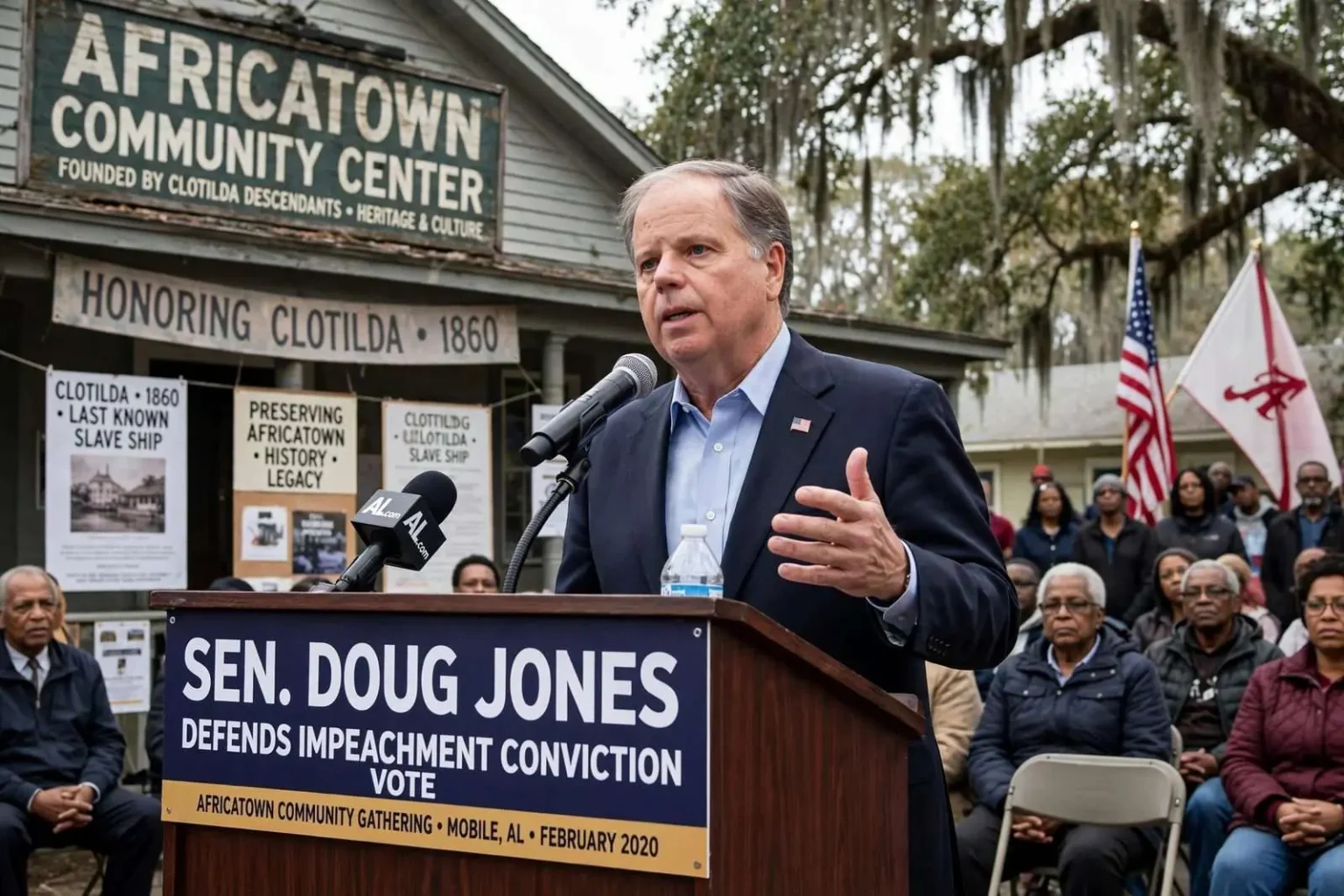
U.S. Senator Doug Jones used his first Gulf Coast public appearance since the impeachment vote to defend his decision to convict President Trump, telling a Mobile audience he was bound by his oath rather than by polls. Jones spoke Saturday at an Africatown event in Mobile, days after Wednesday’s Senate vote that acquitted the president on both articles of impeachment while Jones joined the minority voting to convict.
The appearance put the state’s junior senator in front of an Alabama audience at the most delicate moment of his term. The Alabama Democrat acknowledged the political risk — Trump remained popular in the state, and several Republican Senate opponents had spent the week issuing statements criticizing his vote. But Jones said the decision came down to due diligence and duty, not popularity, and he made no effort to soften that position for the crowd.
‘I Don’t Do Things Based on Polls’
“The constitution doesn’t require a poll in which to vote,” Jones said. “It requires a lot of due diligence and a lot of work. I don’t do things based on polls. I understand there will be people who disagree with this … What I did do is follow my oath in the constitution.”
The comments amounted to the senator’s fullest public accounting of his reasoning since the vote. Jones described the impeachment trial as a solemn legislative function rather than a campaign question, and he pointed to the oath senators swear before an impeachment trial — to do impartial justice according to the Constitution — as the standard that guided him. He characterized impeachment as anything but a political issue, calling it a question of making what he saw as the correct decision.
For a senator whose term would be decided by Alabama voters that November, the stance carried obvious electoral risk. Jones had won his seat in a 2017 special election, and his re-election campaign was already framed by national forces: a Republican field competing to prove its loyalty to the president, and a state Trump had carried decisively. Voting to convict the president gave those opponents a ready-made line of attack, and they used it within hours of the vote.
The Setting: Africatown
The venue gave the remarks a distinctive resonance. Africatown, the historic community just north of downtown Mobile, was founded by the survivors of the Clotilda, the ship that carried the last known group of enslaved Africans to the United States in 1860 — decades after the importation of enslaved people was outlawed. The community’s descendants have preserved its history through generations, and in recent years the area has drawn national attention as archaeological work confirmed the Clotilda’s wreckage in the Mobile-Tensaw Delta.
Jones’s appearance at an Africatown event placed his impeachment defense in front of a community with its own long memory of injustice and civic struggle. The senator has deep ties to civil rights history in Alabama — his career was built in part on prosecuting long-buried civil rights-era crimes — and audiences in Alabama’s black communities have been among his most consistent supporters. Saturday’s event gave him an audience inclined to weigh his explanation seriously, whatever the political winds across the rest of the state.
The Vote That Brought Him Here
The Senate acquitted President Trump on Wednesday on both articles of impeachment passed by the House — abuse of power and obstruction of Congress — with the votes falling almost entirely along party lines. Jones was among the Democrats voting to convict on both counts, a position that put him at odds with most of his state’s electorate but in step with the constitutional argument he articulated Saturday. The interval between the Wednesday vote and his Saturday appearance was brief, and his decision to face Alabama audiences immediately rather than avoid them was noted by those in attendance.
Impeachment trials are rare events — the Senate had conducted only two full presidential impeachment trials before this one — and they place every senator on the record in a way ordinary legislation never does. There is no amendable compromise in an impeachment vote, no half-measure to point to later. Each senator’s choice is singular and permanent, which is why Jones’s framing of the decision as a matter of oath rather than politics addressed the only question his vote truly allowed.
The Republican Response
Within Alabama’s Republican Senate primary, the week’s statements criticizing Jones’s vote served a dual purpose: attacking the incumbent and competing for the president’s endorsement. Several of Jones’s prospective Republican opponents issued statements denouncing the vote, casting it as a betrayal of Alabama’s voters and vowing to support the president. In a primary contested largely on loyalty to Trump, the impeachment vote was a gift of material, and none of the candidates let it pass unused.
The criticism set up the framing that would define the campaign to come: Jones defending his vote as a constitutional duty, his opponents recasting it as a disqualifying departure from the state’s voters. Jones, for his part, declined to apologize for it. His Saturday message — that the Constitution requires due diligence rather than popularity contests — doubled as a preview of the argument he intended to carry into the fall, whatever its political cost.
What the Moment Meant
For the Mobile audience, the event offered an unusual sight: a sitting senator explaining an impeachment vote in person, days after casting it, in a historic community far from Washington’s cameras. Jones’s willingness to make that case face to face — and to concede that people would disagree — fit the persona that had carried him into office: an unglamorous, deliberative style that leaned on his record as a prosecutor who followed evidence where it led.
Whether the argument persuades Alabama’s broader electorate remained the open question the fall would answer. What Saturday’s appearance made clear is that Jones had chosen his ground: he would defend the vote on constitutional terms, in front of Alabama audiences, rather than hoping the moment would pass quietly. For the Africatown crowd that heard him, the senator’s message was unmistakable — he knew the cost, and he had concluded that his oath required it anyway.
Africatown’s Story in Brief
The community where Jones spoke carries one of the most remarkable histories on the Gulf Coast. In 1860, the Clotilda slipped into Mobile Bay on a illegal voyage financed by a local shipbuilder, carrying 110 African captives decades after the transatlantic slave trade had been banned. After the Civil War, the survivors — many from West African towns — pooled their wages and purchased land north of Mobile, building a community they called African Town, complete with its own schools and churches, determined to preserve their languages and traditions on their own property.
That legacy made Africatown a symbol of self-determination long before it became a subject of national documentaries and archaeological discovery. The community’s residents and their descendants have pressed for generations for recognition, preservation and investment, and events like Saturday’s — bringing state and national figures to the neighborhood — are part of that continuing effort to keep Africatown’s story in public view. The confirmation of the Clotilda’s remains in 2019 intensified that attention, drawing visitors, researchers and officials to a community that had kept the memory alive on its own for more than a century and a half.
Jones’s Path to the Senate
Jones’s own history gave his oath-based argument a particular weight. A former U.S. Attorney for the Northern District of Alabama, he built his national reputation prosecuting two former Klansmen for the 1963 Birmingham church bombing that killed four girls — a case that had waited more than three decades for its day in court. That record, built on following evidence across decades of silence, became the backbone of his 2017 special-election victory and of the image he presented Saturday: a public official who argues that decisions should rest on diligence, facts and duty.
His Senate term, born of a special election, was always going to be defined by the 2020 campaign that followed. Alabama’s Senate races draw national attention and money, and the impeachment vote added fuel to what was already certain to be one of the country’s most contested contests. Jones’s appearance in Mobile — defending his most controversial vote before a home-state audience — was an early exercise in exactly the kind of campaigning he preferred: showing up, taking questions and explaining himself.
The Political Landscape Around Him
The Saturday appearance came as the state’s political calendar was already moving. The Republican field was still taking shape, the president’s campaign was organizing in a state it expected to win easily, and national observers were watching whether Alabama’s 2017 surprise would repeat or reverse. Jones’s conviction vote was certain to be central to the race’s framing — embraced by his base, condemned by his opponents and scrutinized by undecided voters who cared less about Washington than about who would represent Alabama’s interests.
Into that landscape walked the constitutional argument. Jones’s case to Alabama voters was essentially this: a senator’s oath is not conditional on popularity, and an electorate that sends someone to Washington must expect them to cast hard votes there. It was a risky appeal in a state where the president’s approval ran high, but it was consistent — the same case he made at Africatown, on a Saturday, eleven days before the impeachment trial’s final chapter would fade from the headlines and the campaign would begin in earnest.
For the audience at the Africatown event, though, the moment was less about November than about February: a senator, three days after the most consequential vote of his term, standing in one of Alabama’s most historic communities to explain, without apology, exactly why he cast it the way he did.