Senator Shelby Announces New Southwest Alabama Regional Airport in Thomasville
Senator Shelby announces FAA authorization of new Southwest Alabama Regional Airport in Thomasville, closing the transportation gap for Clarke County.
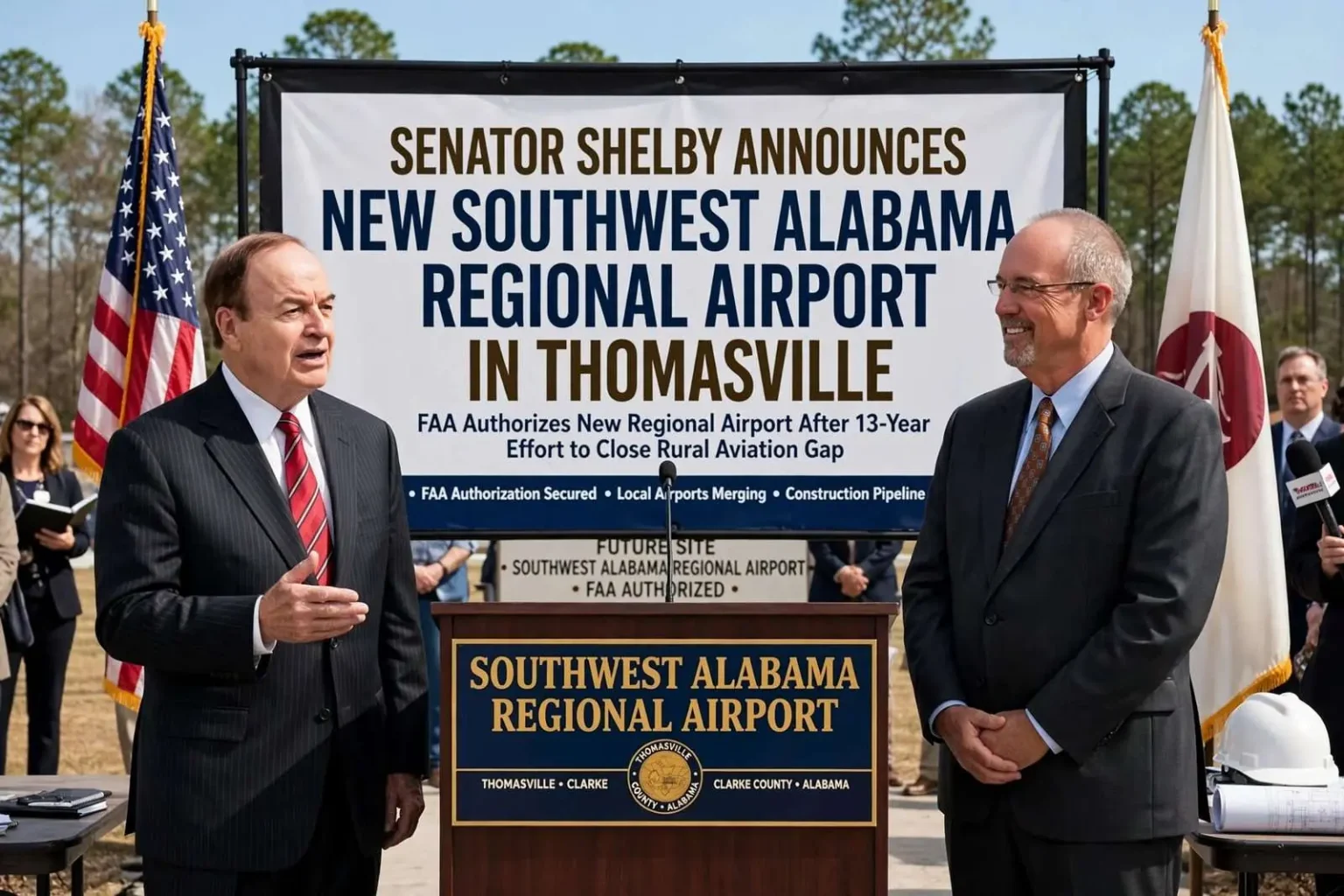
U.S. Senator Richard Shelby (R-Ala.) announced that the Federal Aviation Administration (FAA) has authorized a new regional airport in Thomasville, Alabama, for residents across the southwest region of the state. Under the authorization, local airports will merge to become the Southwest Alabama Regional Airport, consolidating aviation services that had been scattered among smaller fields into a single facility designed to serve Clarke County and the surrounding region for decades to come.
Federal authorization is the decisive milestone in any airport project. Before the FAA signs off, a community can study, plan and acquire land, but it cannot build to federal standards or receive the federal grants that fund most general aviation construction. With the FAA’s approval in hand, Thomasville moves from a long-range vision to an actual construction pipeline — the position every rural airport aspirant in the state hopes to reach and relatively few ever do.
“The recent growth and economic investment in Thomasville and the surrounding areas have created an ideal environment to host the new Southwest Alabama Regional Airport,” said Senator Shelby. “I am grateful for the efforts of Mayor Day, Dr. Eagerton, and Gil Gilmore over the years as we have worked to make this vision possible. I am also proud that the Federal Aviation Administration has recognized the need for this airport, and I am confident this project will contribute to the economic vitality of the region for generations to come.”
Closing a transportation gap in rural Alabama
Thomasville Mayor Sheldon Day emphasized the airport’s importance for the region’s transportation infrastructure. “North Clarke County is located 60 miles from the closest interstate. The new Southwest Alabama Regional Airport is vital in closing the transportation gap for business and industry in our rural region,” Mayor Day said.
The distance Day cited defines daily life for economic development in the region. Thomasville sits in the interior of southwest Alabama, hours from the interstate grid that connects the rest of the state, and companies evaluating rural sites routinely rank transportation access among their top considerations. A modern general aviation airport does not replace an interstate, but it changes what kinds of business the region can realistically pursue: site consultants and corporate executives can fly into the community directly rather than driving more than an hour from the nearest commercial airport, and existing industries gain a practical tool for moving personnel, parts and customers.
Thirteen years in the making
The airport project has been in development for 13 years, a span that included site selection studies, feasibility studies, and land acquisition. Each of those stages carries its own federal requirements — environmental review, airspace analysis, compatible land use — and each had to be completed before the FAA would consider the authorization Shelby announced. The timeline is a reminder of how demanding rural aviation projects are: communities that see an airport open within a decade of first proposing one are considered fast.
The local investment climate gave the project its strongest argument. Over the past decade, various companies have invested over $550 million in facilities and infrastructure in the Thomasville area, supporting hundreds of jobs. For a town of Thomasville’s size, that volume of industrial commitment is exceptional, and it built the case Shelby referenced: an expanding industrial base needs aviation infrastructure to match, and a region that has already attracted hundreds of millions in capital has demonstrated that companies will come when the fundamentals are in place.
A gap identified in the state aviation plan
The need was not just a local talking point. The 2005 Alabama Statewide Airport System Plan revealed that southwest Alabama was underserved in terms of access to aviation infrastructure, flagging the region as one of the state’s weak spots in an otherwise systematic network of general aviation fields. Statewide airport plans are updated periodically to measure where Alabama’s aviation capacity stands against its population and economy, and the 2005 edition made the region’s deficit part of the official record.
That finding set the machinery in motion. The Alabama Department of Transportation’s Aeronautic Bureau worked with FAA and the Southwest Alabama Regional Airport Authority to conduct studies confirming the area’s need for a new general aviation airport in Clarke County. The arrangement is the standard division of labor for projects of this kind: the state aeronautics bureau coordinates planning and helps channel funding, the FAA evaluates safety and demand, and a locally chartered airport authority holds the land and carries the project through its political and administrative stages. Every study, agreement and land parcel from those years now forms the foundation of the authorized airport.
What the merger of local airports means
The decision to have local airports merge into a single regional facility is a pragmatic one that more rural areas across Alabama have adopted. Small municipal fields often struggle individually to justify maintenance, staffing and capital improvements, while a merged regional airport concentrates demand, funding eligibility and management under one authority. For pilots and businesses in Clarke County and neighboring counties, the practical effect is a single, better-equipped destination rather than several underused ones — with longer runways, better lighting and instrument approaches as the project advances toward construction.
General aviation airports function as economic instruments as much as transportation ones. Industries that locate near them cite access for corporate flights, time-critical freight and customer visits; agricultural operators use them for aerial application; and medical flights depend on them in emergencies across rural stretches of the state where the nearest trauma center is far away. In southwest Alabama, where dense pine forest and river systems separate communities from the state’s larger cities, those functions carry particular weight.
The long road from authorization to runway
Authorization does not mean the airport opens tomorrow. Construction typically proceeds in phases — clearing, grading, runway base and surfacing, then lighting, fueling and terminal facilities — with each phase dependent on further federal and state grants. But the authorization Shelby announced is the gate that everything else waits behind, and communities that reach it generally finish. Thirteen years of studies, land acquisition and local persistence stand between the 2005 plan finding that identified the gap and an FAA approval that lets Thomasville close it.
For residents of Clarke County and the broader southwest Alabama region, the airport represents the kind of infrastructure investment that rural areas rarely win. The combination cited in the announcement — hundreds of millions in private investment, a documented statewide need, and more than a decade of local coordination among the mayor’s office, the airport authority and federal partners — proved enough to earn the FAA’s authorization. The merger of the local airports into the Southwest Alabama Regional Airport now gives the region its single most visible piece of new transportation infrastructure in a generation, and a base from which to compete for the industries that follow it.
Why rural airports depend on federal partnership
Projects like the Southwest Alabama Regional Airport are built on a funding partnership that has shaped American aviation since the mid-20th century. The FAA administers a national grant program that typically covers the large majority of eligible costs at general aviation airports, with the state and the local sponsor splitting the remainder. Alabama’s Aeronautic Bureau, which assisted with the studies for the Clarke County project, channels state aviation fuel tax revenue into local matching shares, which is how communities of modest size manage to build and maintain airfields that would otherwise be far beyond their budgets. Eligibility for that pipeline is exactly what the FAA authorization unlocks, and it is why the announcement matters more to Thomasville’s budget than any single year of local fundraising could.
The sponsorship structure also explains the role of the Southwest Alabama Regional Airport Authority. As the local sponsor, the authority signs the federal grant agreements, holds title to the airport property, and takes on the long-term obligation to keep the facility maintained to FAA standards. It is a permanent civic commitment, not a one-time construction project, and the years of work by local leaders that Shelby acknowledged were largely devoted to preparing the community to carry that responsibility.
A regional pattern of airport investment
Alabama’s smaller cities have increasingly treated aviation as economic development infrastructure rather than a civic amenity. Across the state, general aviation airports have become the first stop for site-selection visits, the staging point for industrial construction projects, and a magnet for aviation-related businesses that cluster wherever hangar space and runways are available. Communities that invested early in modernizing their fields have generally found the demand follows; communities without adequate aviation access routinely appear on the losing side of industrial recruitment decisions. The 2005 statewide plan’s finding about southwest Alabama put the region squarely in the second category, and the Thomasville project is the region’s answer.
For Clarke County specifically, the merger arrangement offers a path that fits its circumstances. Rather than stretching thin resources across multiple small fields, the region consolidates behind one facility that can meet FAA design standards, qualify for the full range of federal grants, and present a single professional face to the corporations and pilots the region hopes to attract. Industry in Thomasville — from the manufacturing plants built during the past decade’s investment wave to the timber and agricultural operations that have anchored the county for generations — gains a single reliable point of air access.
What comes next
The years of patient work behind the authorization — site selection, feasibility analysis, land acquisition, and the joint studies by the state aeronautics bureau, the FAA and the airport authority — are the invisible half of any airport announcement. What remains is the visible half: construction phasing, continued grant applications and, eventually, ribbon cuttings. Communities that reach this stage with federal backing and a documented record of regional demand are well positioned to see the project through.
For southwest Alabama, the FAA’s authorization of the Southwest Alabama Regional Airport closes a circle that opened with a 2005 planning study and ran through $550 million in local industrial investment, 13 years of development work, and the persistent advocacy of Shelby, Mayor Day and the region’s other airport advocates. Sixty miles from the closest interstate, the region will finally have transportation infrastructure designed for the way modern business travels — and a lasting answer to the aviation gap the state plan identified nearly two decades ago.