
Several Alabama and Florida Panhandle beaches land on national ‘dirty beaches’ list
A national study names Fairhope, Dog River and other Coastal Alabama and Escambia County beaches among the most bacteria-contaminated in the U.S.
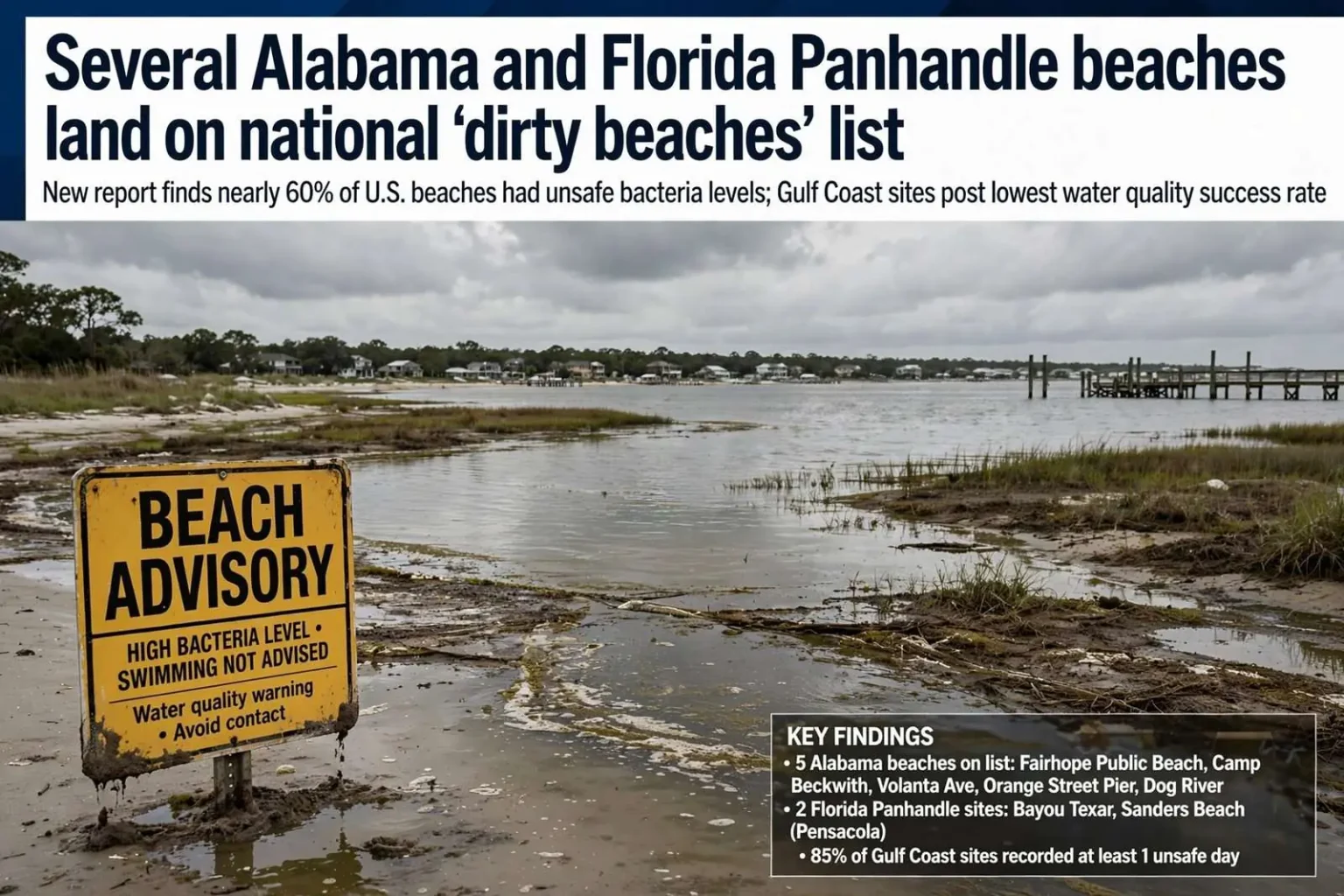
Several beaches across Coastal Alabama and the Florida Panhandle have been named among the nation’s most bacteria-contaminated shorelines in a new national report examining water quality at popular swimming destinations. The study, from the Environment America Research and Policy Center, examined 4,500 beaches in 29 coastal and Great Lakes states and found that nearly 60 percent had bacteria counts exceeding U.S. Environmental Protection Agency standards at least once during the testing period. Researchers estimated that high bacteria levels can sicken an estimated 75,000 swimmers a year nationwide.
The findings are drawn from the routine bacteria sampling that health agencies and beach managers carry out throughout the swimming season. Water samples are tested for indicator bacteria, organisms whose presence signals the likely contamination of the water by fecal matter and the pathogens that travel with it. When a sample comes back above the EPA’s recommended threshold for recreational contact, that day is counted as unsafe, and agencies may post an advisory or close a beach until follow-up samples show the water is clean again. Exposure to contaminated water can cause stomach illness, skin rashes, and ear, eye and respiratory infections, with the greatest risk to small children, older swimmers and anyone with a weakened immune system.
In Alabama, five beaches made the list: one in Mobile County and four in Baldwin County. The Baldwin County sites were Fairhope Public Beach, which recorded 21 unsafe days out of 60 samples; Camp Beckwith, with 8 unsafe days out of 58 samples; Volanta Avenue, with 8 of 36; and Orange Street Pier, with 6 of 34. In Mobile County, the Dog River site at the Alba Club recorded 9 unsafe days out of 36 samples. All five locations sit along Mobile Bay and its tributaries rather than on the open Gulf, in the sheltered, slower-moving waters where bacteria concentrate most readily.
Gulf Coast sites post the nation’s lowest success rate
The pattern continued east into the Florida Panhandle. In Escambia County, Bayou Texar recorded 24 unsafe days out of 50 samples, and Sanders Beach had 23 out of 64, making the two Pensacola-area sites among the most frequently contaminated in the region. Like the Alabama sites on the list, both sit on enclosed or semi-enclosed waters — bayous and sounds — rather than the Gulf itself, where constant wave action and rapid exchange with open water tend to dilute contamination quickly.
The report said 85 percent of sampled sites on the Gulf Coast were contaminated at least one day, giving the region the lowest success rate in the country. The figure reflects how thoroughly the northern Gulf shoreline is monitored as much as how contaminated it is; states that sample frequently and report conservatively tend to accumulate more advisory days than states that test less often. Even so, researchers said, the consistency of exceedances across the Gulf region points to a real and recurring source of pollution reaching recreational waters.
Water quality along the northern Gulf Coast is shaped by geography as much as by any single source of contamination. Mobile Bay receives the outflow of the Mobile River system, one of the largest drainage basins in the United States, and the bay’s smaller tributaries collect stormwater and runoff from the neighborhoods and roadways that line their banks. On the eastern shore, Fairhope’s public beaches and piers sit near the mouths of streams that drain developed portions of the city, while Dog River funnels runoff from a broad swath of western Mobile into the bay.
After heavy rain, those drainage systems deliver a concentrated pulse of pollutants — pet waste, failing sewer lines, septic tank overflows and street runoff — directly into the waters where swimmers wade. Bacteria counts typically spike in the hours and days following a storm and then fall back as sunlight, salinity and water movement do their work. That cycle is visible in the sampling data: sites on bayous and near stream mouths post advisory days far more often than Gulf-front beaches, which are monitored in the same programs and routinely come back clean.
Fairhope points to wastewater rehabilitation
The City of Fairhope responded to the report with a statement saying it has begun aggressive rehabilitation of its wastewater collection, transmission and treatment system and maintains some of the strictest stormwater-quality requirements in Coastal Alabama. The city sits on the eastern shore of Mobile Bay, where its public beach and fishing pier draw swimmers and anglers throughout the year, and where steady residential growth has put sustained pressure on aging collection lines. Officials said the system improvements now underway are aimed squarely at reducing the overflows and leaks that can contribute bacteria to the bay.
City officials noted, however, that water quality in Mobile Bay depends on factors beyond any single municipality, including failing septic systems and upstream discharges throughout the Mobile River Delta watershed. That point reflects how the bay actually functions as a system. Much of the shoreline around Mobile Bay is served by septic tanks rather than central sewer, and in the low, wet ground that characterizes the coastal plain, aging or poorly maintained systems can leach waste into groundwater and nearby streams. Water that enters the Delta eventually moves through the same bay where Fairhope’s beach, Volanta Avenue and Orange Street Pier are monitored.
The City of Fairhope statement also emphasized that its stormwater rules go beyond what state or federal law requires, applying controls to new development that are intended to slow runoff and filter it before it reaches the bay. Local governments across Baldwin and Mobile counties have adopted a patchwork of such requirements over the years, and environmental groups in the region have long argued that stronger, more uniform stormwater controls are one of the most effective steps available to protect coastal waters. The city’s position, in short, is that it is addressing what it can control directly while acknowledging that the beaches listed in the report are affected by forces far beyond the city limits.
What the numbers mean for beachgoers
Experts stressed that most days the beaches were considered safe, and that agencies typically close beaches or post warnings when pollution spikes. An unsafe-day count does not mean a beach is contaminated year-round; Fairhope Public Beach, for example, posted 21 unsafe days out of 60 samples, meaning the large majority of sampling days found the water within standards. Health authorities generally consider brief advisories a normal part of coastal life, particularly during the warm, rainy months when bacteria thrive and storms flush the watershed.
Along the Alabama coast, samples are collected at popular swimming areas during the recreational season and results are posted publicly, allowing residents and visitors to see current conditions before heading to the water. Similar programs operate in Florida, where county health departments sample designated beaches and issue swimming advisories when enteric bacteria exceed state thresholds. When a sample exceeds the standard, agencies resample, and advisories are lifted once two consecutive clean results come back.
They encouraged beachgoers to check water-quality reports before swimming, particularly at sites on enclosed waters. Officials and health experts offer a few common-sense rules of thumb: avoid swimming for a day or two after heavy rain, when runoff and sewer overflows are most likely; keep children from swallowing bay or bayou water; shower after swimming; and pay attention to posted signs at public access points. Open-water swimmers at Gulf-front beaches face far lower risk than those in tributaries and bayous, which is where most of the region’s advisory days occur.
For a region whose economy leans heavily on coastal tourism, the report’s findings carry weight beyond public health. Beaches, piers and boat launches support the restaurants, rentals and bait shops that anchor communities from Fairhope to Pensacola, and repeated advisories can erode the confidence of visitors who have plenty of alternatives. Local officials in both states responded to the report by emphasizing the monitoring and infrastructure work already underway, an approach that treats the advisory data as evidence that the system is catching problems rather than a verdict on the coast itself.
Still, environmental advocates hope the national attention will accelerate investment in sewer systems, septic repair and stormwater controls across the Gulf Coast, arguing that the surest way to improve the numbers is to stop the pollution at its source. In the meantime, the beaches remain open, monitored and — on most days, by the numbers themselves — safe for the swimmers who visit them.
The five Alabama sites and two Florida sites named in the study will continue to be sampled on the same schedule as before, and their future results will be added to the same public databases that produced this report. That steady record of testing is what gives both residents and officials a common set of facts to work from: it shows where the problems concentrate, how quickly water recovers after an advisory, and whether the infrastructure investments now being made are moving the numbers in the right direction.


