Share the Beach Reports 89 Sea Turtle Nests Along Alabama’s Coast in 2026
Share the Beach has confirmed 89 sea turtle nests along Alabama's Gulf Coast in 2026, including 85 loggerhead nests.
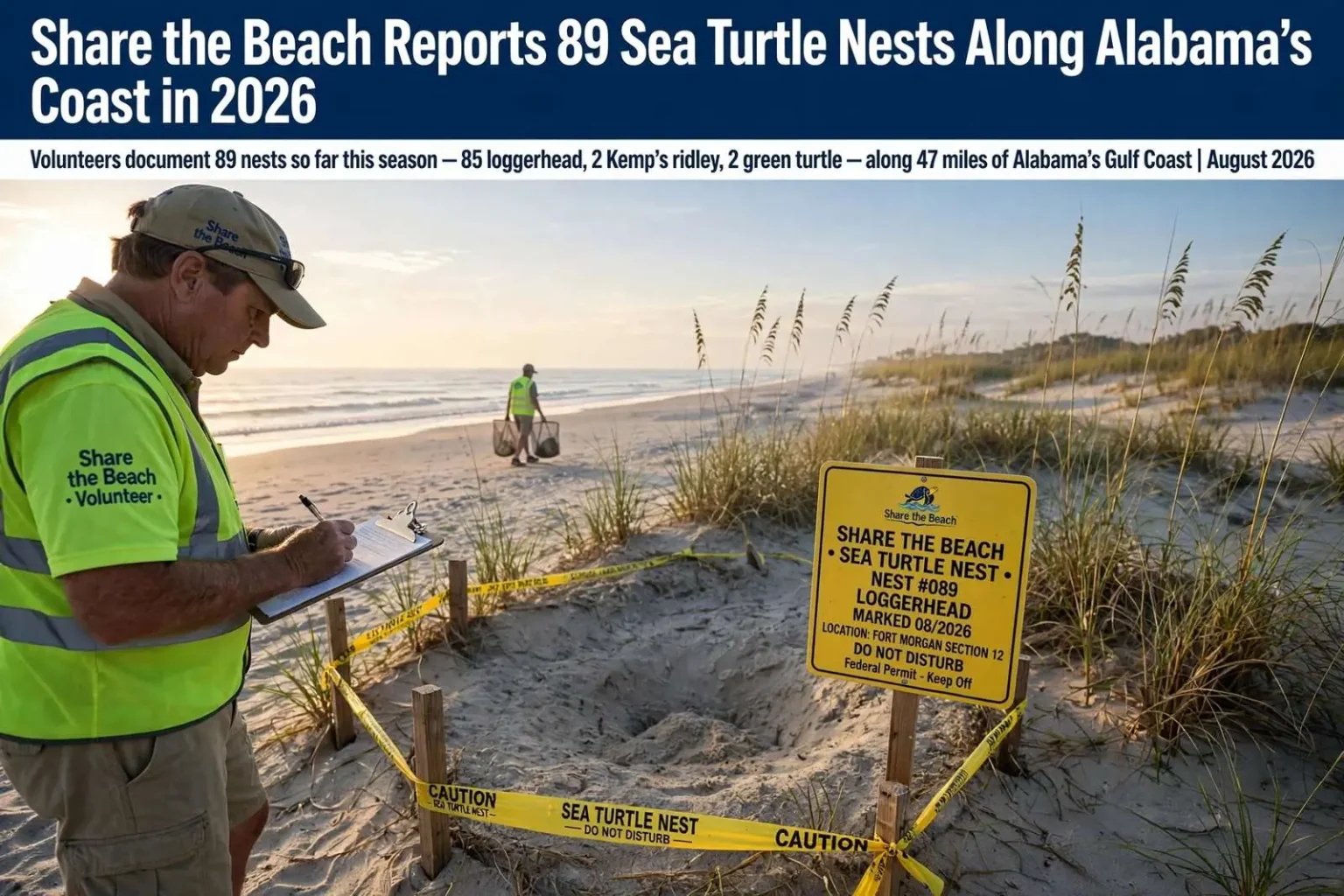
Alabama’s Gulf Coast is experiencing a strong sea turtle nesting season, with the state’s Share the Beach conservation program confirming 89 nests along the shoreline so far in 2026. Volunteers with Share the Beach patrol all 47 miles of Alabama’s Gulf Coast daily, searching for signs of nesting activity. As of August, the program has documented 85 loggerhead nests, two Kemp’s ridley nests and two green turtle nests, with loggerheads accounting for the vast majority of nests recorded on Alabama beaches each season.
The numbers represent dozens of morning patrols conducted from Fort Morgan to the Florida line, where trained volunteers walk the sand at dawn looking for the telltale tracks that reveal a female turtle came ashore overnight. When a crawl is found, volunteers locate the egg chamber, mark and stake the nest, record the species and location, and begin a watch that lasts roughly two months until the eggs hatch.
The 2026 season in context
Each nesting season is counted independently, and comparisons between years depend on survey effort as much as turtle behavior, but the composition of the 2026 nest count follows the long-standing pattern on Alabama’s coast. Loggerhead sea turtles dominate the region’s nesting, with the occasional green turtle and Kemp’s ridley nest drawing particular attention from volunteers precisely because they are rarer events.
Loggerheads, listed as threatened under the Endangered Species Act, typically nest at night from May through August, with hatchlings emerging through the summer and into the fall. Females return to nest on the same stretch of coastline where they were born, a biological loyalty called natal homing that means protections put in place on Alabama beaches today shape the species’ future here for decades.
Kemp’s ridleys, the world’s most endangered sea turtle, nest primarily on a single stretch of Mexican coastline, so every Kemp’s ridley nest confirmed in Alabama is a notable event for the program’s volunteers. Green turtles, also listed under the Endangered Species Act, nest in the region in small numbers each year alongside the loggerhead majority.
Funding and program structure
The program’s work is funded in part by Deepwater Horizon natural resource damage settlement funds provided by the Alabama Trustee Implementation Group. Following the 2010 oil spill in the Gulf of Mexico, settlement funds were directed toward restoring the natural resources the spill injured, and sea turtle conservation on Alabama’s nesting beaches has been among the projects supported through that process.
Share the Beach operates as the volunteer sea turtle conservation program for the Alabama Gulf Coast, with volunteers organized by section along the state’s beachfront. Beyond the daily nest surveys, section leaders coordinate nest inventories after hatchlings emerge — digging excavated nests to count hatched and unhatched eggs and release any stragglers — and staff educational outreach throughout the year.
Leave the beach clean, flat and dark
Share the Beach is asking beachgoers to help protect nesting turtles and their hatchlings by keeping beaches clean, flat and dark each night. Officials said beachfront lights should be turned off or shielded after dark, since artificial light can confuse nesting females and disrupt hatchlings trying to reach the Gulf.
The lighting issue is one of the most consequential threats facing hatchlings. Baby turtles instinctively head toward the brightest horizon, which for millennia meant the moonlit surf. On a developed beach, porch lights, streetlights and illuminated balconies can pull hatchlings inland instead, where they become disoriented, exhausted and vulnerable to predators, vehicles and dehydration. Turtle-friendly fixtures that mount lights low and shield them from the beach are the standard remedy, and residents of beachfront properties are asked to close curtains and extinguish unnecessary lights during nesting season.
Visitors and residents are also asked to fill in holes, knock down sandcastles, and remove all trash, chairs, tents and other beach gear from the sand before leaving each evening.
Those simple habits address two distinct hazards. Obstacles left on the sand at night can trap a nesting female or block her path to a suitable nest site, and they can wall hatchlings into a hole they dug themselves or fell into. Plastic bags, fishing line and food waste attract predators and can be fatal if a turtle ingests them. Flat, clear sand gives both nesting mothers and emerging hatchlings an unobstructed route between the Gulf and the dunes.
Local beach cities have backed those requests with ordinances of their own. Gulf Shores and Orange Beach require beach gear to be removed nightly and prohibit leaving holes unfilled, and both cities enforce lighting rules for beachfront properties during turtle season. Baldwin County’s unincorporated beachfront at Fort Morgan is patrolled by the same volunteer network, making the clean-flat-dark standard a coastwide expectation rather than a city-by-city patchwork.
About Share the Beach
Established in 2005, Share the Beach is dedicated to protecting sea turtles that nest on Alabama’s beaches from May through October. Volunteers patrol beaches, educate the public and school groups, conduct late-night nest observations, and help prepare supplies and equipment.
The program’s structure divides the 47 miles of Alabama beachfront into sections, each with a trained team responsible for morning surveys and nest monitoring in that stretch. New volunteers complete training before the season begins, learning to identify crawls, handle nesting verification and follow the strict protocols that govern how nests are staked, screened and inventoried. Federal permits under the Endangered Species Act authorize the program’s hands-on work, which is limited to what trained, permitted personnel may do.
Nest observations are among the program’s most delicate responsibilities. When a nest nears its hatch window, volunteers monitor it through the night, watching for the boil — the sudden emergence of hatchlings from the sand — and helping ensure the tiny turtles reach the water without wandering into lighted areas. Nest inventories conducted a few days after a hatch complete the record and often give the public, on announced evenings, a chance to watch released hatchlings make their dash to the Gulf.
How the public can help
Anyone who wants to support the effort can adopt a nest through the Alabama Coastal Foundation, with proceeds funding Share the Beach volunteers and staff. Nest adoptions have become a popular way for families, school classes and businesses to tie a donation to a specific nest, with updates provided as the season progresses.
Anyone who spots a nesting sea turtle, an injured turtle or a distressed hatchling is urged to call 866-Sea-Turtle (866-732-8878).
Callers should be prepared to describe the location as precisely as possible, including the nearest beach access point or landmark, and to leave the animal undisturbed while awaiting trained responders. Touching a nesting female, handling hatchlings or digging into a nest is prohibited without authorization, and flash photography and flashlights can disorient turtles, so observers are asked to keep their distance and keep lights off.
Why Alabama’s beaches matter to the species
Although Alabama’s 47 miles of shoreline are a small fraction of the Gulf’s nesting habitat, the state’s beaches form part of the northern Gulf nesting assemblage that scientists track closely, and every nest contributes to the species’ recovery picture. The consistency of the volunteer patrol program is what makes Alabama’s data valuable: because the entire coast is surveyed daily, the nest counts and hatch numbers produced here are among the most complete records available for the northern Gulf Coast.
The hatchlings that emerge from Alabama nests begin lives that may span decades. Female loggerheads do not nest until they are decades old, and mature females typically lay several clutches in a season before taking years off between nesting years. The survival odds for any individual hatchling are famously slim, which is why conservationists emphasize reducing human-caused hazards on the beach — every hatchling that reaches the water unimpeded matters to a population that reproduces slowly.
The season’s remaining months
With the August nest count standing at 89 nests, hatching activity will continue into the fall. Nests laid in midsummer hatch after roughly 55 to 65 days of incubation, meaning September and October are busy months for late-night nest watches, and some late-season nests may not hatch until well after school resumes. The incubation period also depends on sand temperature, which influences the sex ratio of the hatchlings inside the nest — a quirk of sea turtle biology that makes warm sand a long-term consideration for the population’s future.
Visitors planning beach trips through the rest of the season can expect to see the staked and flagged nests along the dune line, often with explanatory signs. The stakes and screens are legal protections, not decorations: disturbing a marked sea turtle nest carries federal penalties under the Endangered Species Act, and the program asks anyone who sees damage to a nest site to report it through the hotline.
Beach towns along the coast reinforce the message during hatching season. Gulf Shores and Orange Beach post turtle-season reminders at public access points, vacation rental operators relay lighting requests to guests, and the volunteer teams hang awareness signage near active nests. The combined effort has made the clean, flat, dark routine a familiar part of a Gulf Coast beach vacation for returning visitors, and program officials credit that public cooperation alongside the volunteer patrols for the coast’s standing as a protected nesting destination.
As the 2026 season progresses toward its final counts, Share the Beach will continue its daily surveys and its calls for public help, with the hotline — 866-Sea-Turtle (866-732-8878) — serving as the single number to remember for anyone who encounters a turtle, a nest or a hatchling in trouble on Alabama’s beaches.