Site Work Underway on Baldwin County Mega-Site Near Bay Minette
Crews have begun grading land and preparing to extend a rail spur at the roughly 3,000-acre Baldwin County mega-site near Bay Minette, part of a $7 million effort to improve rail and interstate access to the property.
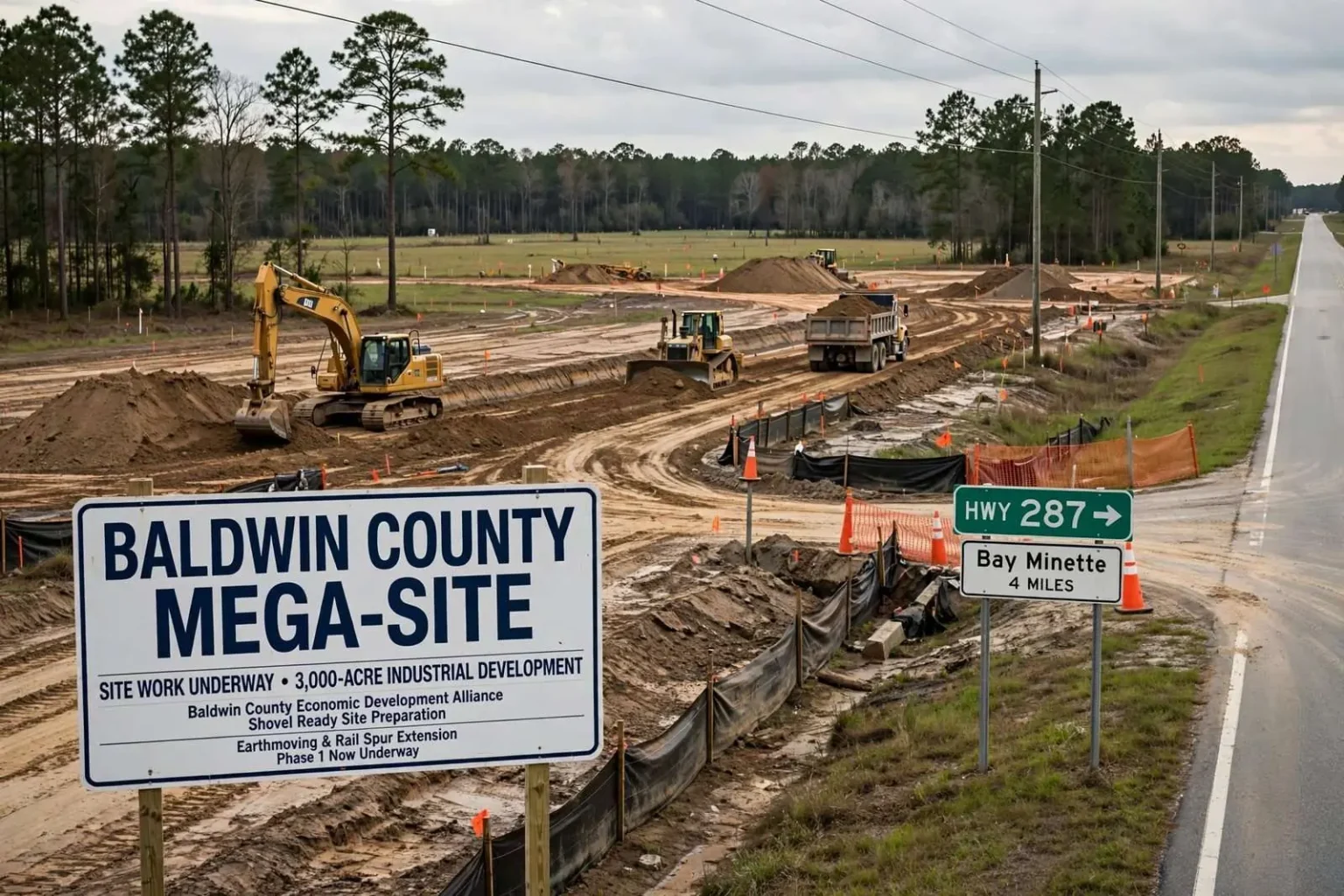
Heavy equipment has begun reshaping a stretch of land just north of Bay Minette as work gets underway on a long-planned expansion of the Baldwin County mega-site, a roughly 3,000-acre tract positioned as one of the region’s largest opportunities for future industrial development. Over the past couple of weeks, crews have moved earth near the site’s entrance along Highway 287, marking the first visible activity in what officials describe as a multi-year effort to prepare the property for large-scale industrial users. For residents of north Baldwin County, the dirt work at the entrance is the first tangible sign of a project that has been discussed for years largely in planning documents and economic development presentations.
In the coming weeks, work is expected to expand to include extending an existing rail spur into the property and grading a 200-acre pad along with a separate pad large enough to support a building of roughly one million square feet. The scale of those improvements matters: single-site pads of that size are scarce along the Gulf Coast, and companies scouting for advanced manufacturing, food processing, distribution, or heavy assembly operations routinely eliminate candidate locations that cannot offer flat, serviced acreage adjacent to freight rail.
The mega-site was transferred from Baldwin County to the Baldwin County Economic Development Alliance earlier this summer, a move that allowed the alliance to pursue grant funding earmarked for site improvements. That shift in ownership was seen as a key step toward making the property more competitive for prospective employers, since economic development groups are often better positioned than county governments to apply for certain state and federal grant programs tied to industrial recruitment. It also placed the property in the hands of the organization that markets Baldwin County to companies every day, aligning ownership with promotion.
Officials expect roughly $7 million to be invested in the property over the next two years, with the funding directed toward improving both rail and interstate access to the site. Better connectivity to rail lines and nearby highway corridors is considered essential to attracting the kind of large manufacturing or distribution operations that require heavy freight capacity, and site-readiness improvements like grading and rail access are frequently cited by site selection consultants as deciding factors when companies choose where to locate new facilities.
Why site readiness decides deals
In industrial recruitment, timing often matters more than incentives. Companies evaluating locations typically operate on compressed schedules, and a site that requires years of environmental review, rezoning, and earthwork before construction can begin loses out to property that is graded, rail-connected, and permitted. That is the logic behind the so-called shovel-ready standard: a community that has already invested in its industrial real estate can answer a company’s timeline instead of asking the company to wait for one.
Site selection consultants who guide manufacturers through location decisions consistently rank utility capacity, freight access, and pad readiness among the first screening criteria, ahead of tax abatements and other financial packages. A graded 200-acre pad and a second pad capable of supporting a million-square-foot building put the Baldwin County property into a category that very few sites in south Alabama can match, and the rail spur extension addresses the requirement that most often disqualifies otherwise attractive land.
The investment also signals seriousness to brokers and corporate real estate teams who track which communities are actively improving their product. Grants targeted at site development are competitive precisely because state economic development officials want to concentrate public money on properties that can realistically close a deal, and the alliance’s ownership change was made with exactly those funding programs in mind.
Bay Minette and north Baldwin’s position
The mega-site sits within a part of Baldwin County that has seen steady interest from developers and industrial prospects in recent years, as the county’s growing population, workforce and proximity to interstate corridors have made it an increasingly attractive option for companies looking to expand or relocate operations along the Gulf Coast. Baldwin County has ranked among Alabama’s fastest-growing counties for years, drawing new residents from across the Mobile metro area and beyond, and that population growth has expanded the local labor pool that industrial employers evaluate.
Bay Minette, the county seat, sits near the northern end of the county along the U.S. 31 corridor, with Interstate 65 running nearby and connecting the area to both Mobile and the Montgomery market to the north. The geography is central to the site’s pitch: rail lines that reach the Port of Mobile, interstate access toward the I-10 corridor, and a position within the larger Gulf Coast industrial belt that includes the aerospace cluster around Mobile’s Brookley Aeroplex and the shipbuilding and energy operations scattered across the region.
Local leaders have pointed to projects like the mega-site as central to the county’s long-term strategy of diversifying its economy beyond retail and residential growth by building the infrastructure needed to land large industrial employers. Tourism and coastal development dominate the county’s southern end, but officials in the northern county have argued for years that durable, high-wage industrial jobs require land, rail, and interstate access — assets that north Baldwin County holds in abundance.
No tenant yet — and that is the plan
No specific company has been announced as a tenant for the property. Site preparation of this scale is typically completed in advance of securing a named user, allowing the property to be marketed as “shovel ready” to companies with shorter timelines for opening new facilities. Economic development organizations across Alabama have adopted the same playbook: certify and improve industrial sites before a prospect appears, because a company that announces first usually forces the host community into a race against its own construction calendar.
That sequence also protects taxpayers. Public money spent on grading, rail access, and infrastructure converts raw land into a permanent community asset that remains marketable whether or not any single deal comes together, whereas incentive packages negotiated for a specific company carry deal-specific risk. Officials involved in the project have emphasized that the improvements raise the property’s value and competitiveness regardless of who ultimately occupies it.
Mega-sites of several thousand acres are inherently long-cycle projects. The land must be assembled and master-planned, environmental constraints identified, utilities sized for industrial-scale demand, and transportation access engineered before even the first prospect visit. The $7 million expected over the next two years represents the phase that makes the site legible to the corporate site selection world — visible progress that turns the tract from a line on an inventory list into a location that can credibly host a major employer.
The regional competition for big projects
Baldwin County is not pursuing industrial investment in a vacuum. Communities across the Gulf Coast — from the Mississippi pine belt to the Florida Panhandle — have invested heavily in certified industrial sites, each trying to position itself for the automotive suppliers, aerospace manufacturers, timber processors, and logistics operators expanding in the Southeast. Alabama’s economic development apparatus has long emphasized product readiness, a philosophy that produced the states’ automotive and aerospace manufacturing bases, and Baldwin County’s leadership wants the mega-site to compete at that level.
The proximity of the Mobile metro area cuts both ways in that competition. It gives the Bay Minette site access to the port, to a deep labor market, and to the supplier networks that have grown around the region’s largest manufacturers, but it also means the site is evaluated alongside established Mobile County industrial parks and the large tracts that already surround the aerospace corridor. The alliance’s bet is that 3,000 contiguous acres with new rail and interstate access is a product Mobile County cannot easily replicate inside its own developed areas, and that scarcity will eventually draw the kind of project the site was assembled to attract.
What happens next
Additional details on the scope of the rail and pad work, along with any prospective tenants, are expected to be released as the project moves forward. The next visible milestones for residents along Highway 287 will be the extension of the rail spur into the property and the grading of the 200-acre pad — work that will run in phases over the two-year spending window as grants and engineering allow.
For north Baldwin County, the earth moving near the site entrance marks the transition from planning to production. Whether the mega-site ultimately lands a marquee manufacturer or serves a series of smaller industrial users, the alliance’s investment is designed to ensure the answer to that question is determined by the property’s merits rather than by the county’s preparation — the standard by which site selection consultants judge every competing location in the region. For now, the trucks and graders along Highway 287 are the project’s most persuasive marketing.