Six Charged, Including a 16-Year-Old, in Vancleave Shooting That Wounded Teen
Six people, including a 16-year-old, face aggravated assault charges in a Vancleave shooting that left a 17-year-old hospitalized in Mobile.
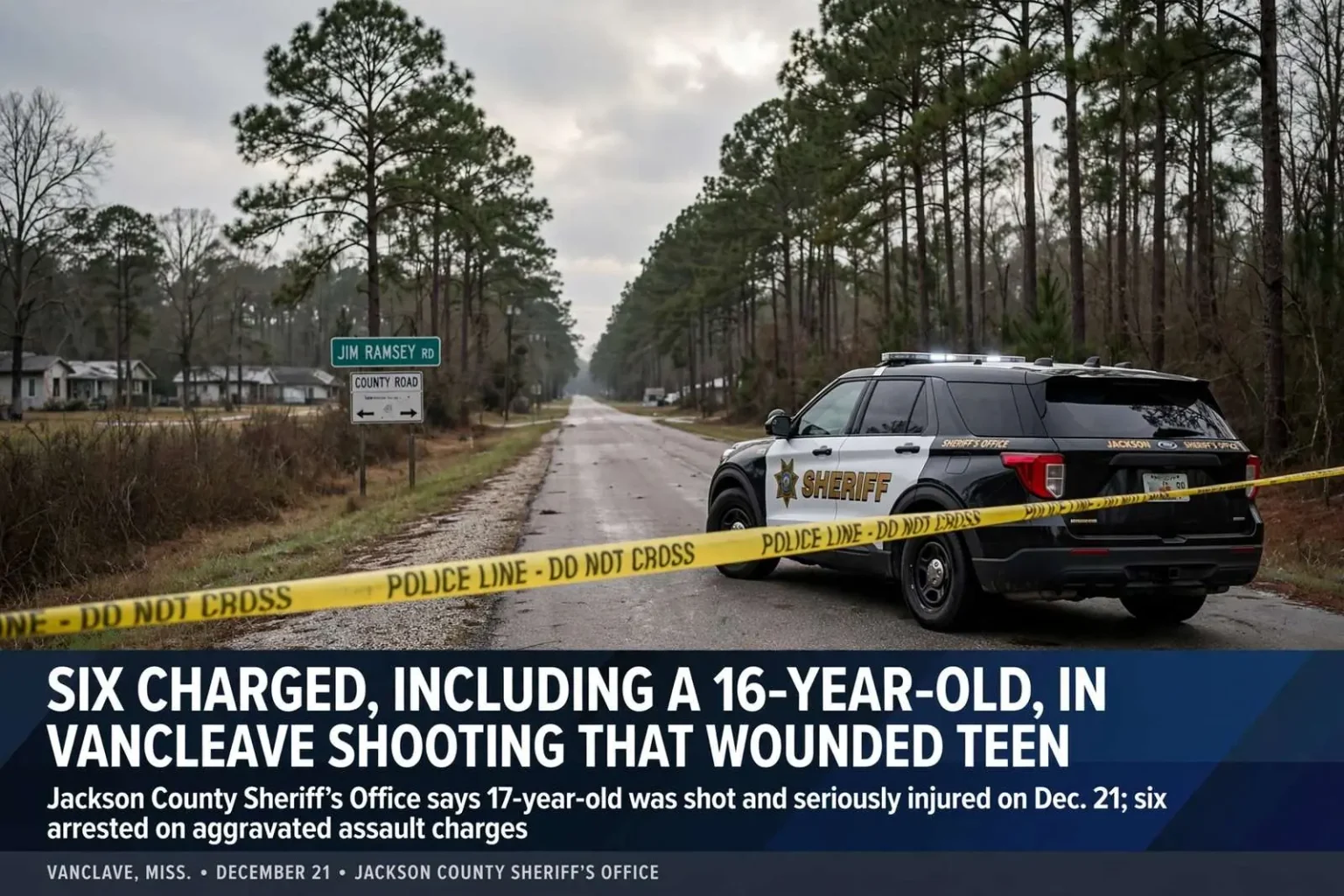
VANCLEAVE, Miss. — Six people, one of them 16 years old, have been charged in what investigators describe as a drug-related shooting that left another teenager seriously hurt, according to the Jackson County Sheriff’s Office. The case, assembled by deputies and investigators over the weeks following the December shooting, represents one of the more serious violent-crime prosecutions in the county this year, and the identities and roles of each defendant will play out in Mississippi’s court system in the months ahead.
The shooting happened on the morning of Dec. 21 on Jim Ramsey Road, Sheriff Mike Ezell said. Jim Ramsey Road runs through the rural northern reaches of Jackson County, an area of subdivisions, wooded parcels and long stretches of road where Vancleave’s spread-out neighborhoods meet the pine forest of the Mississippi Gulf Coast hinterland. The morning timing of the shooting, on a quiet residential road, made the incident especially jarring for residents of the community.
Deputies said the victim, a 17-year-old, was shot in the head and was treated at a hospital in Mobile. The transport across the state line reflects the reality of emergency medicine in southern Mississippi: the most serious trauma cases in Jackson County are frequently routed west and across the border to Mobile’s hospitals, where the region’s highest-level trauma care is available. A head wound of that severity requires the kind of specialized neurosurgical capability that only major medical centers can provide, and Mobile serves that role for much of the central Gulf Coast.
Each of the six people arrested is charged with aggravated assault with a deadly weapon, the sheriff’s office said. Charging six people with the same felony indicates that investigators concluded each played a part in the incident that led to the shooting, whether or not every defendant fired a weapon. Aggravated assault in Mississippi carries serious potential penalties, and prosecutors must prove each defendant’s individual role in court.
Investigators said one of the teenage defendants will be charged as an adult. Mississippi law treats certain serious felonies differently when juveniles are involved, allowing or requiring prosecutors to seek adult charges depending on the age of the suspect and the nature of the offense. The decision to charge the 16-year-old as an adult moves that case out of the youth court system and into the same track as the older defendants.
The Charges Ahead
All six were being held at the county’s Adult Detention Center on bonds of $500,000 each, according to the sheriff’s office. Bond amounts of that scale, set six times over in a single case, signal how seriously the courts weigh both the gravity of the alleged offense and the circumstances of the defendants. Defendants who cannot post bond remain in custody while their cases move toward trial, a process that can take many months.
Authorities characterized the shooting as drug-related but did not detail what led up to it. That restraint is common in active investigations, where releasing specifics about drug activity, witnesses or evidence can compromise the prosecution before trial. The characterization, though, places the case within a broader pattern that Gulf Coast law enforcement agencies confront: violent encounters connected to drug activity, often involving young defendants and weapons, in communities that span the Alabama-Mississippi line.
The charges reflect accusations by investigators and have not been tested in court. Every defendant is presumed innocent, and the state’s burden at trial is to prove guilt beyond a reasonable doubt for each individual charged. Defense attorneys will examine the evidence gathered by investigators — forensic work, witness statements and whatever physical evidence ties each defendant to the scene — and the case could resolve through plea agreements, dismissal of some charges, or trial.
For the victims and families involved, the court process will unfold slowly. Felony cases in Mississippi’s state courts move through preliminary stages, grand jury action and pretrial proceedings before reaching trial, and cases with six defendants require additional coordination. The 17-year-old victim’s recovery remains the most immediate human concern, with the medical outcome dependent on the severity of the head injury and the treatment that followed at the Mobile hospital.
Vancleave and Its Setting
Vancleave is an unincorporated community in northern Jackson County, part of the Mississippi Gulf Coast region where serious trauma cases are frequently transported across the state line to hospitals in Mobile. The community takes its name from the families who settled the area along the Pascagoula River basin, and it has grown over recent decades from a rural crossroads into a residential area serving families who commute to jobs in Pascagoula, Moss Point, Biloxi and Mobile. Its schools and community institutions anchor daily life across a wide geographic area.
Jackson County, stretching from the Alabama line to the Pascagoula River, is one of Mississippi’s three coastal counties and has historically balanced an industrial economy — shipbuilding, chemical plants and the Port of Pascagoula — with rural stretches like those around Vancleave. The Jackson County Sheriff’s Office patrols that full expanse, and incidents in its northern communities often require deputies to cover long distances across a jurisdiction larger than many urban counties.
The cross-border relationship in emergency response runs in both directions. South Mississippi residents rely on Mobile’s trauma centers for the most serious injuries, while Mobile-area agencies regularly coordinate with their Mississippi counterparts on investigations that cross the state line. In a case like this one, the medical treatment of a Mississippi teenager in an Alabama hospital becomes part of the same story being built by Jackson County investigators.
How Youth Cases Move Through Mississippi Courts
When a 16-year-old is charged as an adult in Mississippi, the case typically originates with a youth court transfer or a statutory provision that gives the adult court jurisdiction over the offense. Juveniles charged as adults face the same potential penalties as older defendants, a legal reality that has drawn debate in Mississippi and across the country about adolescent brain development and rehabilitation. Once in the adult system, the defendant receives the same due process as anyone else — counsel, preliminary hearings, and the full weight of the state’s burden of proof.
The decision about which defendant faces adult charges often reflects the specific evidence of each person’s role rather than age alone. Investigators and prosecutors examine who was present, who acted, and what each participant knew, and those distinctions shape the charges filed against each of the six. As the case proceeds, more of those details will become public through court filings.
Aggravated assault with a deadly weapon is among the most serious felony charges available to prosecutors in a non-fatal shooting, and a conviction can carry a lengthy prison sentence under Mississippi law. The charge structure also matters for sentencing: with six defendants facing the same count, the outcomes can diverge widely based on individual culpability, criminal history and the strength of the evidence against each person.
The Community Impact
For Vancleave, a mass-charging case of this kind lands in a community unaccustomed to headlines about six arrests tied to a single shooting. Rural and semi-rural communities along the northern Gulf Coast have seen an influx of drug activity in recent years as trafficking routes follow the interstate corridors that connect the ports of Mobile, Pascagoula and Biloxi to inland markets. Sheriff’s offices in the region have responded with multi-agency drug task forces that pair local deputies with state and federal partners.
Incidents involving teenage defendants and victims draw particular attention in small communities, where schools and neighbors feel the effects directly. The 17-year-old victim and the young defendants are part of the same generation in a community where connections run deep, and the case will be followed personally by many who know the families involved. Community leaders in such situations typically emphasize support services for young people as the longer-term response.
The $500,000 bonds mean the defendants will remain at the Jackson County Adult Detention Center pending trial unless they are able to secure release, which would come with court-imposed conditions. As the case moves through the system, the sheriff’s office has indicated that the investigation remains active, and additional details or charges are possible as prosecutors prepare the case for presentation.
Sheriff Ezell’s office has built its violent-crime response on the same coordinates that produced this case: rapid scene response, sustained follow-up investigation, and coordination with the District Attorney’s office before charges are filed. Cases with multiple defendants and juvenile involvement require that coordination from the earliest hours, because decisions about adult charges and bond recommendations shape everything that follows in court.
What is settled for now is the factual outline: a December morning on Jim Ramsey Road, a 17-year-old fighting to recover from a gunshot to the head in a Mobile hospital, and six defendants — five adults and a 16-year-old — whose futures now rest with the courts of Jackson County, Mississippi.