Six Weeks Into Pensacola’s Mask Rule, Police Have Issued Two Warnings and No Citations
Six weeks into Pensacola's mask mandate, police have issued two trespass warnings and no citations, while Escambia County has twice rejected its own rule.
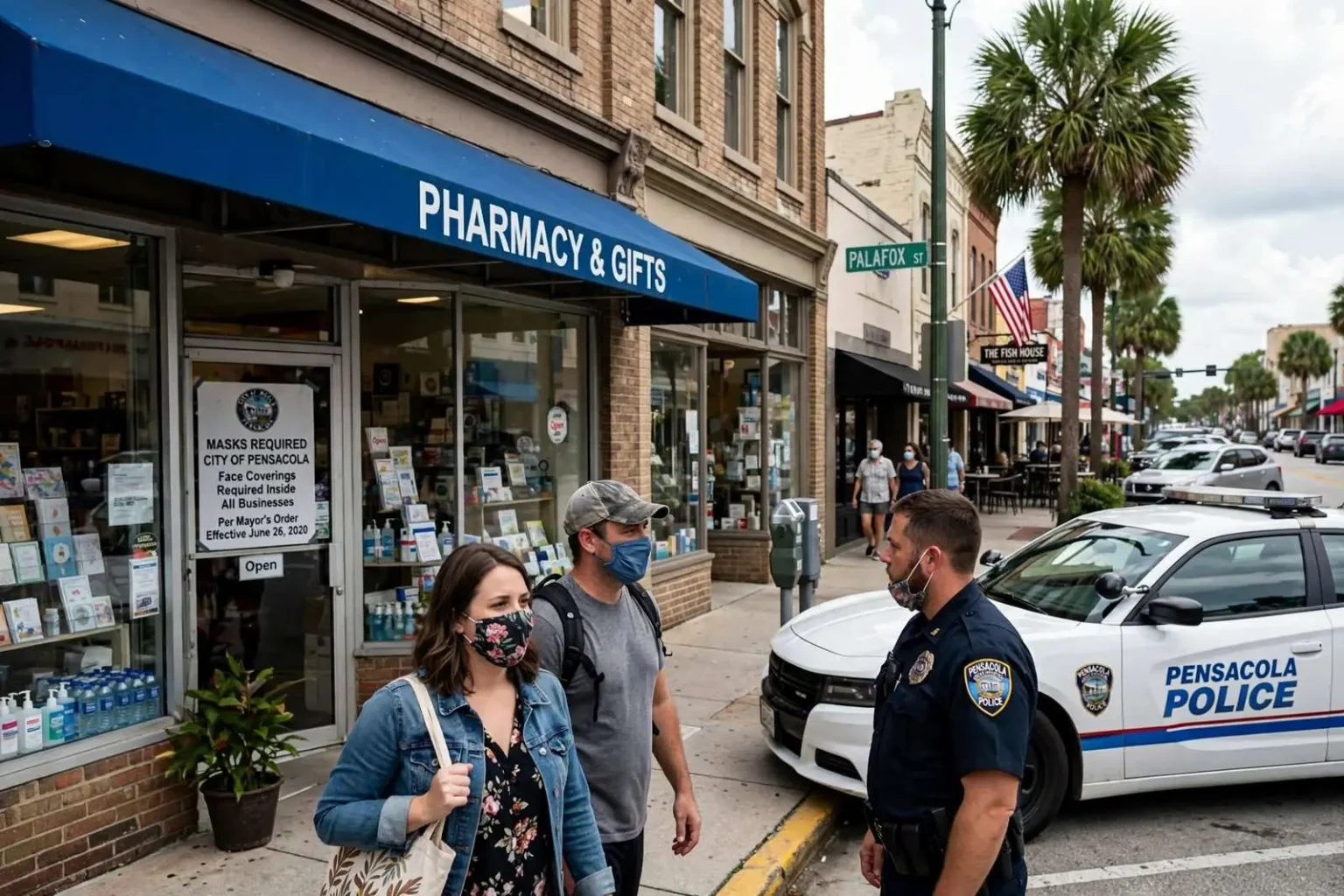
PENSACOLA — Six weeks after Mayor Grover Robinson ordered masks required inside businesses within Pensacola city limits, police say they have written no citations at all and have issued just two trespass warnings, both to people who refused to leave private property. The enforcement picture describes an ordinance operating primarily through persuasion rather than penalties — six weeks in, the city has not charged anyone with violating the rule itself.
The requirement took effect June 26 and applies to anyone entering a business inside the city. Pensacola’s order arrived during the summer of the pandemic’s first major Gulf Coast surge, when cities across Florida and the broader South were deciding one by one whether to mandate face coverings indoors, and the mayor’s order put Pensacola among the Florida cities that chose to act while much of the state left the decision to local discretion.
The two trespass warnings issued under the rule followed a pattern familiar to cities with mask mandates and no citation mechanism: the enforceable conflict tends to arise not from the mask requirement itself but from a customer’s refusal to comply with a business’s rules. Under Florida trespass law, a business owner may exclude anyone who refuses to follow posted requirements, which allows police to act on the property owner’s complaint rather than on the mask order directly.
Six weeks of zero citations suggests both broad voluntary compliance and a deliberate enforcement posture. Police departments in cities with masking requirements generally trained officers to treat the ordinance as a compliance tool — educate first, remind second, and reserve formal action for escalating refusals — and the Pensacola numbers indicate that approach in practice.
Downtown Support for the Rule
Most people who spoke downtown Friday said they backed the mandate, including Jana Hoggle, who lives in Lillian. “It keeps everybody safe and it makes me feel safer knowing that everybody’s got a mask,” Hoggle said. “Originally, we might have a mask on but we’d go in a place and 90 percent of the people didn’t.”
Her comments described the before-and-after that mask mandates were designed to create. In the weeks before the June 26 order, masking in Pensacola businesses had been voluntary, and voluntary compliance had been inconsistent — the situation Hoggle described, in which a masked customer entered stores where most others wore nothing. The mandate’s practical effect was to make the precaution universal at the door rather than a matter of individual choice, which supporters cited as both a health measure and a reassurance to shoppers and staff.
Another resident, Emily Dillons, compared the requirement to other everyday safety rules. “It’s like wearing a seat belt or wearing a motorcycle helmet,” she said. “Is it really that big of an inconvenience to try and not get people sick?” The analogy placed the mandate in a familiar category for Floridians: safety rules — seat belts, helmets, life jackets — that require minor daily inconvenience to reduce preventable harm, most of which are settled law across the state.
Downtown business sentiment itself was divided by necessity rather than ideology. Shops and restaurants that support the mandate gained a clear rule to point to when customers arrived unmasked; the requirement shifted the burden of enforcement conversations away from clerks and servers, who previously had to ask customers individually, and onto a citywide standard that everyone entering a business had been told about in advance.
County Has Rejected a Mandate Twice
Outside the city limits, the picture is different. The Escambia County Commission has voted on a countywide mask requirement twice and rejected it both times, most recently Thursday night. The county’s refusal means the mandate ends at the city line, leaving the unincorporated stretches of Escambia County — from the ferry landing communities along Perdido Bay to the fast-growing corridors toward Cantonment and Molino — without a masking rule of their own.
Most speakers who opposed a mandate at that meeting framed it as a question of government overreach rather than public health. The argument echoed across Florida’s county commissions that summer, where mask mandates became the most visible local proxy for a larger argument about the proper limits of emergency government power during the pandemic.
One man told commissioners he could not wear a mask for a medical reason and added that he was not going to be told what to do with his body. Medical exemptions have complicated mask rules everywhere they have been adopted, since requiring proof of a disability runs into federal disability law and enforcing against an unknown exemption is effectively impossible — which is why most mandates, including city ordinances like Pensacola’s, carve out exemptions and rely on accommodations rather than verification.
Commissioners voting against a countywide rule also pointed to practical considerations unique to a county of Escambia’s geography. The county stretches from the urban Pensacola metropolitan core to rural northern communities whose residents rarely travel into the city, and opponents questioned whether a single rule could sensibly cover both. Rural commissioners also reported little constituent demand for a mandate, in contrast to the downtown sentiment the mayor was hearing.
The split leaves a patchwork along the Northwest Florida coast, where a shopper can be required to mask inside a Pensacola storefront and face no such rule at a business a few miles outside the city line. The inconsistency is the predictable product of Florida’s structure of local government, in which municipalities hold broad ordinance powers and counties hold separate ones, and no state mandate existed in either direction during the period in question.
For residents, the practical effect shows up in daily routines. A trip that crosses the city line — a grocery run from a county neighborhood into the city, a shift worked in a Pensacola restaurant by a county resident, a stop at a big-box store on the boundary — changes the rules mid-route. Businesses near the line report the confusion most directly, with customers unsure which jurisdiction’s rules apply and employees left to explain the difference.
The patchwork also has economic dimensions in a tourism economy like Pensacola’s. The city’s beach district draws visitors from across the Southeast during the summer, and visitors encounter rules that differ not just from their home states but from the unincorporated county immediately around them. Businesses on both sides of the question have argued the inconsistency cuts the other way too: a mandate confined to the city can push customers a few blocks out, while a regional absence of rules can deter cautious travelers from the area altogether.
Six weeks is also a meaningful milestone for evaluating an emergency ordinance. By that point, the initial burst of publicity has faded, compliance has settled into routine, and the enforcement numbers — or in Pensacola’s case, the absence of them — begin to show what the rule actually is: a standard most people follow, a mechanism for the rare confrontation, and a statement of local policy in a state where those statements varied county by county.
The zero-citation record does not mean the debate is settled. Mask mandates everywhere in Florida that summer remained subject to continuing public comment, litigation threats, and revisitation by the elected bodies that adopted them, and the divide visible between City Hall and the county commission chambers showed no sign of closing. A rule that operates by persuasion succeeds only as long as the public it addresses continues to cooperate voluntarily — a condition that public health officials warned would be tested as case numbers moved.
Police agencies elsewhere in Florida that adopted similar rules reported the same pattern — mandates whose citation counts stayed at or near zero, because the real enforcement work happens in the first minutes of an encounter rather than at the courthouse. A customer reminded of the rule at the door almost always puts the mask on or leaves; only the rare refusal to do either becomes an incident an officer must resolve.
What the six-week record does establish is a working model of least-enforcement government: a mandate adopted by mayoral order, applied to everyone entering a business, backed by the trespass powers that any business already held, and enforced — so far — without a single ticket. Whether that model holds depends on the virus’s trajectory, the mayor’s office, and a county commission that has now twice declined to extend the same rule to the rest of Escambia County.
For now, the region’s two governments have drawn a line that anyone can see at the city limits: masks inside Pensacola businesses, courtesy elsewhere. The two trespass warnings are the entire enforcement history of one of the Gulf Coast’s most debated summer ordinances — and for the residents downtown who said they feel safer because of it, that quiet record is precisely the point.