‘Skanska Fix Your Mess’ Banner Flown Over Northwest Florida as Bridge Stays Closed
A law firm hired a banner plane to fly 'Skanska Fix Your Mess' over Santa Rosa County as the Pensacola Bay Bridge closure nears the two-month mark.
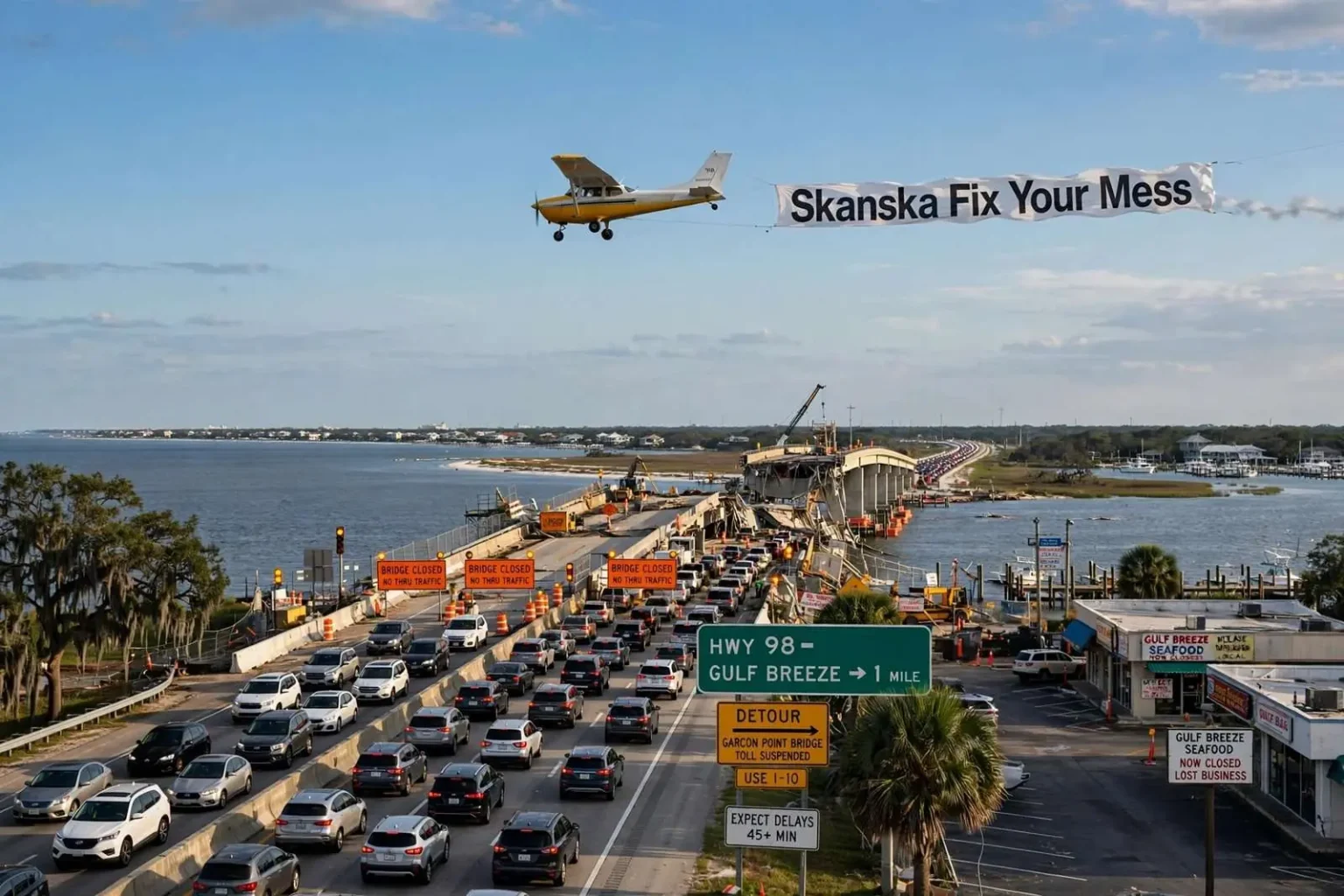
PENSACOLA — A banner plane crossed the sky over Santa Rosa County on Tuesday afternoon trailing a message aimed squarely at the company blamed for the Pensacola Bay Bridge closure: “Skanska Fix Your Mess.” The law firm Levin Papantonio hired a pilot with Boomer Aviation to fly the banner. The firm has said it intends to bring legal action against Skanska on behalf of business owners who are losing money because the bridge is out of service.
The flight turned a familiar local grievance into something impossible to ignore. Anyone standing in the traffic backup on the detour route, or staring up from a parking lot in Gulf Breeze, could read the accusation in the sky: the region’s most important bridge is closed, the closure traces to a contractor’s equipment, and the businesses left on the wrong side of the closure want everyone to know who they hold responsible.
Tuesday marked the third day the banner had flown over Northwest Florida. Additional flights were planned for Thursday morning and afternoon, following a route over Interstate 10 at Avalon Boulevard and continuing south to Highway 98. That path is no accident. Interstate 10 carries the bulk of through traffic heading toward the coast, and Highway 98 is the main artery feeding commuters from Milton and communities along the Blackwater River down toward the bridges that cross into Pensacola and Gulf Breeze.
The aerial campaign is a public pressure tactic layered on top of the legal one, keeping the closure and its cost to local businesses visible to the commuters sitting in the resulting traffic. It is a familiar style of advocacy for a plaintiffs’ firm: make the grievance public, make it memorable, and make it part of the daily experience of the people affected before the first courtroom filing lands.
A bridge out since the storm
The bridge has been closed since Skanska’s construction barges broke loose during Hurricane Sally and slammed into the span. Sally, a Category 2 hurricane, came ashore in September near Gulf Shores, Alabama, and drove a sustained assault on the Pensacola Bay area with days of onshore winds, a storm surge measured in feet, and rain totals that flooded neighborhoods across the western Panhandle. As the storm passed, unsecured construction equipment on Pensacola Bay broke loose, and multiple barges — some carrying construction materials, excavators, and other heavy equipment — battered the bridge structure on their way across the water.
The damage proved severe enough that transportation officials closed the bridge entirely, cutting the direct link between Pensacola and Gulf Breeze. In the nearly two months since, drivers moving between the two cities have been funneled onto the Garcon Point Bridge, where the added volume has produced long backups that can stretch for miles during morning and evening rush hours. What had been a quick drive across the bay became an endurance test, with commute times that sometimes doubled or worse for the tens of thousands of drivers who crossed the old bridge on an ordinary day.
The closure’s reach extends well beyond commuters. The Pensacola Bay Bridge carries U.S. 98, the commercial spine connecting Pensacola to Gulf Breeze and Pensacola Beach, and businesses on both sides of the bay depend on the steady flow of customers, employees, and deliveries that crosses it every day. Restaurants, shops, hotels, and service businesses in Gulf Breeze and along the beach have reported the same story since the storm: customers who used to arrive in minutes now face an unfamiliar detour, and many simply go somewhere else.
The detour itself has costs of its own. The Garcon Point Bridge, a toll crossing that links Gulf Breeze to the Milton area across Escambia Bay’s eastern cousin, Santa Rosa Sound, was never intended to carry the full volume of the Pensacola Bay Bridge. Tolls on the crossing were suspended to ease the burden on diverted drivers, but the toll revenue loss for the bridge authority added a quiet financial cost on top of the visible traffic jams, and the little two-lane structure has absorbed wear and traffic far beyond anything its designers anticipated.
The legal and public relations fight
Levin Papantonio, one of Pensacola’s best-known law firms with a national practice in mass tort and personal injury litigation, has positioned itself as the voice of the business owners bearing the losses. The firm has said it intends to bring legal action against Skanska on behalf of clients who are losing money because the bridge is out of service, framing the closure as the direct result of the contractor’s failure to secure its equipment ahead of a storm the region saw coming for days.
Skanska, the global construction and development company, was the contractor on the long-running project to replace the aging Pensacola Bay Bridge, a span that opened in 1960 and carried generations of daily traffic between the two communities. The new bridge, built alongside the old one, was meant to be the region’s answer to decades of congestion and maintenance worry. Instead, the construction site itself became the source of the disaster, when the project’s barges broke free during Sally and pounded the old span with each wave and gust.
The central legal question such cases turn on is responsibility: what obligations did the contractor have to secure its work site ahead of a forecast storm, and did the equipment’s breakaway reflect a failure to meet those obligations? Contractors generally argue that hurricane-force conditions are acts of God beyond any preparation, while plaintiffs counter that marine construction in hurricane country demands storm plans precisely because such storms are foreseeable. Between those positions sit the business owners, whose damages accumulate with every week the bridge stays closed.
Flying a banner is a way of framing that fight in public before it is fought in filings. Aerial advertising works because it cannot be clicked away or turned off; a message trailing behind a small plane over a traffic-clogged interstate reaches thousands of the exact people living the consequences. By naming the company in the sky, the firm converts private frustration into a public argument about accountability, and it invites the community to see the closure not as weather’s fault alone but as the result of decisions made before the storm.
The tactic also serves the practical goal of finding clients. Business owners watching the banner who have suffered their own losses now know the name of a firm pursuing claims, which is precisely how class and group actions assemble themselves in high-profile disputes. Each additional flight, scheduled for Thursday morning and afternoon along the Avalon Boulevard and Highway 98 corridors, extends the message to another wave of commuters and business operators.
What the closure has cost the region
For nearly two months, the daily rhythm of the Pensacola Bay Area has been rewritten. Gulf Breeze, a city of a little more than 6,000 residents perched on the peninsula between the bay and the sound, sits directly on the closed bridge’s eastern landing, and its businesses feel the absence of pass-through traffic most acutely. Commuters who once crossed the bridge to jobs in Pensacola now budget extra time each way, and school runs, medical appointments, and deliveries all carry the detour’s delay tax.
Pensacola Beach, the tourist engine at the end of Santa Rosa Island, depends on visitors arriving by way of the bridges, and the fall season following a hurricane is already a delicate time for the island’s economy. Add a closed main bridge and a detour that tests the patience of even determined beachgoers, and the compounding effect on hotels, restaurants, and charter operators becomes a genuine threat to livelihoods rather than an inconvenience. It is exactly this class of loss — measurable, ongoing, and tied to a single preventable cause, in the plaintiffs’ telling — that the planned legal action aims to recover.
Meanwhile, the work of assessing and repairing the span continues, though no quick reopening is in sight. Damage assessments after the storm documented impacts to bridge sections where the barges struck, and replacing major structural components of a bridge across open water is a months-long undertaking even under favorable conditions. State and local officials have urged patience while the engineering work proceeds, but patience has grown thin in the communities on the wrong side of the closure.
Until the bridge reopens, the banner will keep circling the skies over Santa Rosa County, and the message it carries will keep running beneath it in the traffic on Highway 98: a region waiting on its bridge, a contractor under pressure, and a law firm making sure the two are never far from the public’s mind. The plane is only the messenger, but in a dispute this visible, the messenger is part of the story now too.