Small plane makes emergency landing on Monroeville highway
A single-engine Vans RV-10 made a safe emergency landing on Highway 21 in Monroeville, Alabama, with the pilot uninjured, the FAA said.
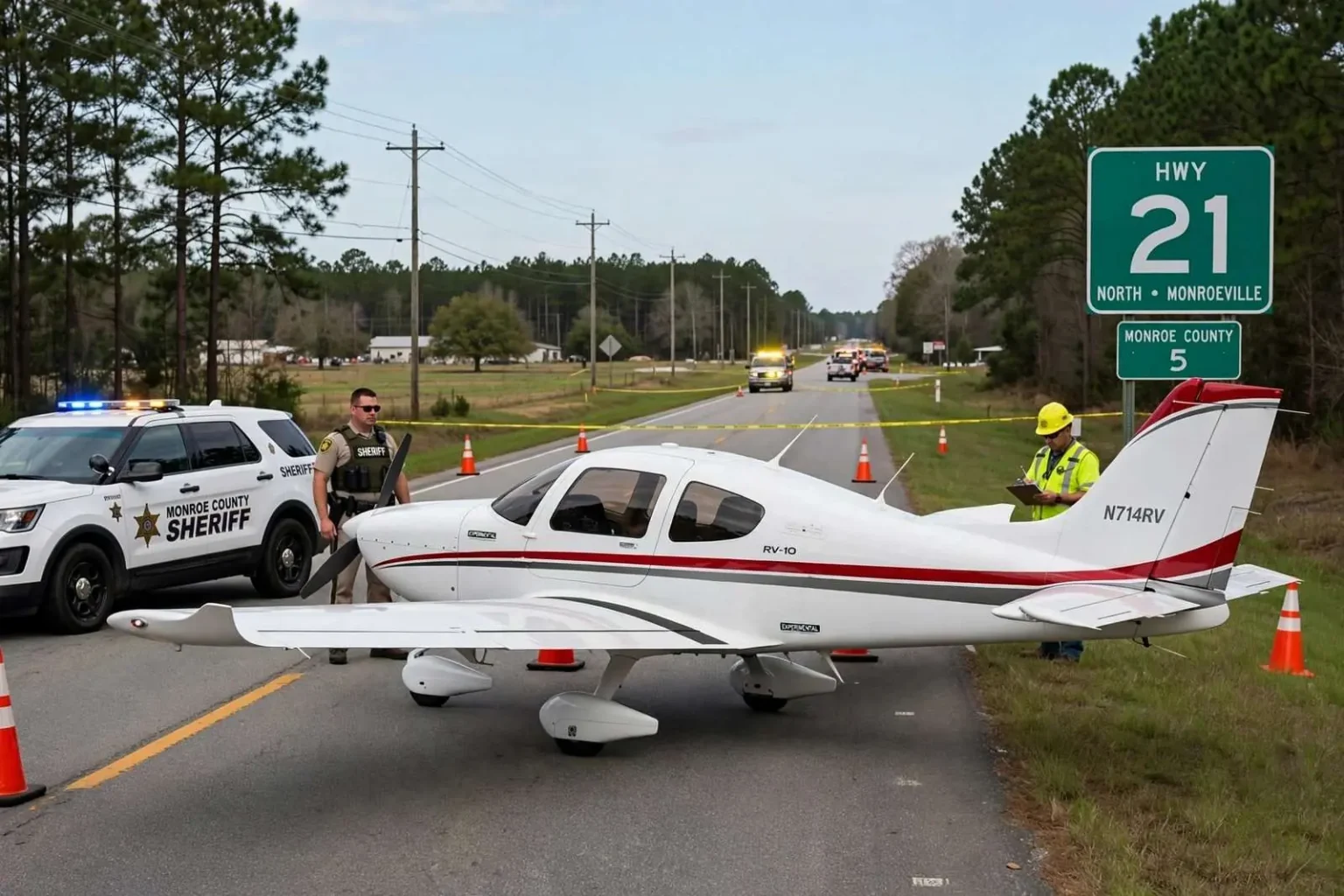
MONROEVILLE, Ala. — A small plane made an emergency landing on Highway 21 in Monroeville on Thursday. The FAA said a single-engine Vans RV-10 landed safely on the highway at 11:45 a.m. The pilot was the only person on board and was not injured, according to local officials.
Highway 21 is a principal arterial through Monroeville, the seat of Monroe County, carrying local traffic as well as travelers between the region’s towns and connecting to the corridor that runs toward the Montgomery area and the communities of south-central Alabama. A small aircraft touching down on that roadway in the middle of a Thursday morning could easily have ended in tragedy, but the landing came off without injuries, and officials moved quickly to secure the scene and manage the unexpected obstruction.
Aircraft Down on a Highway
The Vans RV-10 is a four-seat, single-engine aircraft popular with amateur builders, one of the most successful homebuilt designs in general aviation. Construction from kits is spread over several years by owners who either build the aircraft themselves or with help from technical counselors, and the finished planes are certified as experimental-amateur-built by the FAA. Pilots of RV-10s frequently fly long cross-country trips, and the aircraft cruises at speeds approaching 200 miles per hour, making them a common sight at airports across the Southeast.
When an aircraft loses power or suffers a mechanical problem away from an airport, the pilot’s training directs them to select the best available landing area, and straight, flat roadways are among the most viable options in rural Alabama. Highway 21’s alignment through Monroeville offered the pilot such an option. Landing safely on a highway requires judgment about power lines, signs, intersections and vehicles, and aviation safety experts note that successful road landings depend on a pilot’s willingness to commit to the touchdown area early rather than stretching a glide beyond its capability.
The Monroeville Municipal Airport, located a short distance from the city, serves general aviation in Monroe County with a lighted runway suitable for small aircraft. Whether the aircraft was approaching that airport, passing overhead en route elsewhere, or departing from it was not immediately stated by officials. The FAA and the National Transportation Safety Board were notified, as they are for any aircraft accident or incident, and investigators routinely examine the aircraft, the pilot’s records and maintenance history to determine what led to the emergency landing.
Clearing the Roadway
Once the plane was safely on the ground, the immediate practical problem belonged to local officials: Highway 21 is a working road, and a parked aircraft — even an undamaged one — blocks a lane and distracts drivers. Police and county crews secured the area while arrangements were made to move the aircraft, typically by towing it to a nearby lot or airport where it can be examined. Traffic was slowed or diverted while the plane remained on the pavement, and drivers passing through Monroeville were advised to expect delays.
Monroeville, a city of about 5,000 people, is best known nationally as the hometown of writers Harper Lee and Truman Capote and draws visitors from around the world to its courthouse square and the Old Courthouse Museum. The town sits in the heart of Alabama’s Black Belt, and its residents are accustomed to the rhythms of a rural county seat — but an airplane on the main highway is not part of anyone’s routine, and word of the landing spread quickly through the community Thursday morning.
No injuries were reported, and no vehicles on the highway were struck, according to officials. The episode stands as an example of an emergency landing done right: an aircraft that experienced trouble, a pilot who found a suitable surface, and a safe outcome on a road that could have presented far greater hazards. Aviation authorities planned to determine what caused the emergency, and their findings will become part of the public record once the review is complete.
General Aviation in Rural Alabama
Small aircraft are a routine part of the airspace over south Alabama. Pilots use the state’s network of municipal and county airports for business travel, medical transport, aerial application and recreation, and homebuilt aircraft like the RV-10 account for a growing share of the general aviation fleet. The Experimental Aircraft Association, which has active chapters across Alabama, supports builders and pilots of amateur-built aircraft, and fly-ins at small airports in the region regularly draw dozens of planes.
Emergency landings on highways, while uncommon, are not unprecedented in Alabama. State troopers and local police have handled aircraft touchdowns on rural highways and city streets over the years, and each episode follows a similar script: secure the scene, keep drivers away from the aircraft, arrange recovery, and stand by for federal investigators. The FAA’s regional office in Atlanta oversees accident and incident inquiries for the Southeast, and the NTSB takes the lead when an event meets its criteria for investigation.
For the drivers who encountered the scene Thursday, the experience was memorable but brief. Law enforcement officers directed traffic around the aircraft while it sat on the pavement, and crews asked motorists to avoid photographing the plane from moving vehicles, a safety concern that has grown alongside the prevalence of dash-mounted phones. Once the aircraft was removed, the highway reopened and traffic through Monroeville returned to its normal pattern.
Pilots who fly over rural Alabama know that their options in an emergency are shaped by the terrain below — pine forests, pastures, waterways and a scattering of highways that run straight between towns. Training emphasizes maintaining airspeed, choosing a landing path early and flying the aircraft all the way to the ground. Thursday’s outcome in Monroeville reflects those fundamentals holding up under pressure, and local officials expressed relief that the only thing hurt in the incident was the morning commute.
Monroe County’s connection to aviation extends beyond Thursday’s unusual landing. The county’s airport and the region’s flying community serve practical purposes that residents rely on: aerial ambulance flights out of the area, agricultural operators treating timber and farmland, and business travelers who skip the long drive to Montgomery or Mobile. The county’s location between several larger airports makes it a waypoint for pilots crossing the state, and aircraft passing over Monroeville on the region’s common flight routes are a near-daily occurrence.
Amateur-built aircraft undergo a rigorous certification process of their own. Before a newly constructed RV-10 can fly, an FAA designee inspects the aircraft to confirm it was built to the builder’s log and meets standards, and the aircraft then flies a restricted test period near its home airport. Annual condition inspections continue throughout the aircraft’s life, performed by licensed mechanics or the original builder holding a repairman certificate. Those requirements are designed to give experimental aircraft the same basic airworthiness assurances that certified planes carry, even though the fleet’s accident rates have historically run higher than certified aircraft.
When Investigators Arrive
After a highway landing, federal investigators typically interview the pilot within days, inspect the aircraft where it is stored and order engine teardowns or component testing when warranted. Common culprits in general aviation emergencies include fuel system problems, carburetor icing in suitable weather, mechanical failures and, occasionally, simply running low on fuel after a navigational misjudgment. The final report, published by the NTSB, usually takes months and includes a probable cause statement along with contributing factors. For an event like Thursday’s — no injuries and no fire — the investigation is generally straightforward and may be handled as an incident rather than a full accident investigation.
Local officials in Monroe County praised the coordination that followed the landing, noting that police, county workers and the aircraft’s representatives moved the plane without further incident. Scenes involving aircraft draw public curiosity, and authorities kept onlookers at a distance both for safety and to preserve the aircraft for examination. The plane was eventually removed from the highway and taken to a secure location pending the review.
Monroeville officials also noted that the episode gave local residents a close-up look at general aviation, and several who watched the recovery asked questions about the aircraft and its journey. The RV-10, with its sleek lines and distinctive canopy, is one of the most recognizable homebuilts in the sky, and curiosity about it ran high long after the highway was clear. Officials said they were simply glad the morning ended without harm to anyone on the ground or in the air.
Highway 21 through Monroeville resumed full operation the same day. The Alabama Department of Transportation was notified as a courtesy since the incident involved a state route, and officials confirmed no damage to the roadway surface required repair. For a community that proudly claims its place as Alabama’s literary capital, Thursday added an unusual footnote to the town’s story — the day the sky came to town and, remarkably, nobody was hurt.