SNAP: Archdiocese of Mobile’s list of 29 accused priests is ‘only a first step’
SNAP says the Archdiocese of Mobile's list of 29 accused priests is only a first step and urges the archbishop to seek an independent investigation.
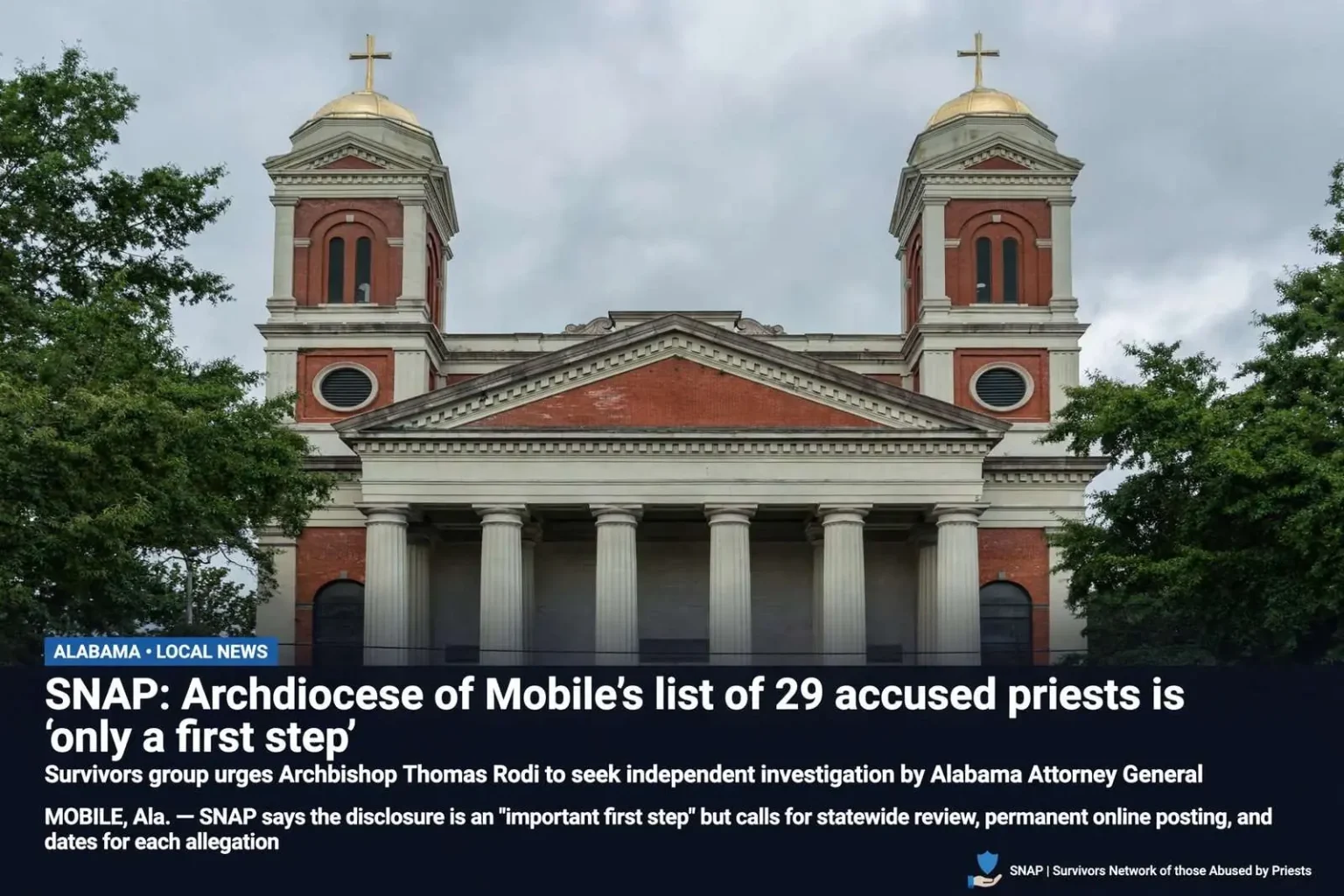
MOBILE, Ala. — SNAP, the Survivors Network of those Abused by Priests, says the release of a list of 29 priests accused of sexual misconduct with minors by the Archdiocese of Mobile is an important first step, but far from the last one the organization believes is needed. The survivors’ group is publicly urging Archbishop Thomas Rodi to go beyond the list itself and contact Alabama’s attorney general to request an outside, independent investigation into the diocese and other church institutions across the state.
According to SNAP, transparency cannot stop at publication of names. The organization wants the list permanently posted on the Archdiocese of Mobile’s website so it cannot quietly disappear from public view, and it wants the names printed at least quarterly in every parish bulletin across south Alabama. Crucially, SNAP says each entry should include the date each allegation first came to church officials — information it argues would help the public understand how long accusations sat within diocesan hands before any action was taken.
Who SNAP Is and Why the Group Is Involved
SNAP is a national support and advocacy organization for survivors of clergy sexual abuse, founded in 1988 by survivors who felt the Catholic Church was handling allegations internally rather than turning them over to civil authorities. The group operates through local chapters and volunteer leaders across the country, and it has become one of the most consistent outside voices pressing dioceses to disclose records, cooperate with law enforcement, and change internal reporting practices. Its statements on diocesan lists typically follow a familiar pattern: acknowledge the disclosure as meaningful, then push for verification, context, and independent review.
In its statement on the Mobile list, SNAP followed that pattern. The organization did not dispute that publishing 29 names represents progress for survivors who have spent years, and in some cases decades, wondering whether the church would ever acknowledge what happened to them. But the group’s leaders argue that a list released by the institution being scrutinized is only as useful as the follow-through behind it — and that only an investigation run by someone outside the church hierarchy can determine whether the files behind the names tell the full story.
The Archdiocese of Mobile in Context
The Archdiocese of Mobile is the oldest Catholic diocese in Alabama and one of the oldest in the southeastern United States, with roots reaching back to the early nineteenth century when Mobile was still a colonial port city. Today it shepherds parishes across the southern half of the state, from Mobile and Baldwin counties through the Black Belt and the Wiregrass, with the Cathedral-Basilica of the Immaculate Conception in downtown Mobile serving as the mother church. Archbishop Thomas Rodi has led the archdiocese since 2008, overseeing roughly dozens of parishes, missions, and schools in a region where Catholic institutions have been woven into civic life for generations.
That history matters for how a disclosure like this lands. In a diocese that has operated in south Alabama for two centuries, the priests named on such lists served in communities across generations — in parish schools, youth programs, and churches in Mobile, Baldwin County, and beyond. For longtime Catholic families in the region, names on the list may belong to clergy who baptized children, taught religion classes, or presided at family funerals. That closeness is precisely why survivor advocates say the publication of names must be paired with accountability measures, not treated as an endpoint.
Why Dioceses Release Accused-Priest Lists
The Archdiocese of Mobile’s disclosure belongs to a broader chapter of the Catholic clergy abuse crisis that has unfolded across the United States since the early 2000s, when investigative reporting in Boston revealed that church leaders had quietly reassigned abusive priests for decades rather than removing them from ministry. The scandal forced a national reckoning, led the U.S. bishops to adopt the Charter for the Protection of Children and Young People in 2002, and created review boards and victim assistance coordinators in dioceses nationwide. The charter established procedures for removing accused clergy from ministry and required cooperation with civil authorities, though advocates have long argued its enforcement varied widely from diocese to diocese.
A second wave of disclosures arrived years later. In 2018, a Pennsylvania grand jury report documented allegations against hundreds of priests across six dioceses and pressed the question of whether institutions had genuinely reformed or simply become more careful about paperwork. In the years that followed, dozens of dioceses around the country published their own lists of clergy credibly accused of abusing minors, often describing the releases as acts of healing and transparency. Survivor organizations like SNAP have responded to many of those lists with the same two-part message now directed at Mobile: publishing names helps, but only independent investigation of church records can establish what leadership knew and when.
That is the core of SNAP’s argument in this case. A list compiled and released by a diocese is, by definition, the diocese’s own account of its own files. Names can be omitted, allegations can be characterized in ways that soften them, and dates can reflect when an accusation was “received” rather than when victims first tried to be heard. An outside investigation — particularly one requested by the bishop himself and conducted by the Alabama Attorney General’s Office — would put those questions in the hands of an agency with subpoena power and no institutional stake in the church’s reputation.
What SNAP Is Asking the Archbishop to Do
SNAP’s request to Archbishop Rodi is specific: contact Alabama’s attorney general and ask for an independent investigation into the Archdiocese of Mobile and others across the state. The reference to “others” reflects the fact that Alabama has two Latin-rite dioceses — Mobile in the southern part of the state and the Diocese of Birmingham in Alabama in the north — and SNAP has historically pressed for statewide reviews wherever multiple dioceses may hold abuse records. Attorneys general in other states have opened such investigations after receiving requests from bishops or following grand jury reporting, and several have produced findings that went well beyond what the dioceses themselves had disclosed.
The organization’s second set of demands concerns how the list lives in public. SNAP wants the names kept permanently on the diocesan website, arguing that periodic publications and quietly revised pages leave survivors and families uncertain about what information still exists. It also wants the list printed in parish bulletins at least quarterly — a demand aimed at reaching Catholics who will never search a diocesan website but sit in the pews each Sunday. And it wants the date of each allegation attached to each name, so readers can see for themselves the gap between when trouble first surfaced and when the church acted on it.
Report to Law Enforcement, Not the Diocese, SNAP Says
A recurring element of SNAP’s messaging — and one it repeated in its statement on the Mobile list — is its advice on where to report. The organization encouraged anyone who may have seen, suspected, or suffered abuse by church officials to report it to Alabama law enforcement rather than to the diocese directly. The reasoning is straightforward: police and prosecutors can open criminal investigations, preserve evidence, and pursue charges, while a diocesan reporting channel produces an internal record and an internal response. Survivor advocates note that people who report only to the church may wait years for any external review, and some allegations may never reach authorities at all.
For residents of the Archdiocese of Mobile, that guidance means an allegation involving clergy in Mobile, Baldwin, Washington, Clarke, Monroe, or any of the other counties the archdiocese serves can be taken to the sheriff’s office or police department with jurisdiction over where the conduct occurred. District attorneys’ offices in southwest Alabama can review accusations even when they are decades old, and the Attorney General’s Office maintains authority to prosecute certain crimes statewide. Advocates also point out that reporting to law enforcement protects not only the person coming forward but others who may have been harmed, since abusers with access to children often offend against multiple victims over many years.
Why Survivor Groups Push So Hard on Disclosure
Research on child sexual abuse consistently shows that victims frequently remain silent for years or even decades — into adulthood, middle age, and beyond. That pattern is why survivor organizations treat old personnel files and long-past allegations as matters of urgent present-day concern: people who were harmed as children in south Alabama parishes may never have told anyone, and a published list can be the first external confirmation that they were not alone and were not imagining what happened to them. It can also give witnesses — adults who noticed something troubling years ago — a reason to come forward while records and memories still exist.
This is also why SNAP presses for dates alongside names. A list that shows an allegation arrived at the chancery in one decade but the priest remained in ministry into another tells a story that a name alone cannot. For families deciding whether to trust church programs with their children, and for prosecutors weighing whether older cases can still be pursued, that timeline is often the most important fact on the page.
What Comes Next for the Archdiocese and Its Parishes
Whether the Archdiocese of Mobile responds to SNAP’s demands — an independent investigation requested by the bishop, permanent online publication, quarterly parish bulletin notices, and dates attached to every name — remains to be seen. What is already clear is that the release of 29 names has moved the conversation in south Alabama Catholic communities from private settlement of old wounds to a public accounting of how the church handled them. For survivors and their families, the list is an acknowledgment; for the archdiocese, it is the beginning of scrutiny that SNAP insists must extend to the state’s top law enforcement office.
In the meantime, the organization’s guidance to the public stands: anyone who saw, suspected, or suffered abuse by church officials is urged to contact Alabama law enforcement directly. For Catholics across the archdiocese, the questions SNAP has raised — about what the diocese knew, when it knew it, and who outside the church will now look at the answers — are likely to remain part of the conversation for some time.