Social Media Blowup Empties Kitchen at Downtown Mobile Restaurant, Prank Sign Pokes Fun at Midtown Potholes
A downtown Mobile restaurant owner's profanity-laced social media rant at his staff sparked a viral back-and-forth and a wave of departures, while a handmade "DeBumpy" sign appeared on a Midtown stop sign poking fun at the rough pavement on Demouy Avenue.
A profanity-laced social media dispute between a downtown Mobile restaurant owner and several of the restaurant’s employees spread quickly online last week, drawing wide attention around the city before most of the posts were taken down.
The dispute began when the owner posted a lengthy message accusing the staff of failing to do their jobs, writing that he had “wasted enough time thinking you’ll act like adults and do your job.” The post, which employees screenshotted and shared before it was removed, escalated into a string of insults directed at the kitchen and front-of-house staff, including a line declaring in bold, oversized text that “this staff needs an enema.”
Several employees responded in kind, and at least a few reportedly walked off the job in the days that followed. What might once have stayed a back-of-house blowup instead played out in public, with the screenshots jumping from the participants’ pages to the feeds of curious onlookers within hours.
One video that circulated among local social media users mixed stock footage and cartoon imagery of rats, including a clip resembling the animated chef-rat from the film “Ratatouille,” before cutting to what appeared to be nighttime video of rodents moving through a kitchen. The authenticity and origin of that footage could not be independently confirmed, and it is not uncommon for restaurant kitchens in older commercial buildings to periodically deal with pest issues, particularly in humid coastal climates like Mobile’s.
That caveat matters. Downtown Mobile’s restaurant row occupies buildings that are, in many cases, more than a century old, and the Gulf Coast’s heat and humidity make pest control a year-round expense for any food business in the district. A video without provenance — no date, no location, no way to verify the kitchen shown — proves nothing about the restaurant at the center of the dispute, though by the time it stopped circulating, that distinction had been lost for much of the audience.
By the following week, most of the posts connected to the dispute had been deleted from public view. It remains unclear how many employees left permanently or whether the restaurant has since brought on new staff. The incident nonetheless became a talking point around downtown Mobile, where word of workplace blowups involving small, tightly knit restaurant staffs tends to travel fast.
The speed of the spread was the story as much as the content. Within a day of the first post, screenshots had traveled through downtown Mobile’s service-industry circles — where nearly everyone in the restaurant world shares group chats and follows the same pages — and out into the general public, with commenters who had never set foot in the restaurant weighing in on everything from the owner’s management style to the state of the kitchen. By the time the original posts disappeared, the audience they had reached was far larger than anything the participants could walk back, a familiar pattern in disputes that might once have stayed between a dozen people on a shift.
The episode sits squarely inside a broader shift in how restaurant workplaces handle conflict. Disputes of this kind are not unusual in the industry, which has faced persistent staffing shortages and high turnover in the years since the pandemic. Restaurant owners and workers across the country have increasingly aired workplace grievances publicly on social media, sometimes turning what would once have been a private personnel matter into a viral moment within hours.
The economics of the industry help explain both the tension and the audience. Kitchens run on thin margins and skeleton crews, where the loss of a single line cook on a Friday can sink a service, and where schedules, pay and working conditions have become flashpoints in a labor market that has not fully recovered its pre-pandemic staffing levels. Owners feel the squeeze from the other side — rising food and insurance costs, a shrinking pool of experienced workers, and customers who expect full service at pre-shortage speed. When both sides are exhausted, the argument that once ended in a parking lot now ends online.
Public airing also carries consequences no screenshot can capture. A restaurant’s reputation is its most fragile asset, and the audience for a viral dispute does not wait for context: regulars pick sides, prospective customers make decisions based on a single post, and the venue’s name attaches itself to the mess regardless of who was right. Labor advocates note that workers who broadcast disputes risk termination and blacklisting; management consultants warn owners that insulting staff in public is, at minimum, a recruiting liability in a tight labor market. Neither consideration seems to slow the trend.
For the downtown Mobile scene specifically, the incident landed in a district where the restaurant community is small and interconnected — cooks move between kitchens, bartenders pick up shifts across the street, and nearly everyone in the industry knows someone who worked somewhere. News of a blowup at one address reaches every other address by day’s end, which is why the dispute was common knowledge downtown days before most residents had seen a screenshot.
A Wry Sign on Demouy Avenue
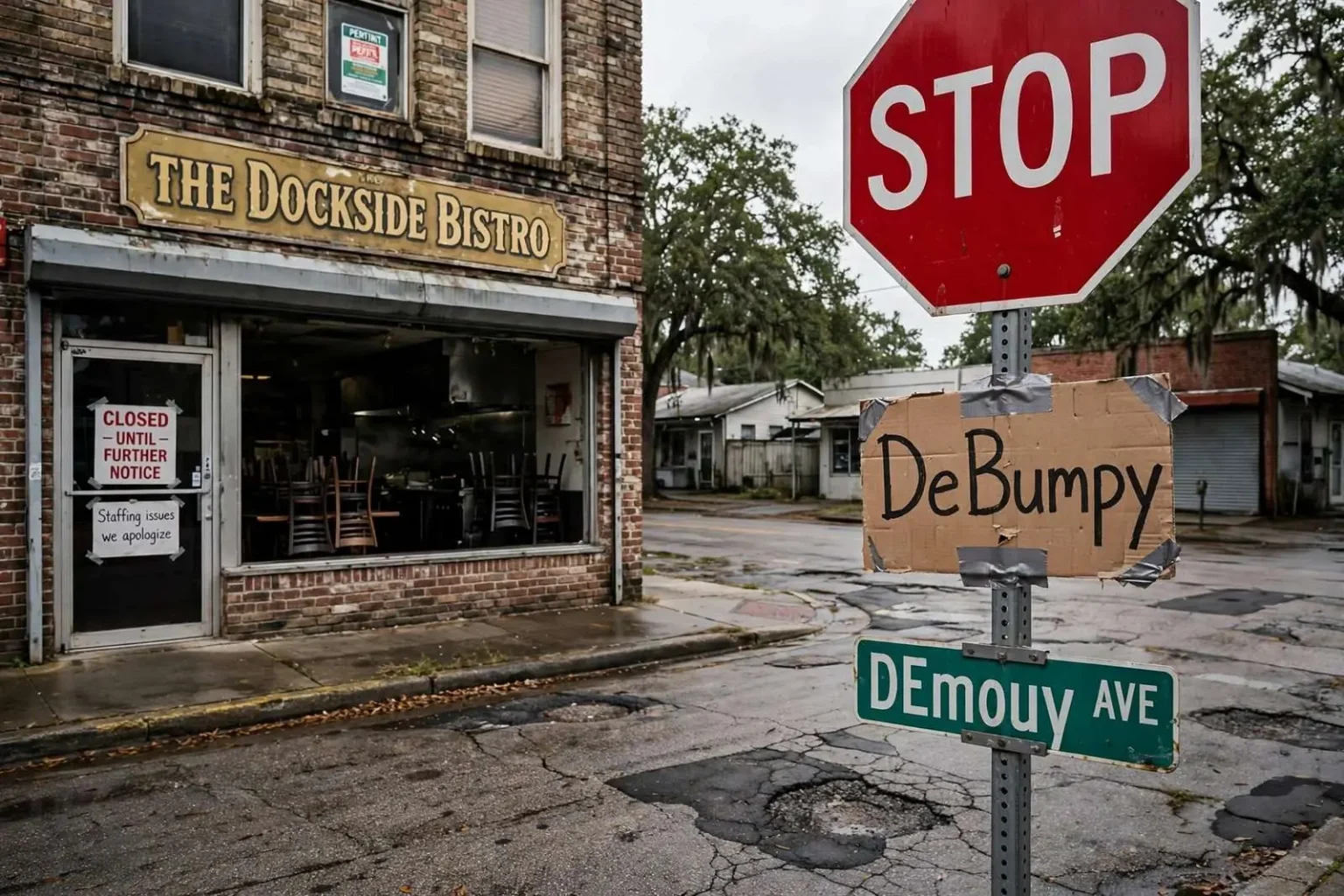
Separately, drivers passing through Mobile’s Midtown neighborhood, sometimes referred to locally as MiMo, may have noticed some unofficial signage added to an existing street sign in recent days. Someone attached a handmade “DeBumpy” sign to a stop sign on Demouy Avenue, a wry nod to the rough pavement condition on the street.
Younger servers and cooks increasingly treat their social feeds as a record of workplace conditions, and managers across the country have learned that a single document of an owner’s worst moment can define a business for years. The reverse is true as well: workers who name their employers online face legal threats and quiet industry blacklisting. The result is an uneasy détente in which both sides sometimes choose public combat anyway — and audiences in cities like Mobile, where the industry is tight-knit enough that everyone knows the participants, become the jury.
Demouy Avenue, like many roads in Mobile’s older neighborhoods, runs through parts of the city that are well over a century old, and residents have long noted the wear and tear on the pavement and sidewalks in the area. Midtown’s grid dates to streetcar-era subdivisions, and its streets — many built on the clay-heavy soils that shift with every wet and dry season along the Gulf — carry a patchwork of repairs that compress into new dips and cracks within a few years of each resurfacing.
Potholes are a perennial civic complaint across the city, and Demouy is hardly the only street with a reputation. But the prank sign captured something that formal complaints rarely do: attention. Photos of the sign circulated among Midtown residents on neighborhood social media groups, where the response was less outrage than recognition — the joke worked precisely because everyone who drove the street already knew.
City officials have not commented on the prank sign, and it is unclear whether it has since been removed. Informal, humor-driven signage pointing out rough roads or other infrastructure complaints has occasionally popped up in Mobile neighborhoods before, typically disappearing within days once city crews or curious passersby take it down.
The city’s street-funding reality gives the humor its edge. Repaving is scheduled through a rolling program that prioritizes heavily trafficked arterials first, which means residential streets like Demouy often wait years between overlays. Residents who report potholes through the city’s service channels typically see patch crews fill the worst spots, but patches are a stopgap; a full resurfacing is a budget line, and budget lines are limited. A hand-lettered sign costs nothing and reaches further than any complaint form.
The two incidents — a restaurant dispute that went viral and a street sign that went gently viral — are, on the surface, unrelated. What they share is the way local grievances now travel in Mobile: not through City Hall or the newspaper, but through phone cameras, screenshots and neighborhood groups, where a screenshot of an insult and a photo of a “DeBumpy” sign can travel just as far.
Neither the restaurant nor the individuals involved in the social media exchange have been publicly identified in connection with this report. The posts are down, the staff situation remains unclear, and the potholes remain — for now — unpatched. In Midtown and downtown alike, the city’s oldest lesson applies: everyone is watching, and everything travels.
The “DeBumpy” sign also fits into a longer Gulf Coast tradition of dry-humored civic complaint, from yard signs criticizing road work to homemade warnings about flooding-prone intersections. Municipal engineers may not enjoy the comedy, but the signs occasionally accomplish what years of service requests have not: they make a street’s condition visible to an audience that includes more than the people who drive it. Whether Demouy Avenue moves up any repaving list as a result is doubtful — but the sign’s brief run as a neighborhood landmark says more about the street than any work order would.